
The Spanish Alphabet: All 27 Letters, Their Names and How to Pronounce Them
Spanish has 27 letters and is almost perfectly phonetic — once you know the sounds, you can read any word aloud. Here are the letter names, the sounds, and the few letters that behave differently.

Good news first: Spanish is one of the most phonetic languages you can learn. Each letter almost always makes the same sound, so once you know the alphabet, you can read new words aloud correctly — and spell words you hear.
The Spanish alphabet has 27 letters: the 26 you know from English, plus ñ. Ch and ll used to be counted as letters, but since 2010 the Real Academia Española treats them as two-letter combinations.
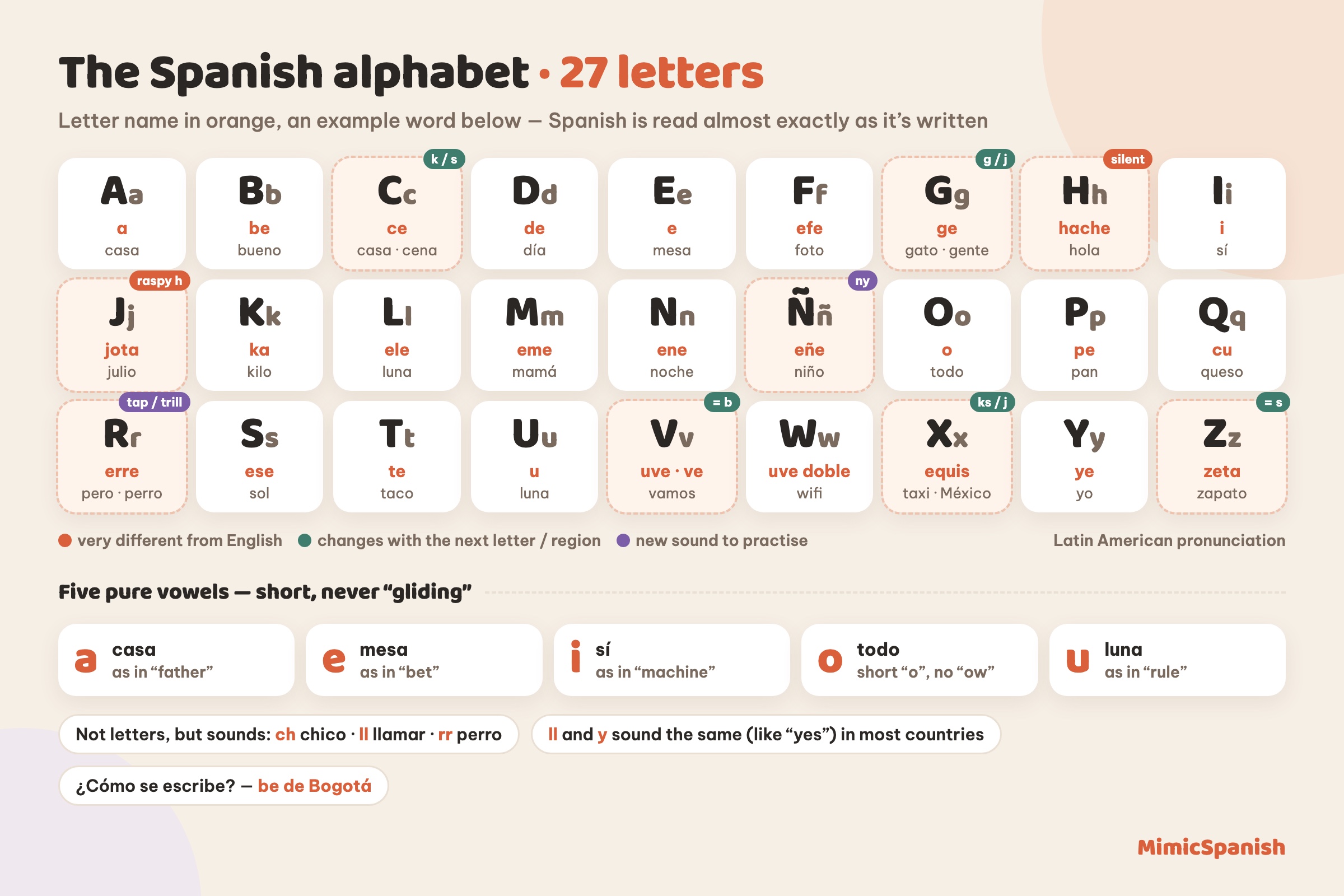
Letter names
| Letter | Name | Letter | Name | Letter | Name |
|---|---|---|---|---|---|
| A | a | J | jota | R | erre |
| B | be | K | ka | S | ese |
| C | ce | L | ele | T | te |
| D | de | M | eme | U | u |
| E | e | N | ene | V | uve (ve) |
| F | efe | Ñ | eñe | W | uve doble (doble ve) |
| G | ge | O | o | X | equis |
| H | hache | P | pe | Y | ye (i griega) |
| I | i | Q | cu | Z | zeta |
In Latin America, many people say ve (or ve corta) for V and be larga for B, because the two letters sound the same.
The five vowels: short and pure
Spanish vowels never change their sound, and they are shorter and cleaner than English vowels:
- a as in father — casa
- e as in bet — mesa
- i as in machine — sí
- o as in more (short) — todo
- u as in rule — luna
This is the single biggest fix for an English accent: don't glide o into "ow" or e into "ay".
Letters that behave differently
- H is always silent: hola = "ola", hablar = "ablar".
- J is a strong, raspy h, from the throat: jamón, julio.
- G sounds like J before e and i (gente, girar), and like the g in go elsewhere (gato, gusto). To keep the hard sound before e/i, Spanish writes gue, gui: guerra, guitarra.
- C sounds like s before e and i in Latin America (cena, cine) — like th in most of Spain — and like k elsewhere (casa, cosa).
- Z sounds like s in Latin America: zapato.
- LL and Y sound the same in most places, like the y in yes: llamar, yo. In Argentina and Uruguay they sound like sh: calle = "cashe".
- Ñ sounds like ny in canyon: niño, España.
- R at the start of a word and RR are rolled (a trill): rojo, perro. A single r between vowels is one quick tap, like the tt in American butter: pero. Pero (but) and perro (dog) are different words!
- B and V sound the same: soft between vowels (uva, Cuba) and like an English b after a pause or m/n (vamos, ambos).
- X sounds like ks (taxi, examen), but like Spanish J in some Mexican names: México, Oaxaca.
- QU is always /k/, and the u is silent: queso, quiero.
Stress and written accents
Accents mark stress, never a different vowel sound: papá, café, teléfono, miércoles. Without an accent, words ending in a vowel, n or s are stressed on the second-to-last syllable (casa, joven); other words on the last (hablar, ciudad).
For more on sounds, see our full Spanish pronunciation guide.
How to spell your name in Spanish
At a hotel desk or on the phone you'll hear ¿Cómo se escribe? — How do you spell it? Say the letter names, and for unclear ones add a word: be de Bogotá, ve de Venezuela, ese de sol. Practise this in our shadowing lesson Hotel check-in.
Practice that works
- Read aloud every day: Spanish spelling tells you exactly how to say a word.
- Shadow short dialogues: copying a native rhythm fixes vowels and stress faster than lists. Try the A1 shadowing topics.
- Dictation: typing what you hear trains the link between sound and spelling. Start with A1 dictation.
Frequently asked questions
How many letters are in the Spanish alphabet?
27: the 26 Latin letters plus ñ.
Are "ch" and "ll" letters?
Not anymore. Since 2010 they are digraphs (two letters for one sound), like rr.
Is the h ever pronounced?
No — the Spanish h is silent. Only in the combination ch (chico) does it change the sound.