
Spanish Slang: 45 Everyday Words from Mexico, Colombia, Argentina and Chile
Textbooks teach "muy bien", but people say "¡qué padre!", "bacano" or "re bueno". Here are 45 friendly slang words and expressions from four countries, with meanings, examples and when it is safe to use them.

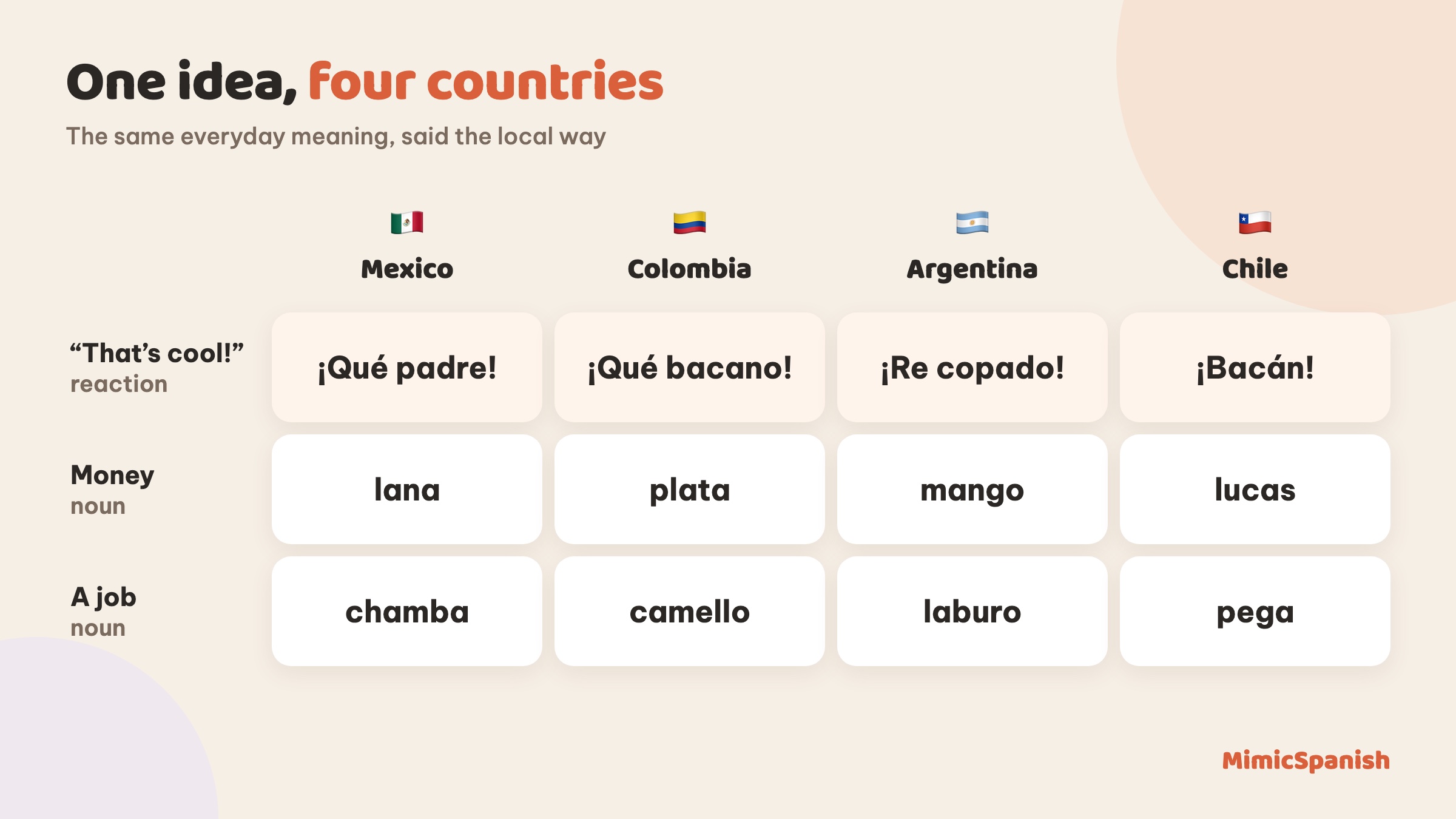
You can know every tense of estar and still get lost in a real conversation, because native speakers don't talk like textbooks. Friends in Mexico City say ¡qué padre!, in Medellín it's ¡qué bacano!, and in Buenos Aires ¡re copado! — all meaning roughly "that's great!".
This guide collects 45 everyday slang words and expressions you will hear from Latin American speakers. All of them are friendly and safe to use with people your age; we left out vulgar words on purpose. Each country has its own flavour, so the list is grouped by where you are most likely to hear it.
A quick rule before you start: slang is about sounding natural, not about knowing many words. Pick a few from the region you care about, listen to how they are said, and repeat them out loud until the melody feels right.
Slang you will hear almost everywhere
These travel well across Latin America.
- ¿Qué onda? — What's up? (very common in Mexico and Central America)
- Chévere — Cool, great (Venezuela, Colombia, Peru, the Caribbean). La fiesta estuvo chévere.
- Plata — Money (literally "silver"; most of South America). No tengo plata.
- Chamba — Work, a job (Mexico, Peru, Central America). Encontré una chamba nueva.
- Ahorita — Right now… or later, depending on the tone. In Mexico, ahorita can mean "in a while", so don't hold your breath.
- ¡Qué pena! — How embarrassing / I'm so sorry (Colombia uses it a lot for "excuse me").
- Buena onda — A nice, easy-going person or a good vibe. Tu hermano es muy buena onda.
Mexican slang
Mexican Spanish has some of the most famous slang, thanks to TV, music and millions of speakers.
- ¡Qué padre! — How cool! ¡Qué padre está tu chamarra! (What a cool jacket!)
- Chido — Cool, nice. Está bien chido el concierto.
- Neta — Truth / for real. ¿Neta? — Seriously? La neta, no sé. — Honestly, I don't know.
- Güey (or wey) — Dude, mate. Very common between friends; avoid it with people you don't know.
- Órale — OK, let's go / wow, depending on tone.
- Ándale — Come on / hurry up / that's it!
- No manches — No way! You're kidding! A mild, friendly expression of surprise.
- Me late — I like it / I'm in. ¿Vamos por tacos? — Me late.
- Lana — Money (literally "wool").
- Fresa — A posh or preppy person (literally "strawberry").
- ¡Aguas! — Watch out!
- Un chorro — A lot. Hay un chorro de gente.
- Chamarra — Jacket (standard Spanish says chaqueta).
If you want to hear Mexican Spanish in a real situation, try our shadowing lesson Ordering at a taquería — you repeat each line and get your pronunciation scored.
Colombian slang
Colombian Spanish is known for being clear and polite, but it has plenty of colour.
- Parce / parcero — Friend, buddy (especially Medellín). ¿Qué más, parce?
- ¿Qué más? — How's it going? (a greeting, not "what else?")
- Bacano — Cool, great. Ese plan está bacano.
- Camellar — To work hard (from camello, camel).
- Una vaina — A thing, stuff; used for almost anything. Pásame esa vaina.
- Llave — Close friend (literally "key").
- ¡Qué boleta! — How tacky / how embarrassing.
- Dar papaya — To leave yourself exposed, to make yourself an easy target. No des papaya con el celular en la calle.
Argentine slang
Argentina (and neighbouring Uruguay) has its own rhythm, the famous sh sound in yo and calle, and the pronoun vos instead of tú.
- Che — Hey, mate; used to get attention. Che, ¿venís?
- Re — Very, really, placed before adjectives. Está re bueno. — It's really good.
- Copado — Cool, nice. Tu amigo es re copado.
- Laburo / laburar — Job / to work (from Italian lavoro).
- Bondi — Bus.
- Morfar — To eat.
- Mango — Peso, money. No tengo un mango. — I'm broke.
- Posta — For real, true. ¿Posta? — Really?
Chilean slang
Chilean Spanish is fast, drops sounds, and is famous among learners for being hard at first. These words help a lot.
- ¿Cachai? — Do you get it? / You know? Chileans add it to many sentences.
- Po — A short form of pues, used for emphasis: sí po, ya po.
- Bacán — Cool, awesome.
- Fome — Boring. La película estuvo fome.
- Al tiro — Right away. Vuelvo al tiro.
- Pololo / polola — Boyfriend / girlfriend.
- Luca — 1,000 pesos. Cuesta cinco lucas.
Spain, just in case
MimicSpanish focuses on Latin American Spanish, but you will hear these two everywhere in Spain:
- Vale — OK. ¿Quedamos a las ocho? — Vale.
- Guay — Cool.
How to actually learn slang (without sounding odd)
Slang sounds natural only when the rhythm and intonation are right. ¿Qué onda? read slowly, word by word, sounds strange; said quickly with a rising tone, it sounds like a local. A few tips:
- Learn it from audio, not from lists. Listen to a short dialogue, then repeat each line right after the speaker — this is called shadowing.
- Match slang to the country. Parce in Buenos Aires or che in Mexico City will make people smile, and not in a good way.
- Start with the neutral words first. Learn standard phrases like the ones in our list of common Spanish phrases, then add slang on top.
- Use it with friends, not at work. Most slang is informal. With a doctor, a bank advisor or your boss, stay neutral.
Our Everyday expressions vocabulary set has more idioms used across Latin America, with audio and spaced review, and the shadowing lessons let you hear them in real situations.
Frequently asked questions
Is Spanish slang the same in every country?
No. Some words travel (like chévere or plata), but most slang is local. The same word can even mean different things: guagua is a bus in Cuba and the Canary Islands, but a baby in Chile.
Is "güey" rude?
Between friends in Mexico it is completely normal, like "dude". With strangers, older people or at work it can sound disrespectful, so avoid it there.
Which Spanish slang should a beginner learn first?
Start with greetings and reactions you can use every day: ¿Qué onda? or ¿Qué más?, chévere / bacano / chido, ¡no manches! and ¿neta?. They make you sound friendly without risk.