How to say “do you speak English” in Spanish
The most common way to say "do you speak English" in Spanish is "¿Habla inglés?". This is the polite (usted) form, which is best with strangers, staff and older people. With friends, kids or people your age, use the informal "¿Hablas inglés?".
How to pronounce “¿Habla inglés?”
- The 'h' in 'habla' is always silent, so start straight on the vowel: 'AH-blah'.
- Say 'in' in 'inglés' like English 'een', not like the short 'i' in 'in'.
- Stress the last syllable, 'GLÉS' (that's what the accent mark shows), and keep the 'e' short and clean, like the 'e' in 'bet'.
What it literally means
Word for word, "¿Habla inglés?" means "Speaks English?". Spanish usually drops the subject pronoun because the verb ending already shows who you mean, so "habla" alone means "you (formal) speak". "Inglés" comes from Old French "angleis" and goes back to the Angles, the Germanic people who gave England its name.
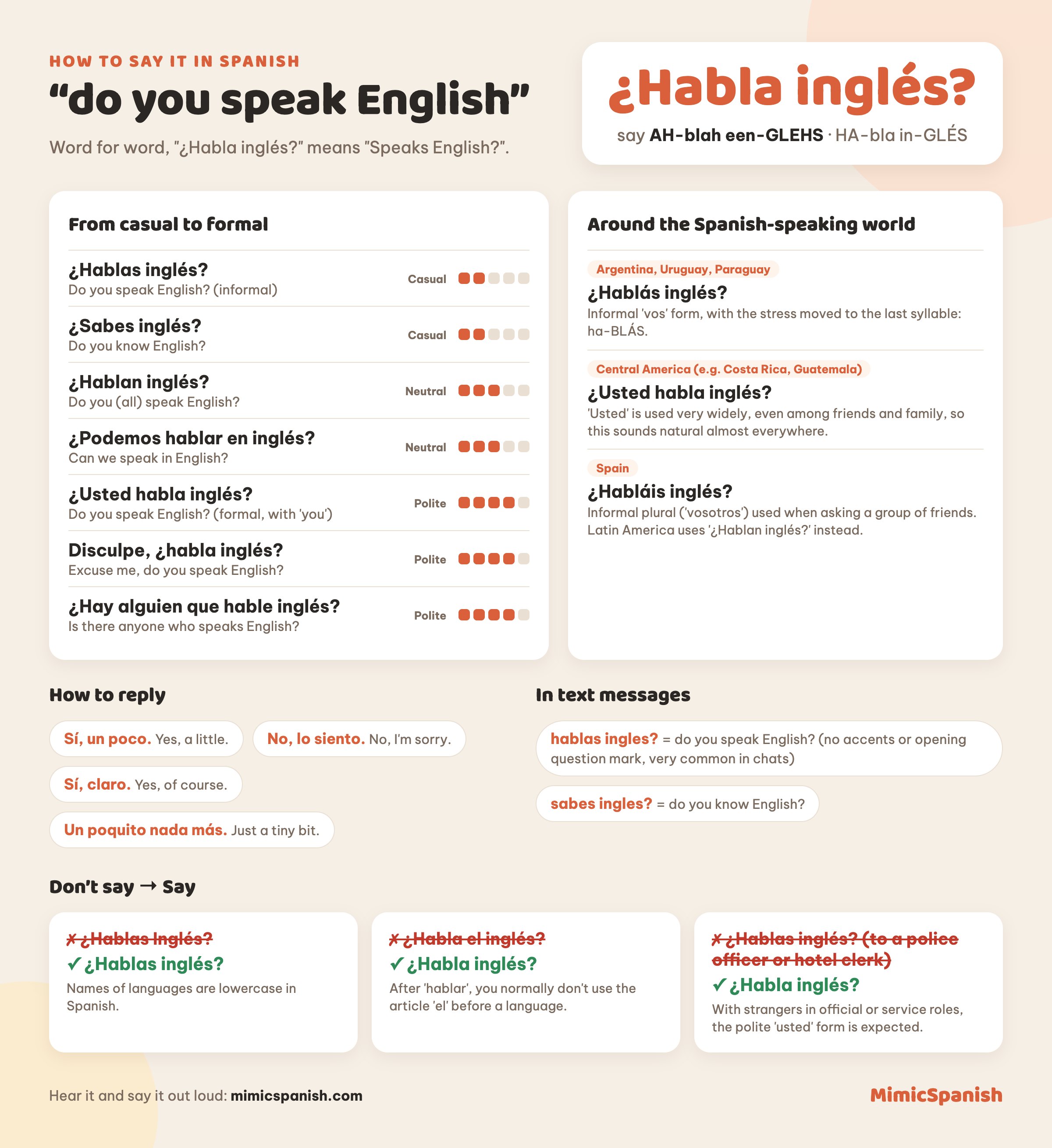
Other ways to say it, from casual to formal
- ¿Hablas inglés?Do you speak English? (informal) · with friends, young people, peersCasual
- ¿Sabes inglés?Do you know English? · casual chat about someone's skillsCasual
- ¿Hablan inglés?Do you (all) speak English? · asking a group, or asking at a hotel or shopNeutral
- ¿Podemos hablar en inglés?Can we speak in English? · asking to switch languages mid-conversationNeutral
- ¿Usted habla inglés?Do you speak English? (formal, with 'you') · politely asking a stranger, adds emphasisPolite
- Disculpe, ¿habla inglés?Excuse me, do you speak English? · approaching a stranger on the street or in a shopPolite
- ¿Hay alguien que hable inglés?Is there anyone who speaks English? · at a hotel, hospital or office, looking for helpPolite
By country
- ¿Hablás inglés?Argentina, Uruguay, Paraguay · Informal 'vos' form, with the stress moved to the last syllable: ha-BLÁS.
- ¿Usted habla inglés?Central America (e.g. Costa Rica, Guatemala) · 'Usted' is used very widely, even among friends and family, so this sounds natural almost everywhere.
- ¿Habláis inglés?Spain · Informal plural ('vosotros') used when asking a group of friends. Latin America uses '¿Hablan inglés?' instead.
In text messages
Example sentences
- Disculpe, ¿habla inglés?Excuse me, do you speak English?
- ¿Hablas inglés o solo español?Do you speak English or only Spanish?
- Mi hermana habla inglés muy bien.My sister speaks English very well.
- Hablo un poco de español, pero no mucho.I speak a little Spanish, but not much.
- ¿Hay alguien aquí que hable inglés?Is there anyone here who speaks English?
- Si no entiende, podemos hablar en inglés.If you don't understand, we can speak in English.
Mini dialogue: At a train station
How to reply
- Sí, un poco.Yes, a little.
- No, lo siento.No, I'm sorry.
- Sí, claro.Yes, of course.
- Un poquito nada más.Just a tiny bit.
Grammar: Tú vs. usted with "hablar"
"Hablar" (to speak) changes its ending depending on who you're talking to. Use "hablas" for informal 'you' (tú) and "habla" for formal 'you' (usted). With strangers, use "habla" by default. Also note that language names like "inglés" are not capitalized in Spanish, and you don't need "el" after "hablar".
- ¿Hablas inglés, Ana?Do you speak English, Ana? (to a friend)
- Señor, ¿habla inglés?Sir, do you speak English? (polite)
Common mistakes
Culture tip
Locals appreciate it when you open with "Disculpe" or "Buenos días" before asking, because jumping straight to the question can feel abrupt.In tourist areas many people speak some English, but outside them it's less common. Asking in Spanish first is seen as respectful, even if the answer is "un poquito".People often answer modestly ("un poco") even when their English is quite good.