How to say “I love you” in Spanish
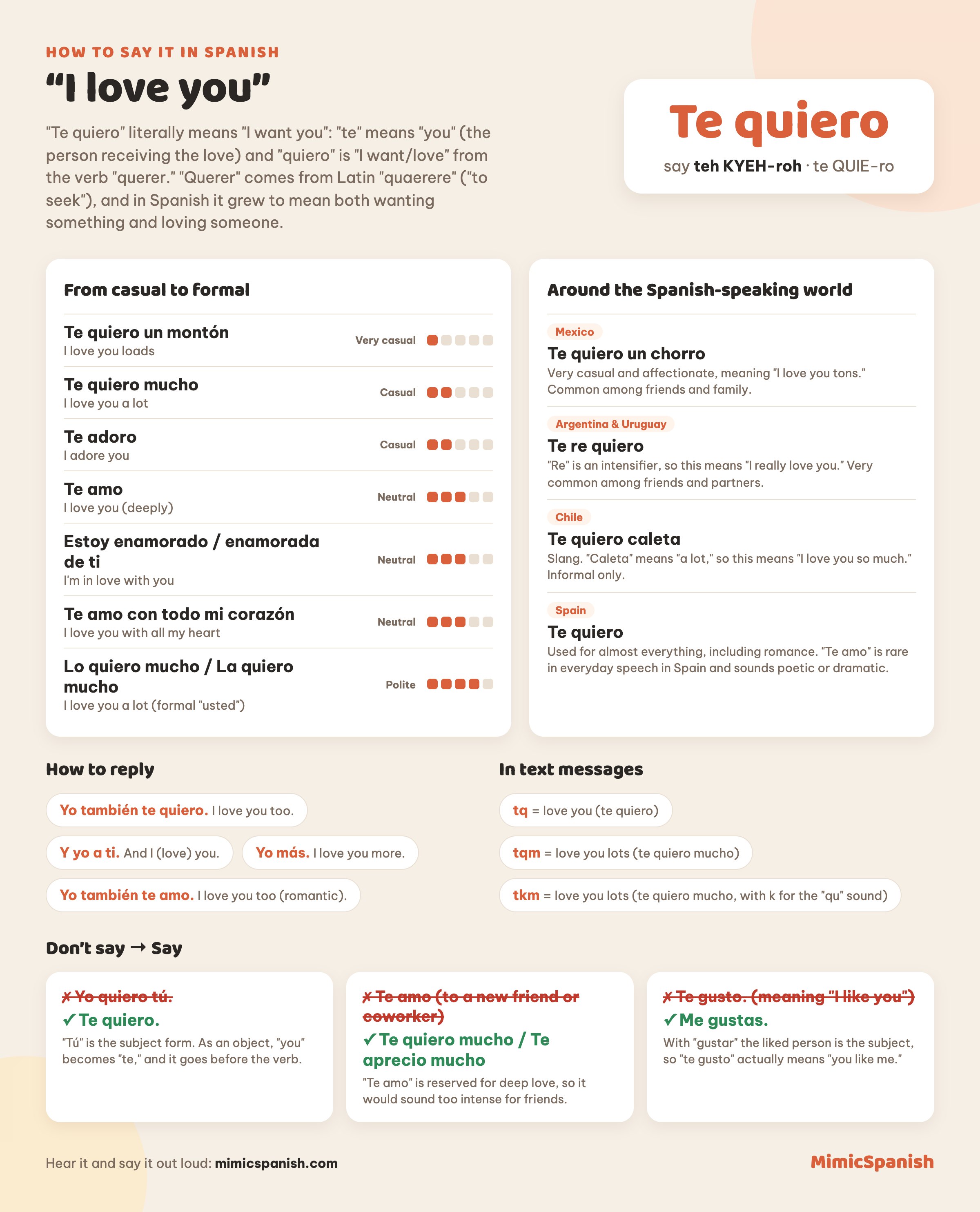
The most common way to say "I love you" in Spanish is "Te quiero" (teh KYEH-roh). It works for partners, family and close friends. For deep romantic love, Latin Americans also often say "Te amo," which sounds more intense.
How to pronounce “Te quiero”
- The "qu" sounds like a plain English "k", and the "u" is silent, so say "kyeh", not "kwee".
- The single "r" in "quiero" is a quick tap of the tongue, like the "tt" in American English "butter", not an English "r".
- Keep the vowels short and pure: "te" is "teh" (not "tay") and the final "o" is a crisp "oh" without gliding into "ow".
What it literally means
"Te quiero" literally means "I want you": "te" means "you" (the person receiving the love) and "quiero" is "I want/love" from the verb "querer." "Querer" comes from Latin "quaerere" ("to seek"), and in Spanish it grew to mean both wanting something and loving someone.
Other ways to say it, from casual to formal
- Te quiero un montónI love you loads · warm and casual, friends and familyVery casual
- Te quiero muchoI love you a lot · family, close friends, ending a callCasual
- Te adoroI adore you · affectionate, playful, with partners or kidsCasual
- Te amoI love you (deeply) · romantic partner, spouse; in Latin America also parents and childrenNeutral
- Estoy enamorado / enamorada de tiI'm in love with you · confessing romantic feelingsNeutral
- Te amo con todo mi corazónI love you with all my heart · anniversaries, cards, very romantic momentsNeutral
- Lo quiero mucho / La quiero muchoI love you a lot (formal "usted") · elderly relatives or people you address as ustedPolite
By country
- Te quiero un chorroMexico · Very casual and affectionate, meaning "I love you tons." Common among friends and family.
- Te re quieroArgentina & Uruguay · "Re" is an intensifier, so this means "I really love you." Very common among friends and partners.
- Te quiero caletaChile · Slang. "Caleta" means "a lot," so this means "I love you so much." Informal only.
- Te quieroSpain · Used for almost everything, including romance. "Te amo" is rare in everyday speech in Spain and sounds poetic or dramatic.
In text messages
Example sentences
- Te quiero, mamá.I love you, Mom.
- Buenas noches, mi amor. Te quiero.Good night, my love. I love you.
- Te quiero mucho, eres mi mejor amiga.I love you a lot, you're my best friend.
- ¡Feliz cumpleaños, papá! Te queremos mucho.Happy birthday, Dad! We love you very much.
- Nunca le he dicho "te amo" a nadie.I've never said "I love you" to anyone.
- Aunque estemos lejos, siempre te voy a querer.Even though we're far apart, I'll always love you.
Mini dialogue: Ending a phone call with Mom
How to reply
- Yo también te quiero.I love you too.
- Y yo a ti.And I (love) you.
- Yo más.I love you more.
- Yo también te amo.I love you too (romantic).
Grammar: Object pronouns go before the verb
In Spanish, the person you love is an object pronoun (te, lo, la, los, las), and it goes before the conjugated verb: "te quiero," not "quiero te." You don't need "yo" because "quiero" already means "I love." Change the pronoun to match the person: "te" for one friend or partner, "lo/la" for formal usted, and "los/las" for a group.
- Te quiero, abuela.I love you, Grandma.
- Los quiero mucho, chicos.I love you all a lot, guys.
Common mistakes
Culture tip
Latin Americans say "te quiero" very freely to family and close friends, often to end phone calls ("te quiero, cuídate") or in quick messages like "tqm." "Te amo" is mostly for romantic partners, though in much of Latin America parents and children say it to each other too. It is usually said with a hug or a kiss on the cheek. In Spain, "te quiero" covers almost all situations, and "te amo" sounds poetic or dramatic.