How to say “I'm hungry” in Spanish
"I'm hungry" in Spanish is "Tengo hambre" (TEN-goh AHM-breh), which literally means "I have hunger." It is the standard, neutral phrase used everywhere in Latin America and Spain, with friends, family or strangers. To say you're very hungry, use "Tengo mucha hambre."
How to pronounce “Tengo hambre”
- The h in hambre is completely silent, so the word starts with an open 'ahm' sound.
- The r after the b is a single quick tap of the tongue, like the 'dd' in American 'ladder', not an English r.
- Keep the vowels short and pure: the final o in tengo is a crisp 'o' without the English 'oh-w' glide, and the final e is a short 'eh'.
What it literally means
Spanish expresses hunger as something you have, not something you are: tengo (I have) + hambre (hunger). Hambre comes from Latin famen/fames, and its f turned into a silent h over the centuries, the same change that turned Latin facere into hacer.
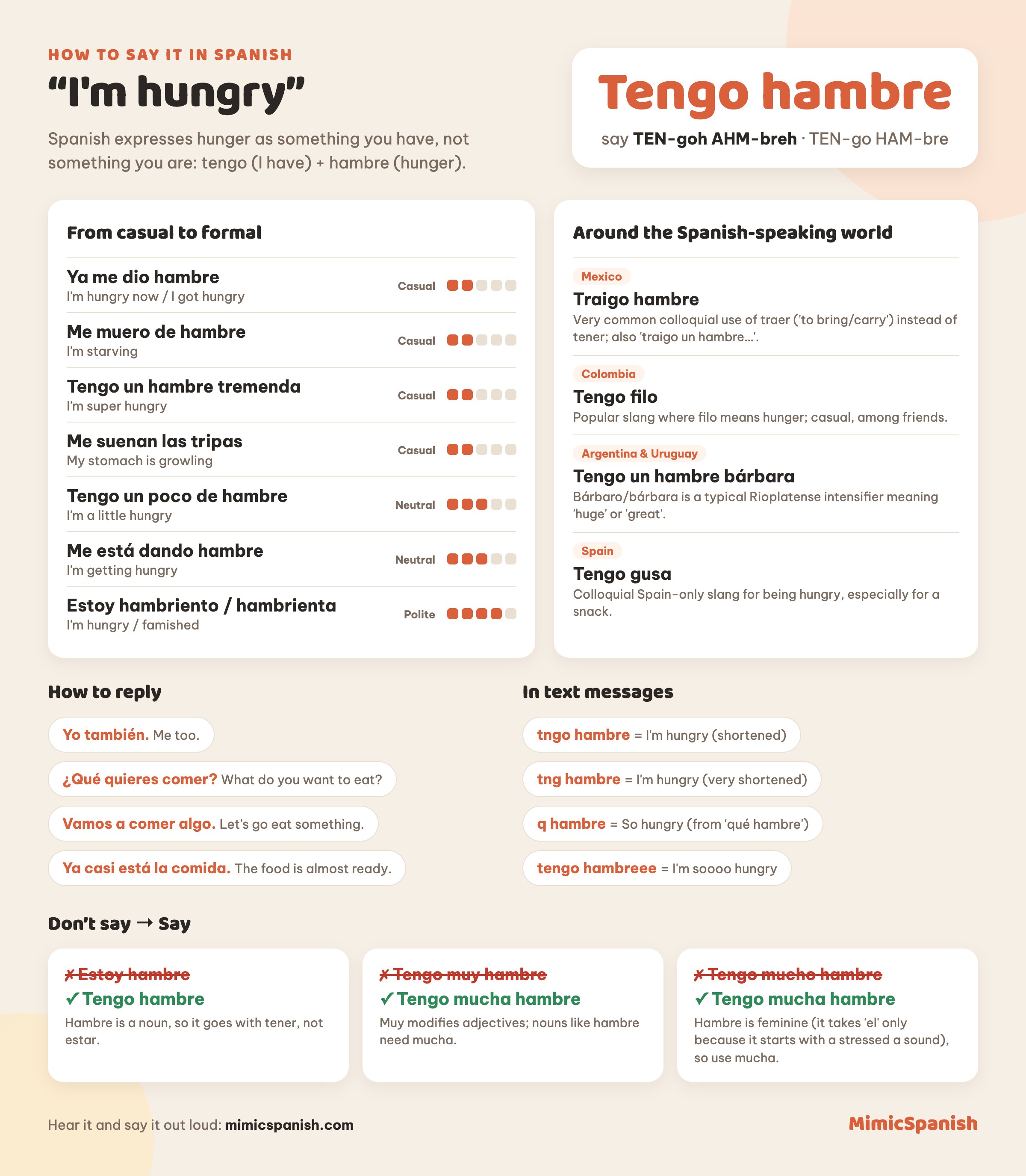
Other ways to say it, from casual to formal
- Ya me dio hambreI'm hungry now / I got hungry · casual, very common in Latin AmericaCasual
- Me muero de hambreI'm starving · exaggerating with friends and familyCasual
- Tengo un hambre tremendaI'm super hungry · emphatic, casual speechCasual
- Me suenan las tripasMy stomach is growling · joking with people you knowCasual
- Tengo mucha hambreI'm very hungry · any everyday situationNeutral
- Tengo un poco de hambreI'm a little hungry · politely hinting it's time to eatNeutral
- Me está dando hambreI'm getting hungry · when hunger is startingNeutral
- Estoy hambriento / hambrientaI'm hungry / famished · more written or emphatic; less common in speechPolite
By country
- Traigo hambreMexico · Very common colloquial use of traer ('to bring/carry') instead of tener; also 'traigo un hambre…'.
- Tengo filoColombia · Popular slang where filo means hunger; casual, among friends.
- Tengo un hambre bárbaraArgentina & Uruguay · Bárbaro/bárbara is a typical Rioplatense intensifier meaning 'huge' or 'great'.
- Tengo gusaSpain · Colloquial Spain-only slang for being hungry, especially for a snack.
In text messages
Example sentences
- Tengo hambre. ¿Comemos algo?I'm hungry. Shall we eat something?
- ¿Tienes hambre? Hay pan en la cocina.Are you hungry? There's bread in the kitchen.
- No tengo hambre, gracias. Comí hace una hora.I'm not hungry, thanks. I ate an hour ago.
- Los niños siempre tienen mucha hambre después de la escuela.The kids are always very hungry after school.
- Si tienes hambre, podemos pedir una pizza.If you're hungry, we can order a pizza.
- Me desperté con tanta hambre que desayuné dos veces.I woke up so hungry that I had breakfast twice.
Mini dialogue: Coming home after work
How to reply
- Yo también.Me too.
- ¿Qué quieres comer?What do you want to eat?
- Vamos a comer algo.Let's go eat something.
- Ya casi está la comida.The food is almost ready.
Grammar: Tener + noun for physical states
Spanish uses tener ('to have') + a noun for feelings like hunger, thirst, cold and sleepiness, so you have hunger instead of being hungry. Because hambre is a noun, you intensify it with mucha ('much'), not muy ('very'). Conjugate tener to match the person: tengo, tienes, tiene, tenemos, tienen.
- Mi hermano tiene mucha hambre.My brother is very hungry.
- Tenemos sed y hambre.We're thirsty and hungry.
Common mistakes
Culture tip
"Tengo hambre" is said constantly and casually, and exaggerations like "me muero de hambre" are completely normal and not dramatic. Meal times matter: in much of Latin America the big meal is lunch in the early afternoon, while in Spain lunch is around 2–3 p.m. and dinner often 9–10 p.m., so visitors often feel hungry at "odd" times. People may pat or rub their stomach while saying it, and a host will often respond by offering food right away.