How to say “how are you” in Spanish
The most common way to say "how are you" in Spanish is "¿Cómo estás?" (KOH-moh ehs-TAHS). It is the informal (tú) form, used with friends, family, and people your age. With strangers, older people, or in professional settings, say "¿Cómo está usted?". With a group, say "¿Cómo están?".
How to pronounce “¿Cómo estás?”
- Say the Spanish 'o' in 'cómo' as a short, pure 'oh' without the 'w' glide English adds, so it isn't 'KOH-moh-w'.
- The 'e' in 'estás' is a crisp 'eh' as in 'bed', never 'ee'. Start the word with a clear vowel, not 'ss-TAHS'.
- Put the stress firmly on the last syllable, 'TÁS'. The written accent tells you exactly where it goes.
What it literally means
Word for word, "¿Cómo estás?" means "How are you?": 'cómo' means 'how' and 'estás' is the tú form of 'estar' (to be). 'Estar' comes from the Latin 'stare', meaning 'to stand', which is why it describes temporary states like your mood or health.
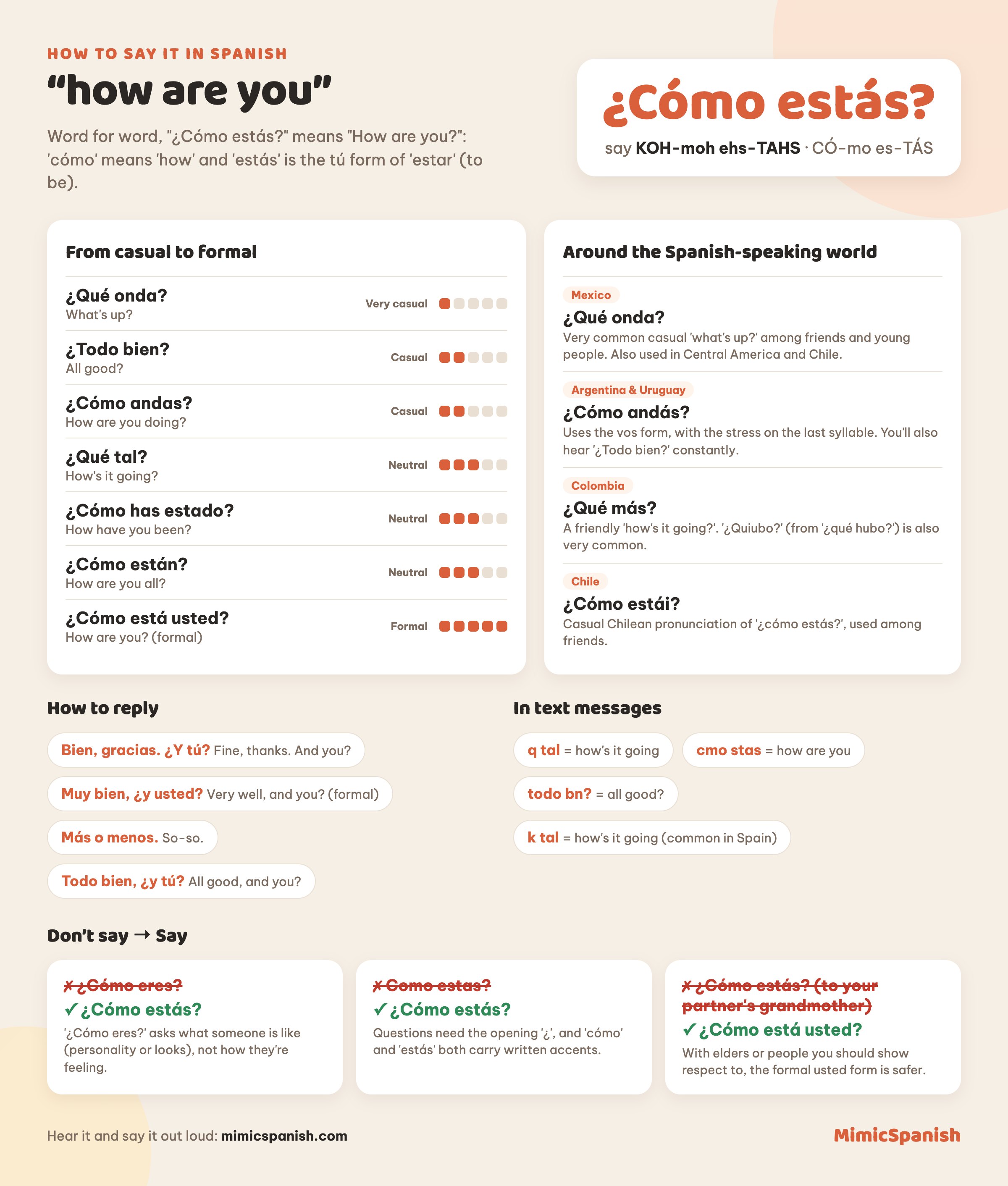
Other ways to say it, from casual to formal
- ¿Qué onda?What's up? · slangy greeting among friendsVery casual
- ¿Todo bien?All good? · casual check-in with friendsCasual
- ¿Cómo andas?How are you doing? · relaxed chat with friendsCasual
- ¿Qué tal?How's it going? · quick, friendly greeting anywhereNeutral
- ¿Cómo te va?How's it going for you? · catching up with someone you knowNeutral
- ¿Cómo has estado?How have you been? · seeing someone after a whileNeutral
- ¿Cómo están?How are you all? · greeting a groupNeutral
- ¿Cómo está usted?How are you? (formal) · with elders, clients, or strangersFormal
By country
- ¿Qué onda?Mexico · Very common casual 'what's up?' among friends and young people. Also used in Central America and Chile.
- ¿Cómo andás?Argentina & Uruguay · Uses the vos form, with the stress on the last syllable. You'll also hear '¿Todo bien?' constantly.
- ¿Qué más?Colombia · A friendly 'how's it going?'. '¿Quiubo?' (from '¿qué hubo?') is also very common.
- ¿Cómo estái?Chile · Casual Chilean pronunciation of '¿cómo estás?', used among friends.
- ¿Qué pasa?Spain · A casual 'what's up?' greeting in Spain. '¿Qué tal?' is extremely common there too.
In text messages
Example sentences
- ¡Hola, Ana! ¿Cómo estás?Hi, Ana! How are you?
- Buenos días, señor López. ¿Cómo está usted?Good morning, Mr. López. How are you?
- ¡Hola, chicos! ¿Cómo están?Hi, guys! How are you all?
- ¿Qué tal? ¿Todo bien en el trabajo?How's it going? Everything okay at work?
- ¡Cuánto tiempo! ¿Cómo has estado?Long time no see! How have you been?
- Te llamo para saber cómo estás después de la operación.I'm calling to find out how you're doing after the surgery.
Mini dialogue: Running into a friend on the street
How to reply
- Bien, gracias. ¿Y tú?Fine, thanks. And you?
- Muy bien, ¿y usted?Very well, and you? (formal)
- Más o menos.So-so.
- Todo bien, ¿y tú?All good, and you?
Grammar: Use 'estar' (not 'ser') and match tú / usted / ustedes
Spanish asks 'how are you' with 'estar' because your mood or health is a temporary state. The verb changes depending on who you're talking to: 'estás' for tú (informal), 'está' for usted (formal), and 'están' for ustedes (a group). Your answer also uses estar: 'Estoy bien.'
- ¿Cómo está usted, doctora?How are you, doctor?
- Estoy muy bien, gracias.I'm very well, thank you.
Common mistakes
Culture tip
In Latin America, "¿Cómo estás?" is usually part of every greeting, often with a handshake, a hug, or a cheek kiss, depending on the country and how well you know the person. It's often a friendly ritual rather than a real question, so a quick "bien, ¿y tú?" is the normal answer. Many people go on to ask about your family, which shows warmth and is considered polite.