How to say “nice to meet you” in Spanish
The most common way to say "nice to meet you" in Spanish is "Mucho gusto." It works in almost any situation, formal or casual, and it's the same no matter who is speaking. You can also say "Encantado" (if you're a man) or "Encantada" (if you're a woman), which is especially popular in Spain.
How to pronounce “Mucho gusto”
- Keep each vowel short and pure: the 'o' is a crisp 'oh' with no 'w' glide at the end, so say 'MOO-cho', not 'MOO-chow'.
- The 'g' in 'gusto' is always hard like in 'go', but in fast speech it softens into a light, breathy g between vowels ('mucho_gusto').
- Pronounce the 't' with your tongue touching the back of your upper teeth and no puff of air, which makes it softer than an English 't'.
What it literally means
"Mucho gusto" literally means "much pleasure." "Gusto" comes from the Latin "gustus" (taste), so the idea is "what a pleasure" to meet you. The longer version is "Mucho gusto en conocerte" (much pleasure in meeting you).
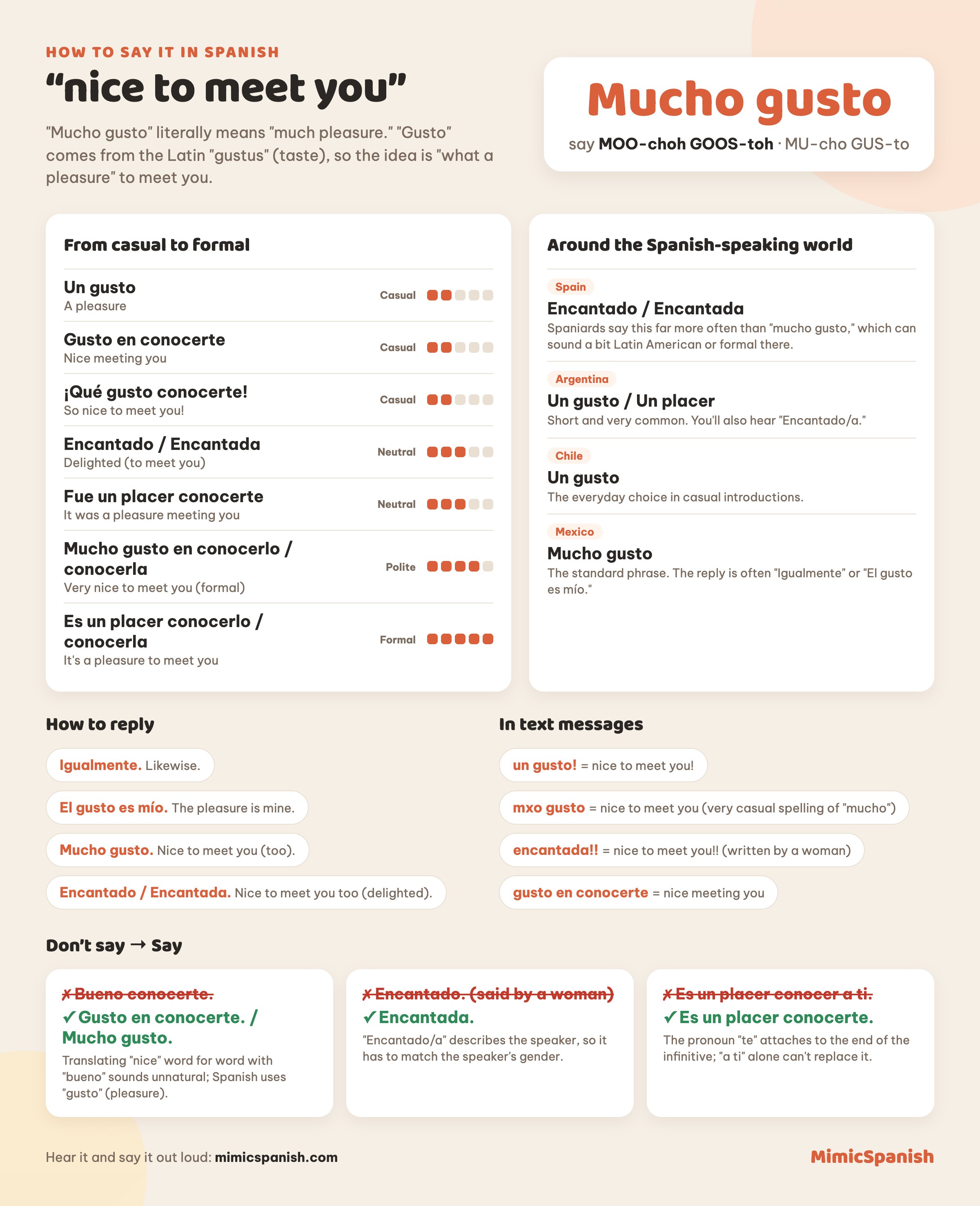
Other ways to say it, from casual to formal
- Un gustoA pleasure · Relaxed introductions, very common in Argentina and ChileCasual
- Gusto en conocerteNice meeting you · Meeting someone your age or in a casual settingCasual
- ¡Qué gusto conocerte!So nice to meet you! · Warm, enthusiastic introductions, e.g. a friend's partnerCasual
- Encantado / EncantadaDelighted (to meet you) · Very common everywhere, the default in Spain; matches the speaker's genderNeutral
- Encantado de conocerteDelighted to meet you · Friendly but polite introductionsNeutral
- Fue un placer conocerteIt was a pleasure meeting you · Saying goodbye to someone you just metNeutral
- Mucho gusto en conocerlo / conocerlaVery nice to meet you (formal) · Meeting an older person, a client or a bossPolite
- Es un placer conocerlo / conocerlaIt's a pleasure to meet you · Business meetings and formal eventsFormal
By country
- Encantado / EncantadaSpain · Spaniards say this far more often than "mucho gusto," which can sound a bit Latin American or formal there.
- Un gusto / Un placerArgentina · Short and very common. You'll also hear "Encantado/a."
- Un gustoChile · The everyday choice in casual introductions.
- Mucho gustoMexico · The standard phrase. The reply is often "Igualmente" or "El gusto es mío."
- Mucho gustoColombia · Used both when meeting someone and when giving your name. "Con mucho gusto" is also a polite way to say "you're welcome."
In text messages
Example sentences
- Hola, soy Ana. Mucho gusto.Hi, I'm Ana. Nice to meet you.
- Mucho gusto, señora López.Nice to meet you, Mrs. López.
- Encantado, yo soy Pedro, el hermano de Luis.Nice to meet you, I'm Pedro, Luis's brother.
- Un gusto conocerte, Sofía. Carlos me habla mucho de ti.Nice to meet you, Sofía. Carlos talks about you a lot.
- Es un placer conocerlo, señor Ramírez. Gracias por recibirme.It's a pleasure to meet you, Mr. Ramírez. Thank you for seeing me.
- Fue un placer conocerlos a todos. ¡Espero verlos pronto!It was a pleasure meeting you all. I hope to see you soon!
Mini dialogue: Meeting a friend's coworker
How to reply
- Igualmente.Likewise.
- El gusto es mío.The pleasure is mine.
- Mucho gusto.Nice to meet you (too).
- Encantado / Encantada.Nice to meet you too (delighted).
Grammar: conocerte vs. conocerlo / conocerla: tú or usted
When you add "to meet you," Spanish attaches the object pronoun to the end of the verb "conocer." Use "conocerte" with "tú" (friends, peers, kids). Use "conocerlo" (a man) or "conocerla" (a woman) with "usted" (older people, clients, formal settings), and "conocerlos" for a group.
- Mucho gusto en conocerte, Javi.Nice to meet you, Javi.
- Es un placer conocerla, doctora Gómez.It's a pleasure to meet you, Dr. Gómez.
Common mistakes
Culture tip
People say "mucho gusto" right after hearing someone's name, usually with a handshake. Among women, or a man and a woman in casual settings, it often comes with a light kiss on the right cheek: one kiss in most of Latin America, two in Spain. It's also common to repeat it when saying goodbye ("Mucho gusto, ¡chao!"), and skipping it in an introduction can come across as a little cold.