How to say “my name is” in Spanish
The most common way to say 'my name is' in Spanish is 'Me llamo,' followed by your name: 'Me llamo Ana.' You can also say 'Mi nombre es Ana' (a bit more formal) or simply 'Soy Ana' (I'm Ana), which is very common in casual introductions.
How to pronounce “Me llamo”
- The double L (ll) sounds like the English 'y' in 'yes' in most of Latin America, so 'llamo' sounds like 'YAH-moh,' not 'LAH-moh.'
- Say 'me' as a short, clean 'meh,' not 'mee' like the English word 'me.'
- Keep the final 'o' short and pure, like 'oh' cut short, without gliding into 'ow' as in 'snow.'
What it literally means
'Me llamo' literally means 'I call myself.' It comes from the reflexive verb 'llamarse' (to be called), which goes back to the Latin 'clamare,' meaning 'to cry out' or 'to call.'
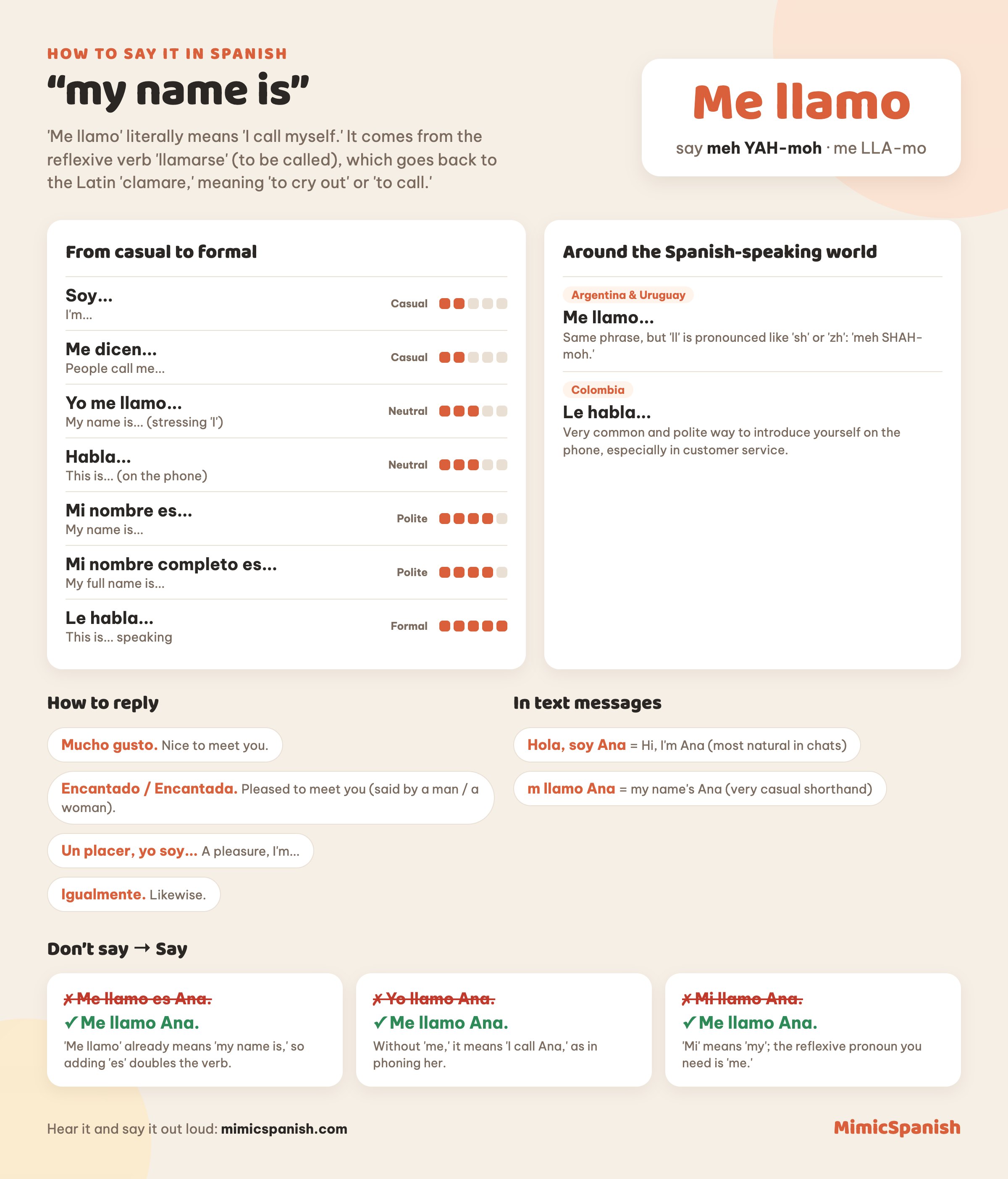
Other ways to say it, from casual to formal
- Soy...I'm... · Quick everyday introductionsCasual
- Me dicen...People call me... · Giving your nicknameCasual
- Yo me llamo...My name is... (stressing 'I') · Contrasting with someone else's nameNeutral
- Habla...This is... (on the phone) · Identifying yourself on the phoneNeutral
- Mi nombre es...My name is... · Forms, presentations, formal settingsPolite
- Mi nombre completo es...My full name is... · Official paperwork, appointments, bookingsPolite
- Le habla...This is... speaking · Answering or making a professional phone callFormal
By country
- Me llamo...Argentina & Uruguay · Same phrase, but 'll' is pronounced like 'sh' or 'zh': 'meh SHAH-moh.'
- Le habla...Colombia · Very common and polite way to introduce yourself on the phone, especially in customer service.
In text messages
Example sentences
- Hola, me llamo Carlos.Hi, my name is Carlos.
- Me llamo Laura, pero me dicen Lau.My name is Laura, but people call me Lau.
- Mucho gusto, me llamo Sofía. ¿Y tú?Nice to meet you, my name is Sofía. And you?
- Buenos días, mi nombre es Daniel Pérez y tengo una cita a las diez.Good morning, my name is Daniel Pérez and I have an appointment at ten.
- Soy Mike, el nuevo vecino del segundo piso.I'm Mike, the new neighbor on the second floor.
- Me llamo Andrés, como mi abuelo.My name is Andrés, like my grandfather.
Mini dialogue: First day of Spanish class
How to reply
- Mucho gusto.Nice to meet you.
- Encantado / Encantada.Pleased to meet you (said by a man / a woman).
- Un placer, yo soy...A pleasure, I'm...
- Igualmente.Likewise.
Grammar: The reflexive verb 'llamarse'
'Llamarse' (to be called) is a reflexive verb, so it always needs a pronoun that matches the person: me llamo, te llamas, se llama, nos llamamos, se llaman. Don't add 'es' after it, because the verb already means 'is called.' To ask someone's name, use the same verb: '¿Cómo te llamas?' (informal) or '¿Cómo se llama?' (formal).
- Mi hermana se llama Lucía.My sister's name is Lucía.
- ¿Cómo se llama usted?What is your name? (formal)
Common mistakes
Culture tip
Spanish speakers often just say 'Soy Ana' in relaxed situations, and introductions usually come with a handshake, or in many Latin American countries a single kiss on the cheek between women or between a man and a woman. In Spain, it's usually two kisses. Nicknames are extremely common, so don't be surprised if someone says 'Me llamo Francisco, pero me dicen Pancho.'