How to say “how old are you” in Spanish
The most common way to say "how old are you" in Spanish is "¿Cuántos años tienes?" (informal). With someone you address as usted, such as an older person or in a formal setting, say "¿Cuántos años tiene?" or "¿Cuántos años tiene usted?". Spanish uses the verb tener (to have) for age, so the question literally asks how many years you have.
How to pronounce “¿Cuántos años tienes?”
- The ñ in años sounds like the 'ny' in 'canyon', so say AH-nyohs, never AH-nohs.
- Say cuántos as one quick syllable, KWAHN, with the 'cu' sounding like the 'qu' in 'quantity'.
- Keep the vowels short and pure: the e's in tienes are like the 'e' in 'bed', not 'ee'.
What it literally means
Word for word, "¿Cuántos años tienes?" means "How many years do you have?". Spanish treats age as something you possess, using tener (to have) rather than ser or estar (to be). Años comes from the Latin annus, 'year', the same root as English 'annual'.
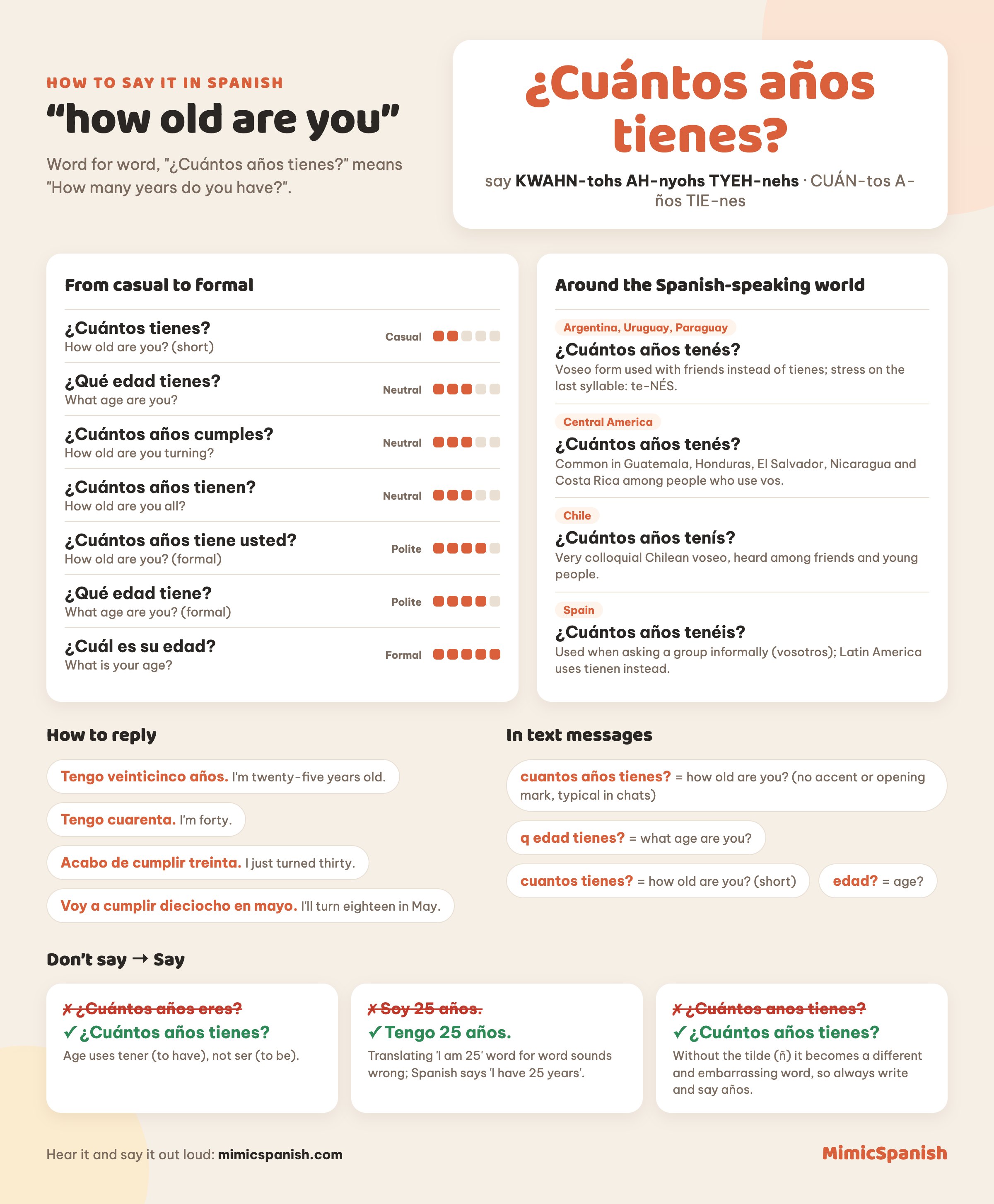
Other ways to say it, from casual to formal
- ¿Cuántos tienes?How old are you? (short) · casual chat once age is already the topicCasual
- ¿Qué edad tienes?What age are you? · a slightly more neutral alternative, very commonNeutral
- ¿Cuántos años cumples?How old are you turning? · on or around someone's birthdayNeutral
- ¿Cuántos años tienen?How old are you all? · asking a group (Latin America)Neutral
- ¿Cuántos años tiene usted?How old are you? (formal) · talking to elders, strangers or professionalsPolite
- ¿Qué edad tiene?What age are you? (formal) · doctors, receptionists and polite conversationPolite
- ¿Cuál es su edad?What is your age? · forms, interviews and official situationsFormal
By country
- ¿Cuántos años tenés?Argentina, Uruguay, Paraguay · Voseo form used with friends instead of tienes; stress on the last syllable: te-NÉS.
- ¿Cuántos años tenés?Central America · Common in Guatemala, Honduras, El Salvador, Nicaragua and Costa Rica among people who use vos.
- ¿Cuántos años tenís?Chile · Very colloquial Chilean voseo, heard among friends and young people.
- ¿Cuántos años tenéis?Spain · Used when asking a group informally (vosotros); Latin America uses tienen instead.
In text messages
Example sentences
- Hola, Sofía. ¿Cuántos años tienes?Hi, Sofía. How old are you?
- ¿Cuántos años tiene su hijo?How old is your son? (formal)
- Tengo treinta y dos años, ¿y tú?I'm thirty-two, and you?
- Mi abuela tiene noventa años y todavía camina todos los días.My grandmother is ninety and still walks every day.
- ¿Cuántos años cumples mañana?How old are you turning tomorrow?
- No sé cuántos años tiene, pero parece muy joven.I don't know how old he is, but he looks very young.
Mini dialogue: At a birthday party
How to reply
- Tengo veinticinco años.I'm twenty-five years old.
- Tengo cuarenta.I'm forty.
- Acabo de cumplir treinta.I just turned thirty.
- Voy a cumplir dieciocho en mayo.I'll turn eighteen in May.
Grammar: Use tener (to have) for age, not ser (to be)
In Spanish you don't 'be' an age, you 'have' years. Ask with tener (¿Cuántos años tienes/tiene?) and answer with tengo + number + años. To talk about a birthday, use cumplir (to turn).
- Tengo veinte años.I'm twenty years old.
- Mi hermana tiene quince años.My sister is fifteen.
Common mistakes
Culture tip
Asking someone's age is normal with children, young people and friends, and it comes up naturally at birthdays. With adults you've just met, especially women or older people, it can feel a bit personal, so many people avoid it or ask playfully. If you're asked, it's common to joke back with "¿Cuántos me das?" (How old do you think I am?).