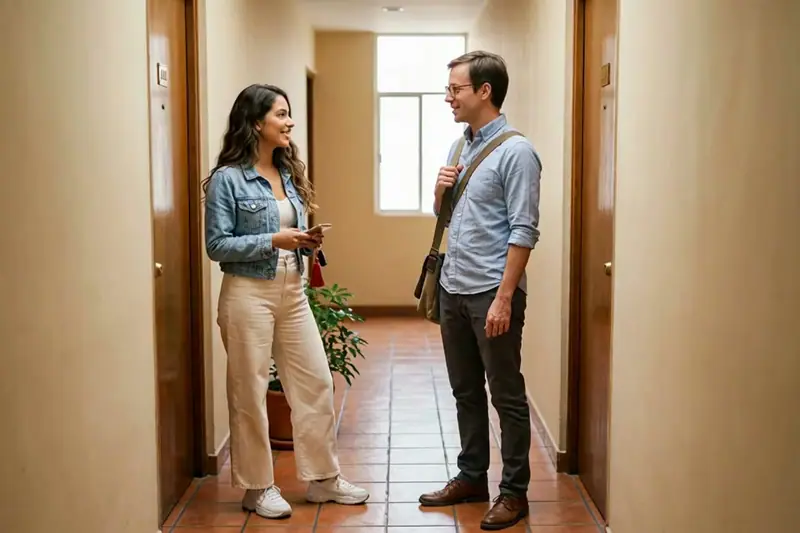
How to say “good morning” in Spanish
"Good morning" in Spanish is "buenos días" (BWEH-nohs DEE-ahs). It works in every Spanish-speaking country, in both formal and casual situations, from waking up until about noon. In Argentina and Uruguay you'll also hear "buen día", and among friends a quick "¡buenas!" is common.
How to pronounce “Buenos días”
- Say the "ue" in buenos as one quick glide, like the "we" in "wet": BWEH, not boo-EH-nos.
- The "d" in días is soft, with the tongue lightly touching the back of the teeth, close to the "th" in "this" but very gentle.
- Días has two clear syllables with the stress on DÍ (DEE-ahs), so don't squash it into one syllable like "dyahs".
What it literally means
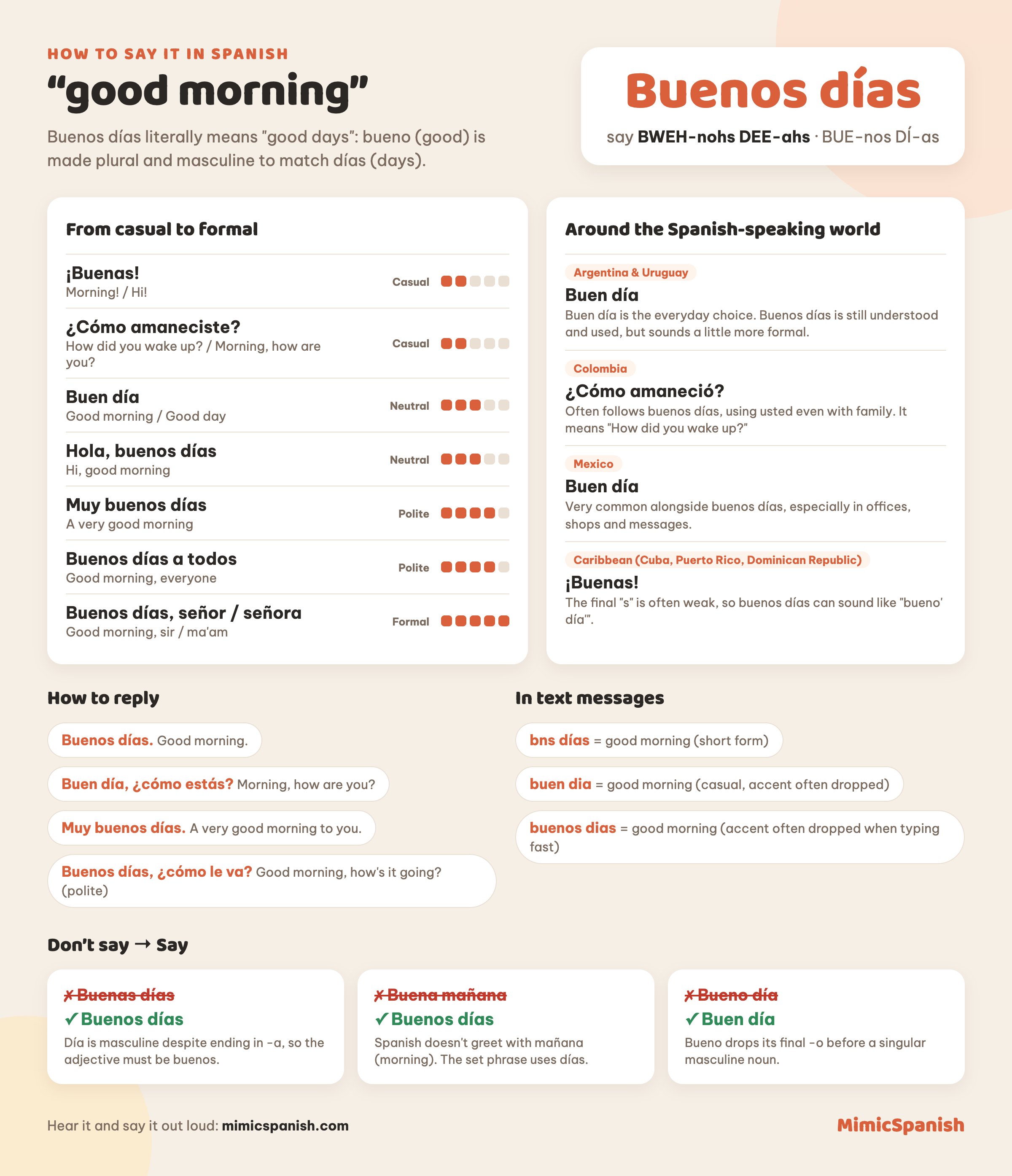
Buenos días literally means "good days": bueno (good) is made plural and masculine to match días (days). The plural is simply the fixed form of the greeting, just like buenas tardes ("good afternoons") and buenas noches ("good nights").
Other ways to say it, from casual to formal
- ¡Buenas!Morning! / Hi! · Quick, friendly greeting at any time of dayCasual
- ¿Cómo amaneciste?How did you wake up? / Morning, how are you? · Caring morning greeting to family or close friendsCasual
- Buen díaGood morning / Good day · Everyday greeting, especially in Argentina, Uruguay and parts of MexicoNeutral
- Hola, buenos díasHi, good morning · Friendly but polite, e.g. walking into a shopNeutral
- Muy buenos díasA very good morning · Warm, polite greeting to a client, audience or elderPolite
- Buenos días a todosGood morning, everyone · Greeting a group, a class or a meetingPolite
- Buenos días, señor / señoraGood morning, sir / ma'am · Respectful greeting to an older person or a customerFormal
By country
- Buen díaArgentina & Uruguay · Buen día is the everyday choice. Buenos días is still understood and used, but sounds a little more formal.
- ¿Cómo amaneció?Colombia · Often follows buenos días, using usted even with family. It means "How did you wake up?"
- Buen díaMexico · Very common alongside buenos días, especially in offices, shops and messages.
- ¡Buenas!Caribbean (Cuba, Puerto Rico, Dominican Republic) · The final "s" is often weak, so buenos días can sound like "bueno' día'".
- Buenos díasSpain · Used until lunchtime (around 2–3 p.m.), not just until noon. Buen día is rarely used.
In text messages
Example sentences
- Buenos días, ¿cómo está usted?Good morning, how are you?
- ¡Buenos días, mamá! ¿Hay café?Good morning, Mom! Is there any coffee?
- Buenos días, un café con leche, por favor.Good morning, a coffee with milk, please.
- Buenos días a todos. Empezamos la reunión en cinco minutos.Good morning, everyone. We'll start the meeting in five minutes.
- Siempre le digo buenos días al portero cuando salgo.I always say good morning to the doorman when I leave.
- Ya es la una, así que mejor di buenas tardes, no buenos días.It's already one o'clock, so you'd better say good afternoon, not good morning.
Mini dialogue: At the neighborhood bakery
How to reply
- Buenos días.Good morning.
- Buen día, ¿cómo estás?Morning, how are you?
- Muy buenos días.A very good morning to you.
- Buenos días, ¿cómo le va?Good morning, how's it going? (polite)
Grammar: Agreement: buenos días vs. buenas tardes
In Spanish, adjectives match the noun's gender and number. Día is masculine even though it ends in -a, so it takes buenos. Tarde and noche are feminine, so they take buenas. In the singular, bueno shortens to buen before a masculine noun: buen día.
- Buenos días, profesor.Good morning, teacher.
- Buenas tardes, profesora.Good afternoon, teacher.
Common mistakes
Culture tip
Spanish speakers say buenos días a lot more than English speakers say good morning. It's normal to say it to everyone when you walk into a shop, a waiting room, an elevator or an office, and staying silent can seem rude. In Latin America people switch to buenas tardes at noon, while in Spain buenos días lasts until lunch, around 2 p.m. Among friends and family, the greeting often comes with a hug or a kiss on the cheek.