How to say “good night” in Spanish
"Good night" in Spanish is "buenas noches" (BWEH-nahs NOH-chehs). Unlike English, Spanish uses it both as a greeting ("good evening") when you arrive somewhere after dark and as a goodbye when you leave or go to bed. For a warmer bedtime goodbye, people often add "que descanses" ("rest well").
How to pronounce “Buenas noches”
- Say "bue" as one quick syllable, like the "bwe" in "bwet". Don't split it into "boo-eh."
- The Spanish "ch" in "noches" sounds like the English "ch" in "church", and the final "es" is a short "ehs", not "eez."
- Keep the vowels short and pure: "o" is like "oh" without the English glide to "oo", and "a" is always "ah."
What it literally means
Literally it means "good nights": "buenas" (good, feminine plural) plus "noches" (nights). The plural is simply idiomatic, the same pattern as "buenos días" and "buenas tardes". It's often explained as a remnant of longer, older well-wishing formulas.
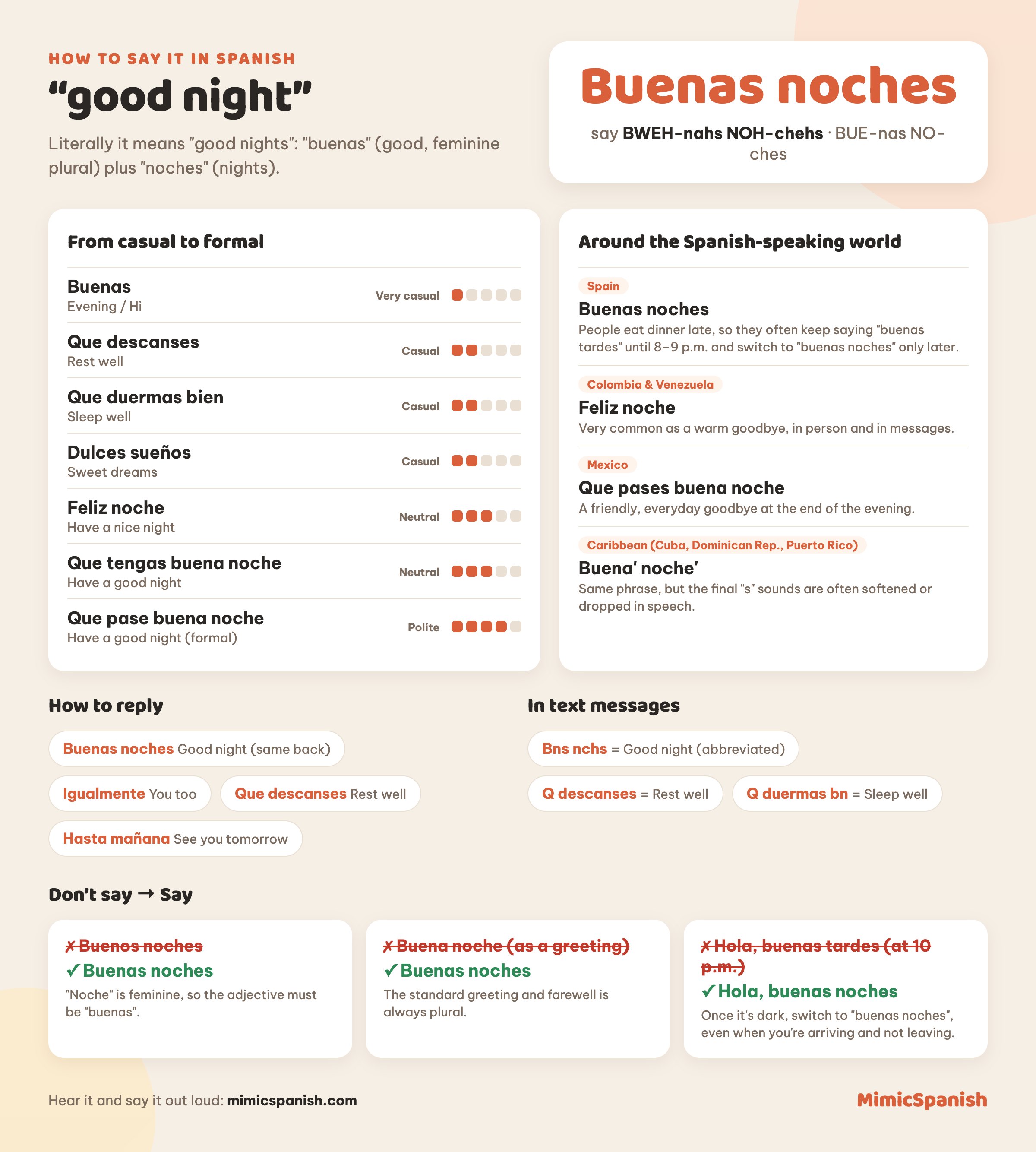
Other ways to say it, from casual to formal
- BuenasEvening / Hi · casual short greeting when arriving somewhereVery casual
- Que descansesRest well · saying goodnight to a friend or family memberCasual
- Que duermas bienSleep well · when someone is going to bedCasual
- Dulces sueñosSweet dreams · to kids, a partner, or close friendsCasual
- Hasta mañanaSee you tomorrow · saying goodnight to people you'll see the next dayNeutral
- Feliz nocheHave a nice night · friendly goodbye or message, very common in Latin AmericaNeutral
- Que tengas buena nocheHave a good night · friendly goodbye to someone you address as túNeutral
- Que pase buena nocheHave a good night (formal) · to customers, older people, or anyone you address as ustedPolite
By country
- Buenas nochesSpain · People eat dinner late, so they often keep saying "buenas tardes" until 8–9 p.m. and switch to "buenas noches" only later.
- Feliz nocheColombia & Venezuela · Very common as a warm goodbye, in person and in messages.
- Que pases buena nocheMexico · A friendly, everyday goodbye at the end of the evening.
- Buena' noche'Caribbean (Cuba, Dominican Rep., Puerto Rico) · Same phrase, but the final "s" sounds are often softened or dropped in speech.
In text messages
Example sentences
- Buenas noches, mamá. Hasta mañana.Good night, Mom. See you tomorrow.
- ¡Buenas noches! ¿Tienen una mesa para dos?Good evening! Do you have a table for two?
- Me voy a dormir. Buenas noches a todos.I'm going to bed. Good night, everyone.
- Buenas noches, que descanses.Good night, rest well.
- Ya es tarde, así que les digo buenas noches.It's already late, so I'll say good night to you all.
- Siempre le doy las buenas noches a mi hijo antes de apagar la luz.I always say good night to my son before turning off the light.
Mini dialogue: Saying goodnight at a friend's house
How to reply
- Buenas nochesGood night (same back)
- IgualmenteYou too
- Que descansesRest well
- Hasta mañanaSee you tomorrow
Grammar: Agreement: "buenas" because "noche" is feminine
In Spanish, adjectives match the noun's gender and number. "Noche" is feminine, so you say "buenas noches", never "buenos noches". In fixed greetings it's plural, but in phrases like "que tengas buena noche" it's singular because you're wishing someone one specific night.
- Buenas noches, señor.Good evening, sir.
- Que tengas una buena noche.Have a good night.
Common mistakes
Culture tip
Spanish speakers say "buenas noches" both as a greeting and as a farewell. You'll hear it when walking into a shop, restaurant, or elevator after dark, and it's polite to greet the room this way. Many people also add a warm "que descanses" when saying goodbye at night, and it's common to send "buenas noches" messages to family and friends before bed.