How to say “goodbye” in Spanish
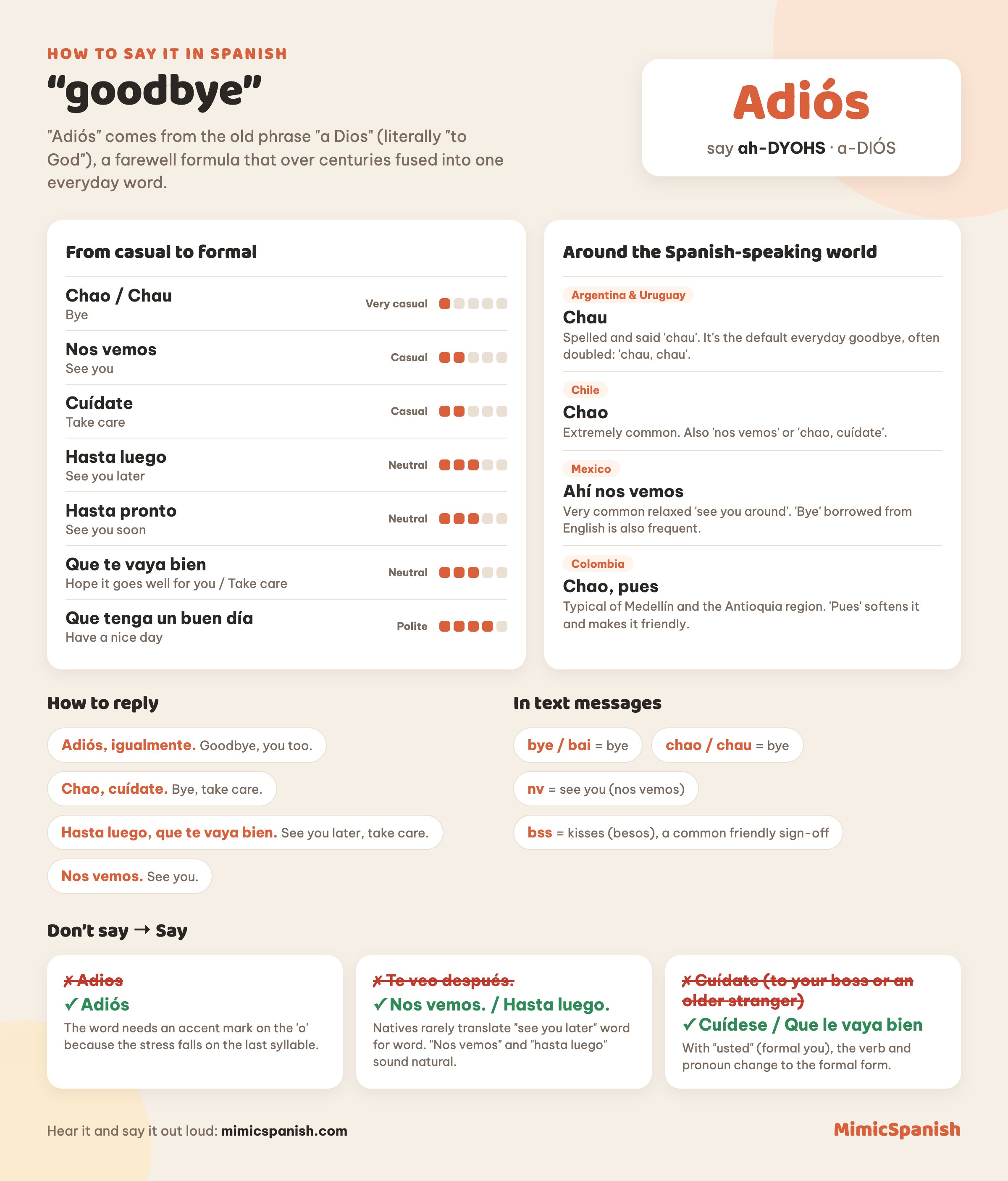
"Goodbye" in Spanish is "adiós" (ah-DYOHS). It is understood everywhere, but in everyday Latin American conversation people more often say "chao" (or "chau"), "hasta luego" (see you later) or "nos vemos" (see you). For a polite, neutral goodbye with strangers or in shops, "hasta luego" is a safe choice.
How to pronounce “Adiós”
- The 'd' between vowels is soft, close to the 'th' in 'this', so it sounds like 'ah-THYOHS', not a hard English 'd'.
- Say 'diós' as one quick syllable ('dyohs'), not 'dee-ohs'.
- Keep the 'o' short and pure with no 'oh-oo' glide, and make the final 's' crisp.
What it literally means
"Adiós" comes from the old phrase "a Dios" (literally "to God"), a farewell formula that over centuries fused into one everyday word. Today speakers just hear it as "goodbye". "Chao" was borrowed from Italian "ciao" and is now very common across Latin America.
Other ways to say it, from casual to formal
- Chao / ChauBye · casual goodbye with friends, family, coworkersVery casual
- Nos vemosSee you · with friends you'll see againCasual
- CuídateTake care · warm goodbye to friends and familyCasual
- Hasta luegoSee you later · neutral goodbye in shops, offices, with anyoneNeutral
- Hasta mañanaSee you tomorrow · leaving work or class for the dayNeutral
- Hasta prontoSee you soon · when you expect to meet again soonNeutral
- Que te vaya bienHope it goes well for you / Take care · wishing someone well as they leaveNeutral
- Que tenga un buen díaHave a nice day · polite goodbye to customers or strangersPolite
By country
- ChauArgentina & Uruguay · Spelled and said 'chau'. It's the default everyday goodbye, often doubled: 'chau, chau'.
- ChaoChile · Extremely common. Also 'nos vemos' or 'chao, cuídate'.
- Ahí nos vemosMexico · Very common relaxed 'see you around'. 'Bye' borrowed from English is also frequent.
- Chao, puesColombia · Typical of Medellín and the Antioquia region. 'Pues' softens it and makes it friendly.
- Venga, hasta luegoSpain · 'Venga' signals the end of a chat. Spaniards also say 'hasta luego' (often clipped to 'hasta lueg') when passing someone briefly.
In text messages
Example sentences
- Adiós, ¡que tengas un buen fin de semana!Goodbye, have a great weekend!
- Chao, mamá, te llamo más tarde.Bye, Mom, I'll call you later.
- Gracias por todo. ¡Hasta luego!Thanks for everything. See you later!
- Me voy a casa. Hasta mañana, chicos.I'm going home. See you tomorrow, guys.
- Fue un placer conocerte. Espero que nos veamos pronto.It was a pleasure meeting you. I hope we see each other soon.
- Ya me tengo que ir, pero nos vemos el sábado en la fiesta.I have to go now, but see you Saturday at the party.
Mini dialogue: Leaving a friend's house
How to reply
- Adiós, igualmente.Goodbye, you too.
- Chao, cuídate.Bye, take care.
- Hasta luego, que te vaya bien.See you later, take care.
- Nos vemos.See you.
Grammar: "Hasta" + a time word = "See you…"
Spanish builds many goodbyes with "hasta" (until) plus a time expression, where English says "see you…". You don't need any verb: just add the day, time or word you want. With days of the week, use "el": "hasta el lunes".
- Hasta el lunes.See you on Monday.
- Hasta la próxima.Until next time.
Common mistakes
Culture tip
In Latin America, goodbyes take time. At a family gathering or party you're expected to say goodbye to each person individually, often with a hug or a cheek kiss (one kiss in most of Latin America, two in Spain). Leaving without saying goodbye can seem rude. "Adiós" is perfectly polite, but in daily life "chao", "hasta luego" and "nos vemos" are heard much more often. In some places people even say a quick "adiós" or "hasta luego" as a greeting when passing someone on the street.