How to say “see you later” in Spanish
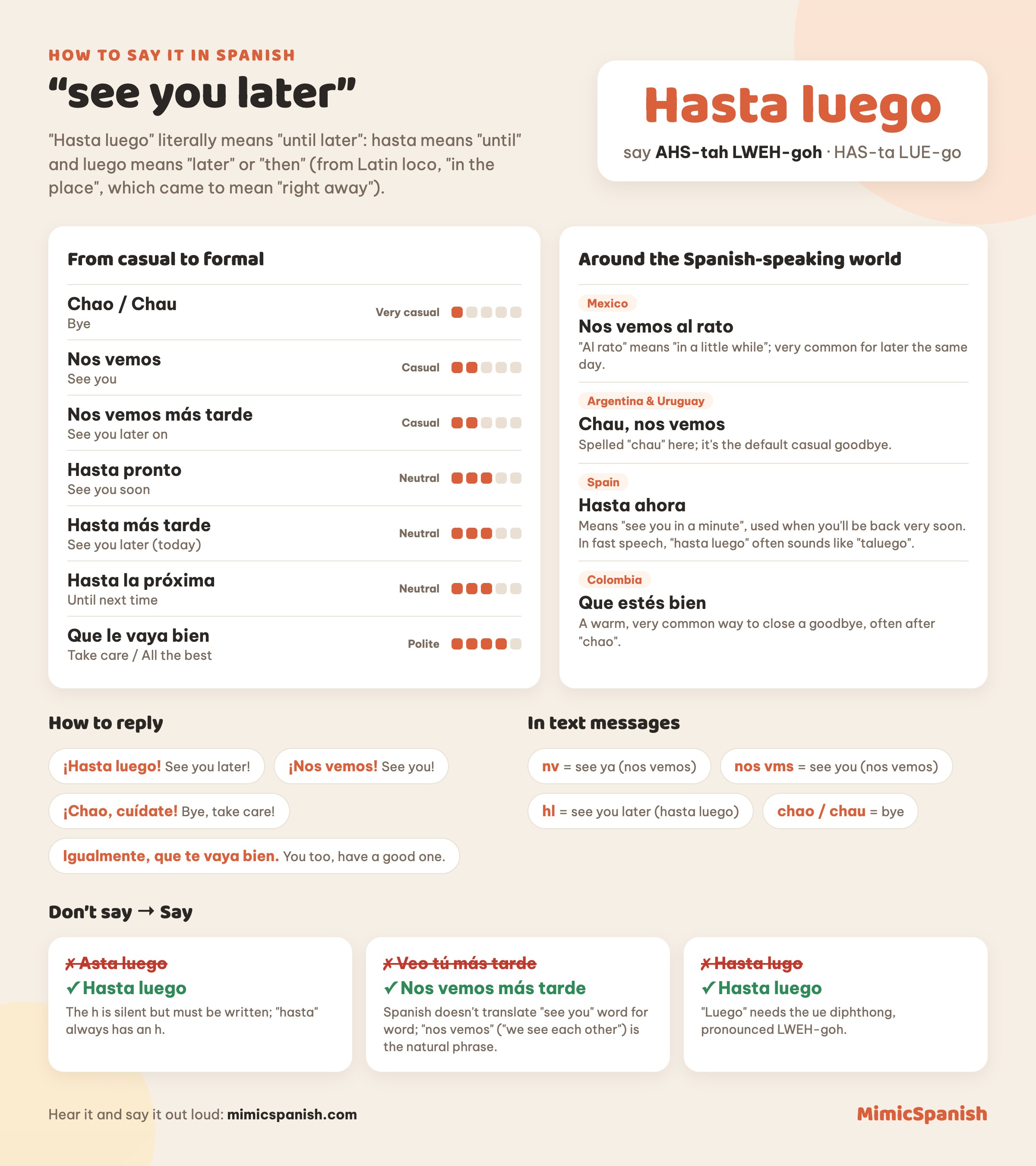
The most common way to say "see you later" in Spanish is "hasta luego" (AHS-tah LWEH-goh). It works in almost any situation, formal or informal, and many speakers use it as a general "bye" even if they won't see the person again soon. With friends, "nos vemos" ("see you") is just as common.
How to pronounce “Hasta luego”
- The h in hasta is completely silent, so it starts with an open 'ah' sound.
- Say luego as two syllables, LWEH-goh, gliding the u into a quick 'w' sound.
- The g in luego is soft because it sits between vowels, almost like a relaxed, breathy 'g' with no hard stop.
What it literally means
"Hasta luego" literally means "until later": hasta means "until" and luego means "later" or "then" (from Latin loco, "in the place", which came to mean "right away"). The phrase follows the same pattern as "hasta mañana" ("until tomorrow") and "hasta pronto" ("until soon").
Other ways to say it, from casual to formal
- Chao / ChauBye · very common quick goodbye among friendsVery casual
- Nos vemosSee you · casual goodbye with friends, coworkersCasual
- Nos vemos más tardeSee you later on · you've made plans for later todayCasual
- Hasta prontoSee you soon · when you expect to meet again soonNeutral
- Hasta más tardeSee you later (today) · you'll meet again later the same dayNeutral
- Hasta la próximaUntil next time · end of a class, meeting or visitNeutral
- Que le vaya bienTake care / All the best · polite goodbye to a customer or older personPolite
By country
- Nos vemos al ratoMexico · "Al rato" means "in a little while"; very common for later the same day.
- Chau, nos vemosArgentina & Uruguay · Spelled "chau" here; it's the default casual goodbye.
- Hasta ahoraSpain · Means "see you in a minute", used when you'll be back very soon. In fast speech, "hasta luego" often sounds like "taluego".
- Que estés bienColombia · A warm, very common way to close a goodbye, often after "chao".
- Chao, nos vemosChile · "Chao" is used constantly, even in fairly polite situations.
In text messages
Example sentences
- Bueno, me voy. ¡Hasta luego!Well, I'm leaving. See you later!
- Gracias por todo. ¡Hasta luego, señora!Thanks for everything. See you later, ma'am!
- Nos vemos más tarde en el parque.See you later at the park.
- Tengo clase ahora. ¡Nos vemos!I have class now. See you!
- Hasta luego, chicos, que tengan un buen día.See you later, guys, have a good day.
- Te escribo cuando salga del trabajo y nos vemos al rato.I'll text you when I get off work and see you in a bit.
Mini dialogue: Leaving the office
How to reply
- ¡Hasta luego!See you later!
- ¡Nos vemos!See you!
- ¡Chao, cuídate!Bye, take care!
- Igualmente, que te vaya bien.You too, have a good one.
Grammar: Hasta + time word
"Hasta" means "until", and you can put almost any time expression after it to make a goodbye. Use "hasta luego" for a general "see you later," and swap in a specific time when you know when you'll meet again. With days of the week, add the article "el".
- ¡Hasta mañana!See you tomorrow!
- ¡Hasta el lunes!See you on Monday!
Common mistakes
Culture tip
"Hasta luego" is used all the time as a friendly, neutral goodbye. Shop assistants, waiters and strangers say it even if they'll never see you again, especially in Spain. In much of Latin America, saying goodbye can take a while: people often hug, give a kiss on the cheek, and say several phrases in a row like "Chao, nos vemos, cuídate".