How to say “have a nice day” in Spanish
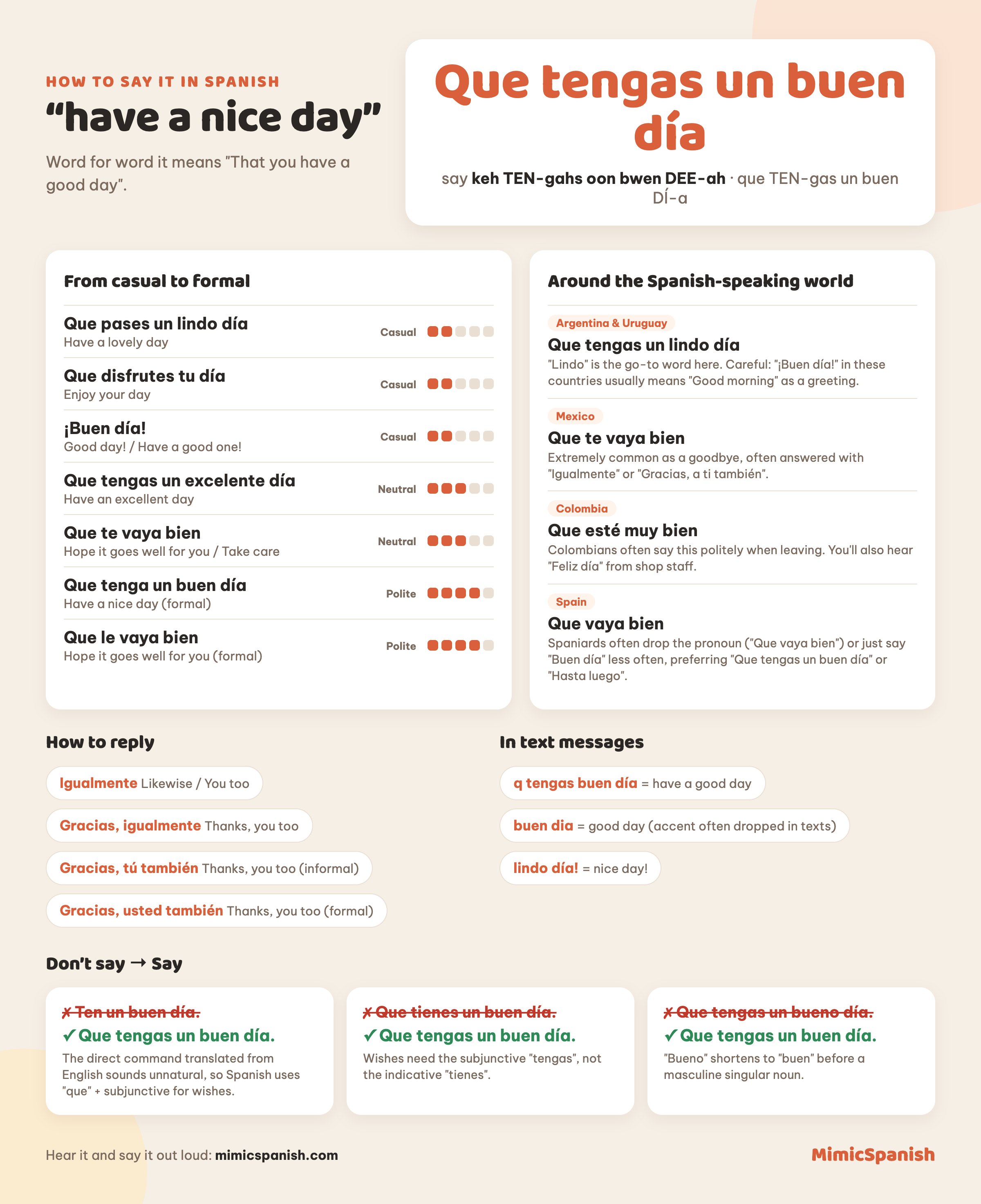
The most common way to say "have a nice day" in Spanish is "Que tengas un buen día" (informal, to a friend) or "Que tenga un buen día" (formal, to a customer, stranger or older person). In Latin America you'll also hear the shorter "¡Buen día!" and the warm "Que te vaya bien" ("I hope it goes well for you").
How to pronounce “Que tengas un buen día”
- "Que" sounds like "keh", so the u is silent and there's no "kway" sound.
- The d in "día" is soft, almost like the "th" in "this", with your tongue lightly touching your upper teeth.
- "Buen" is one quick syllable ("bwen"), and Spanish vowels stay short and pure, so "te" is never "tay".
What it literally means
Word for word it means "That you have a good day". It's a shortened form of "(Espero) que tengas un buen día" ("(I hope) that you have a good day"), which is why the verb is in the subjunctive ("tengas") and not the normal present ("tienes").
Other ways to say it, from casual to formal
- Que pases un lindo díaHave a lovely day · friends, family, warm messages (Latin America)Casual
- Que disfrutes tu díaEnjoy your day · friends, especially on a day offCasual
- ¡Buen día!Good day! / Have a good one! · quick, casual goodbye or greetingCasual
- Que tengas un excelente díaHave an excellent day · friendly service, emails, colleaguesNeutral
- Que te vaya bienHope it goes well for you / Take care · saying goodbye to anyone, very commonNeutral
- Que tenga un buen díaHave a nice day (formal) · to customers, strangers, older peoplePolite
- Que le vaya bienHope it goes well for you (formal) · shops, offices, polite goodbyesPolite
By country
- Que tengas un lindo díaArgentina & Uruguay · "Lindo" is the go-to word here. Careful: "¡Buen día!" in these countries usually means "Good morning" as a greeting.
- Que te vaya bienMexico · Extremely common as a goodbye, often answered with "Igualmente" or "Gracias, a ti también".
- Que esté muy bienColombia · Colombians often say this politely when leaving. You'll also hear "Feliz día" from shop staff.
- Que vaya bienSpain · Spaniards often drop the pronoun ("Que vaya bien") or just say "Buen día" less often, preferring "Que tengas un buen día" or "Hasta luego".
In text messages
Example sentences
- Gracias por todo. ¡Que tengas un buen día!Thanks for everything. Have a nice day!
- Aquí tiene su cambio. Que tenga un buen día.Here's your change. Have a nice day.
- Me voy al trabajo. ¡Que te vaya bien!I'm off to work. Have a good one!
- Hola, María, que pases un lindo día.Hi, María, have a lovely day.
- Mucho gusto, señor López. Que tenga un excelente día.Nice to meet you, Mr. López. Have an excellent day.
- Espero que tengas un buen día en tu nuevo trabajo.I hope you have a nice day at your new job.
Mini dialogue: At the bakery
How to reply
- IgualmenteLikewise / You too
- Gracias, igualmenteThanks, you too
- Gracias, tú tambiénThanks, you too (informal)
- Gracias, usted tambiénThanks, you too (formal)
Grammar: "Que" + subjunctive for wishes
To wish something to someone in Spanish, use "que" + a verb in the present subjunctive. That's why it's "que tengas" (tú) or "que tenga" (usted), not "que tienes". The same pattern works for many other wishes.
- Que tengas un buen viaje.Have a good trip.
- Que te mejores pronto.Get well soon.
Common mistakes
Culture tip
Native speakers say this mostly when parting: shop and restaurant staff to customers, coworkers leaving, or at the end of a phone call or email. It's polite and friendly but not overly formal, and in everyday goodbyes many people prefer the shorter "Que te vaya bien" or just "Chao" or "Hasta luego". The usual reply is a quick "Igualmente" (you too), often with a smile or a small wave.