How to say “what's up” in Spanish
The most common, neutral way to say "what's up" in Spanish is "¿Qué tal?" It's friendly, works in almost any Spanish-speaking country, and suits friends, coworkers and even people you've just met. For something more slangy, Mexicans say "¿Qué onda?" and Colombians say "¿Qué más?"
How to pronounce “¿Qué tal?”
- The 'qu' in 'qué' is just a hard K sound, with no 'w' like in English 'queen.'
- Keep the 'e' in 'qué' short and pure, like the 'e' in 'bet,' without sliding into 'kay.'
- Make the 't' in 'tal' with your tongue touching the back of your upper teeth and no puff of air, and say the 'a' as an open 'ah.'
What it literally means
"Qué" means "what" and "tal" means "such" or "so" (from Latin "talis"), so the phrase is literally something like "what such?" It's a shortened form of longer questions like "¿Qué tal estás?" ("How are you?"), and over time it became a greeting on its own.
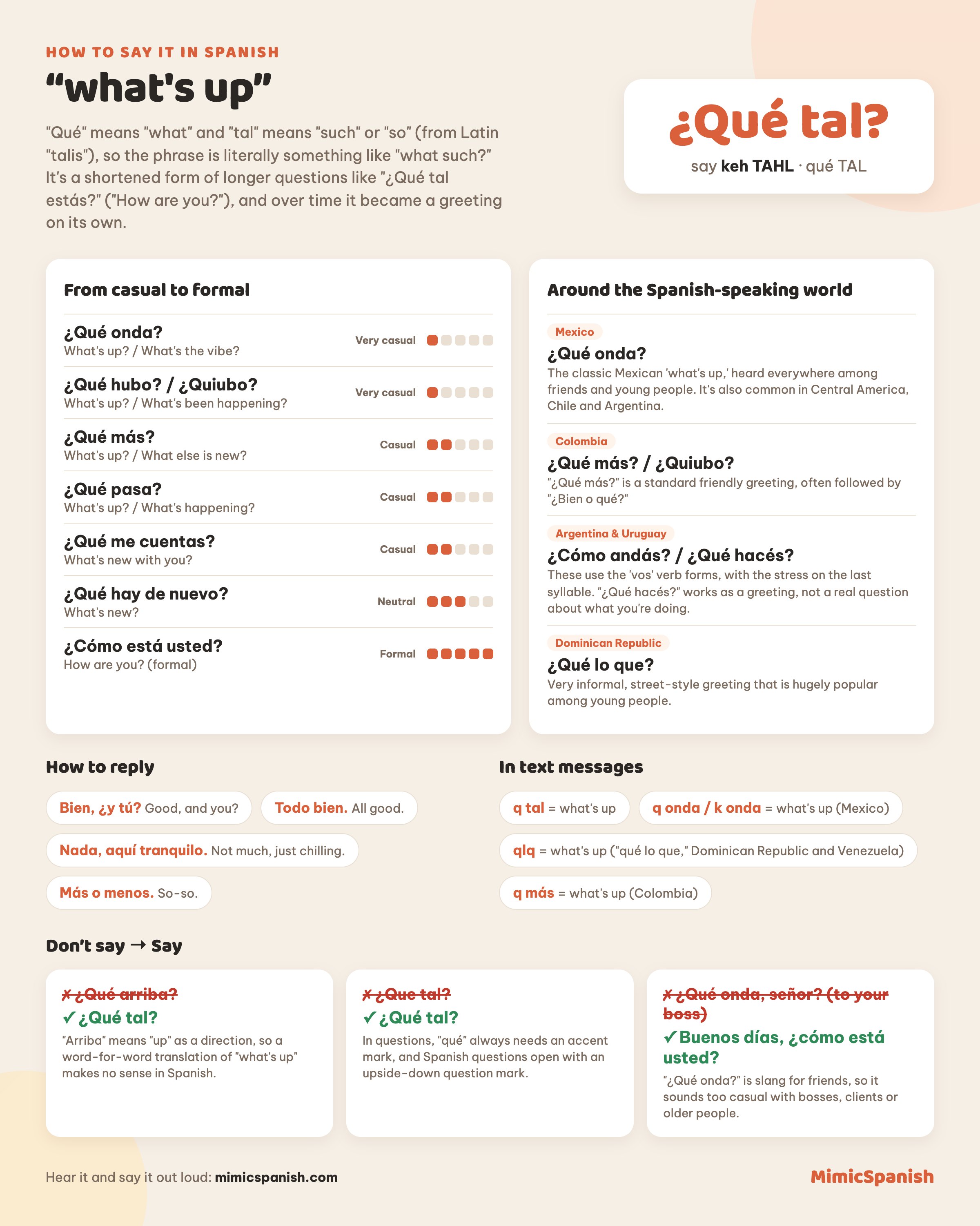
Other ways to say it, from casual to formal
- ¿Qué onda?What's up? / What's the vibe? · with friends, especially in Mexico and Central AmericaVery casual
- ¿Qué hubo? / ¿Quiubo?What's up? / What's been happening? · casual greeting in Colombia, Mexico and ChileVery casual
- ¿Qué más?What's up? / What else is new? · everyday greeting among friends in Colombia and VenezuelaCasual
- ¿Qué pasa?What's up? / What's happening? · casual greeting, very common in SpainCasual
- ¿Cómo andas?How's it going? · relaxed chat with friends or familyCasual
- ¿Qué me cuentas?What's new with you? · catching up with someone you haven't seen in a whileCasual
- ¿Qué hay de nuevo?What's new? · friendly small talk with friends or coworkersNeutral
- ¿Cómo está usted?How are you? (formal) · with older people, clients or your bossFormal
By country
- ¿Qué onda?Mexico · The classic Mexican 'what's up,' heard everywhere among friends and young people. It's also common in Central America, Chile and Argentina.
- ¿Qué más? / ¿Quiubo?Colombia · "¿Qué más?" is a standard friendly greeting, often followed by "¿Bien o qué?"
- ¿Cómo andás? / ¿Qué hacés?Argentina & Uruguay · These use the 'vos' verb forms, with the stress on the last syllable. "¿Qué hacés?" works as a greeting, not a real question about what you're doing.
- ¿Qué lo que?Dominican Republic · Very informal, street-style greeting that is hugely popular among young people.
- ¿Qué pasa? / ¿Qué tal?Spain · Spaniards use "¿Qué tal?" constantly. "¿Qué pasa, tío?" is the very casual version among friends.
In text messages
Example sentences
- ¡Hola, Ana! ¿Qué tal?Hi, Ana! What's up?
- ¿Qué tal tu día?How's your day going?
- ¿Qué tal el trabajo nuevo?How's the new job?
- ¿Qué onda, güey? ¿Vamos al cine?What's up, dude? Shall we go to the movies?
- ¡Buenas! ¿Qué tal todo por tu casa?Hey! How's everything at home?
- Hace mucho que no hablamos. ¿Qué me cuentas de tu viaje?We haven't talked in ages. What's new about your trip?
Mini dialogue: Running into a friend on the street
How to reply
- Bien, ¿y tú?Good, and you?
- Todo bien.All good.
- Nada, aquí tranquilo.Not much, just chilling.
- Más o menos.So-so.
Grammar: ¿Qué tal + noun?
"¿Qué tal?" works alone as a greeting, but you can also add a noun to ask how something is going, with no verb needed. Just put the noun (with its article or possessive) right after "tal." You can also add a verb, as in "¿Qué tal estás?"
- ¿Qué tal la película?How was the movie?
- ¿Qué tal tu familia?How's your family?
Common mistakes
Culture tip
Spanish speakers greet constantly, and a quick "¿Qué tal?" is often said in passing without expecting a real answer, just like English "what's up?" Among friends it usually comes with a kiss on the cheek, a hug or a handshake, depending on the country. Slangy versions like "¿Qué onda?" or "¿Qué más?" instantly mark you as a local, so learners who use them with friends tend to get a warm reaction.