How to say “no” in Spanish
"No" in Spanish is "no". It is spelled exactly like the English word but pronounced with a short, pure "o" (NOH, with no glide at the end). The same word also means "not" and goes right before the verb, as in "No hablo inglés" (I don't speak English).
How to pronounce “No”
- Keep the Spanish "o" short and pure, with no "oh-w" glide at the end as in English "no" (sounds closer to the "o" in "order" than in "go").
- Say it crisply without stretching the vowel, unless you deliberately want to sound emphatic ("¡Nooo!").
- The "n" is the same as in English, so all your attention goes to that clean, single-sound "o".
What it literally means
Spanish "no" comes directly from Latin "non" ("not"). Unlike English, which uses both "no" and "not", Spanish uses one word for both jobs: answering a question and making a verb negative.
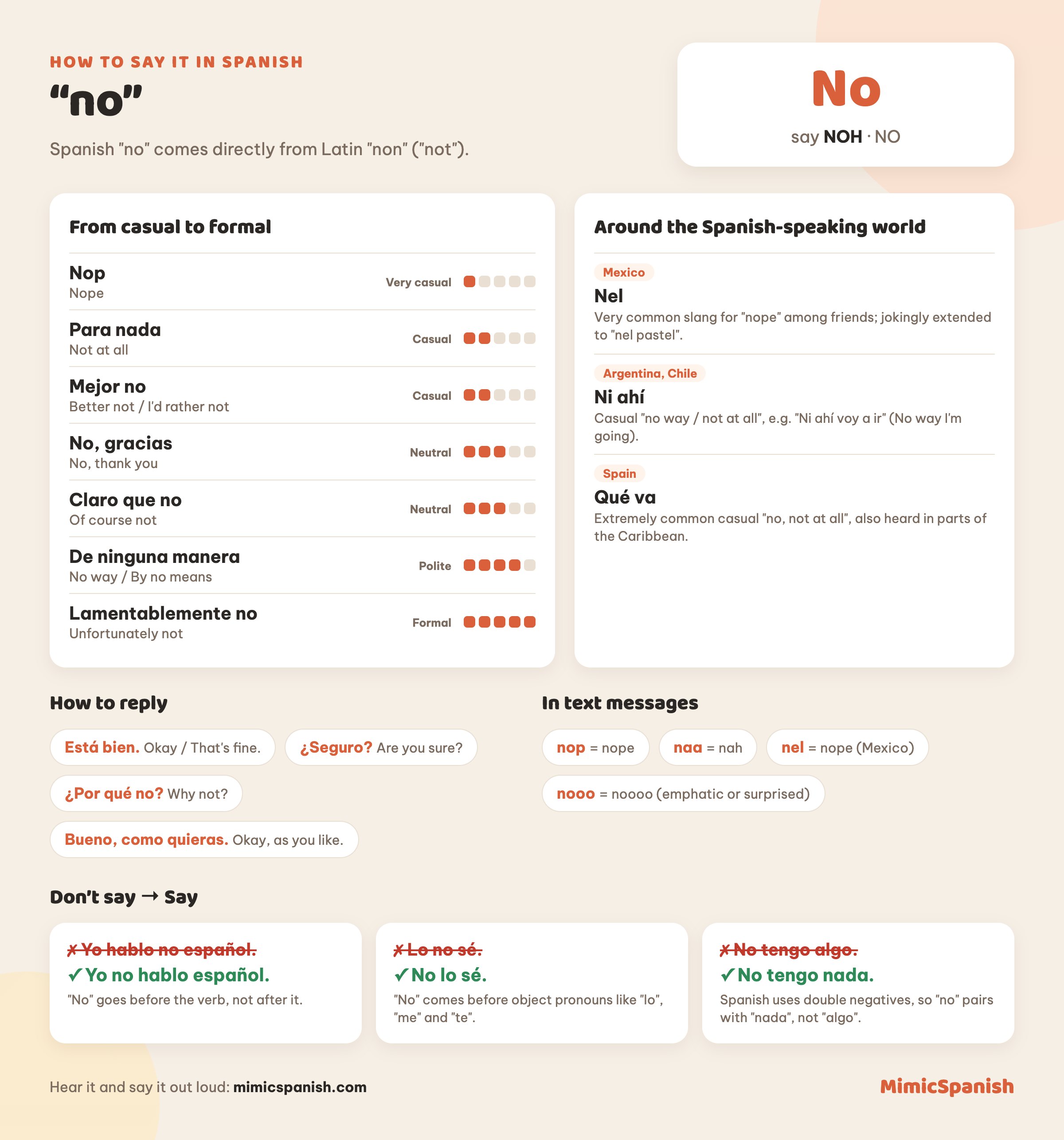
Other ways to say it, from casual to formal
- NopNope · playful no with friendsVery casual
- Para nadaNot at all · a strong, friendly noCasual
- Mejor noBetter not / I'd rather not · softly declining or changing your mindCasual
- No, graciasNo, thank you · politely turning down an offerNeutral
- Todavía noNot yet · something hasn't happened yetNeutral
- Claro que noOf course not · the answer is obviously noNeutral
- De ninguna maneraNo way / By no means · a firm, serious refusalPolite
- Lamentablemente noUnfortunately not · polite no at work or in formal emailsFormal
By country
- NelMexico · Very common slang for "nope" among friends; jokingly extended to "nel pastel".
- Ni ahíArgentina, Chile · Casual "no way / not at all", e.g. "Ni ahí voy a ir" (No way I'm going).
- Qué vaSpain · Extremely common casual "no, not at all", also heard in parts of the Caribbean.
In text messages
Example sentences
- No, gracias. No quiero café.No, thank you. I don't want coffee.
- No hablo mucho español.I don't speak much Spanish.
- ¿Tienes hermanos? No, soy hijo único.Do you have siblings? No, I'm an only child.
- No, ese no es mi carro.No, that's not my car.
- Todavía no he comido.I haven't eaten yet.
- No creo que llueva hoy.I don't think it'll rain today.
Mini dialogue: At the market
How to reply
- Está bien.Okay / That's fine.
- ¿Seguro?Are you sure?
- ¿Por qué no?Why not?
- Bueno, como quieras.Okay, as you like.
Grammar: Put "no" before the verb (and use double negatives)
To make a sentence negative, put "no" directly before the verb, and before any object pronouns like "lo", "me" or "te". Spanish also requires double negatives: with words like "nada" (nothing) or "nadie" (nobody) after the verb, you still keep "no" before it.
- No lo sé.I don't know (it).
- No veo a nadie.I don't see anyone. (literally: I don't see nobody)
Common mistakes
Culture tip
Native speakers often repeat it, saying "no, no, no" or "no, no", to sound friendlier or more emphatic, and they usually soften refusals with "gracias" or "mejor no". A common gesture is wagging the index finger side to side, which can look playful or firm depending on the situation. In many Latin American countries a flat "no" to an invitation can sound blunt, so people often say "a ver" or "tal vez", which frequently means a polite no.