How to say “okay” in Spanish
The most common neutral way to say "okay" in Spanish is "está bien" (ehs-TAH BYEN). It works almost anywhere to agree, accept a plan, or say something is acceptable. In casual speech you'll also hear "ok" (pronounced "okey"), "dale" in much of Latin America, and "vale" in Spain.
How to pronounce “Está bien”
- Make the 'e' in 'es' short and pure, like the 'e' in 'pet', not 'ay'.
- Say 'bien' as one quick syllable, gliding 'b' into 'yen' (BYEN), not 'bee-en'.
- Keep the 't' soft, with your tongue touching the back of your top teeth and no puff of air like in English 'top'.
What it literally means
"Está bien" literally means "it is well" or "it's good". It is built from "estar" (to be, from Latin 'stare', to stand) and "bien" (well, from Latin 'bene'). Spain's "vale" comes from the Latin 'valere', meaning "to be strong, to be worth", so it originally meant something like "it's valid".
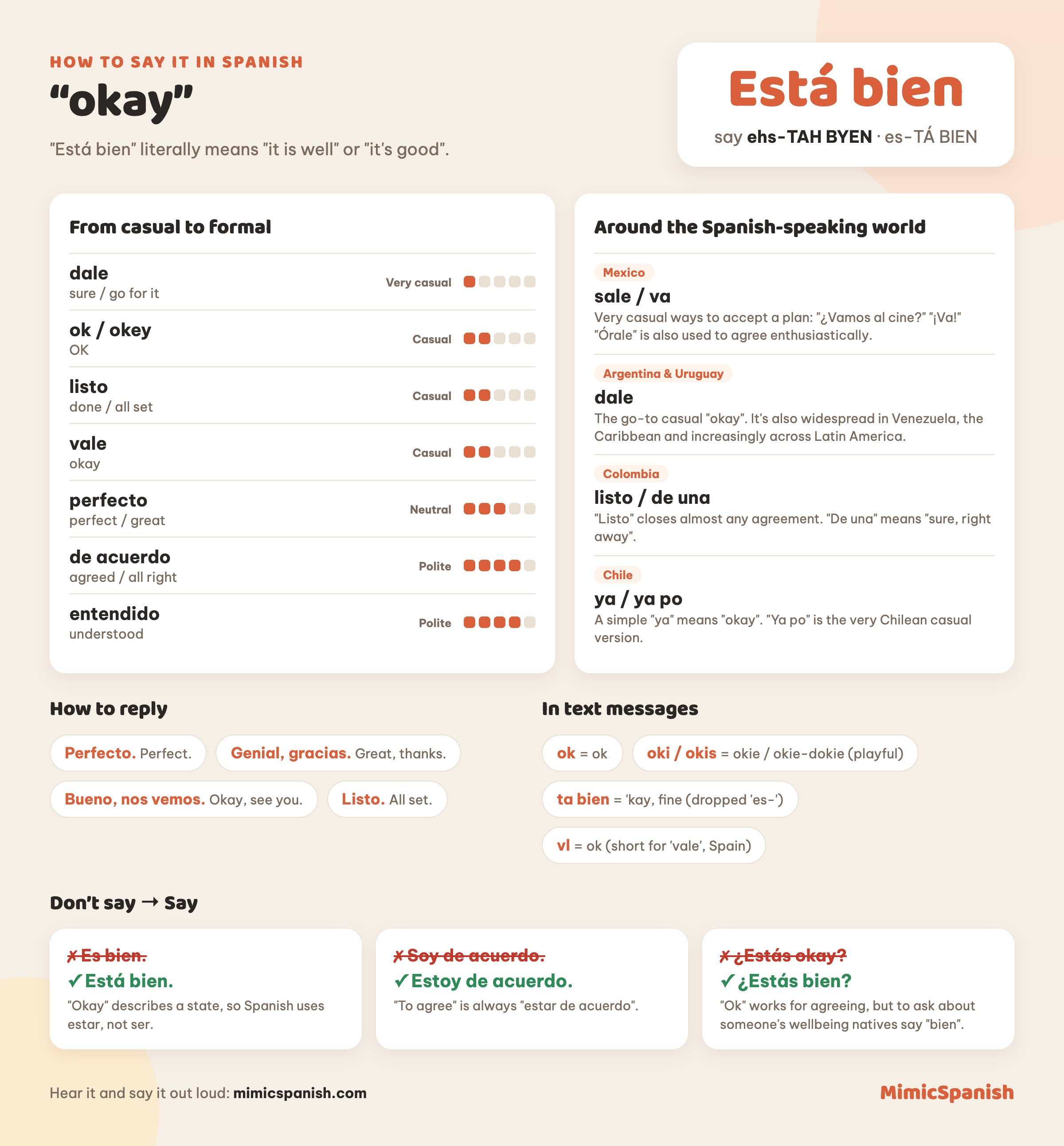
Other ways to say it, from casual to formal
- dalesure / go for it · accepting plans with friends (very common in Latin America)Very casual
- ok / okeyOK · casual everyday speech and texts everywhereCasual
- listodone / all set · confirming something is settled (common in Colombia and South America)Casual
- valeokay · everyday agreement in SpainCasual
- buenookay, well… · accepting something, sometimes reluctantlyNeutral
- perfectoperfect / great · confirming details, appointments, ordersNeutral
- de acuerdoagreed / all right · work, school, polite agreementPolite
- entendidounderstood · acknowledging instructions at work or in formal settingsPolite
By country
- sale / vaMexico · Very casual ways to accept a plan: "¿Vamos al cine?" "¡Va!" "Órale" is also used to agree enthusiastically.
- daleArgentina & Uruguay · The go-to casual "okay". It's also widespread in Venezuela, the Caribbean and increasingly across Latin America.
- listo / de unaColombia · "Listo" closes almost any agreement. "De una" means "sure, right away".
- ya / ya poChile · A simple "ya" means "okay". "Ya po" is the very Chilean casual version.
- valeSpain · Spaniards say "vale" constantly, and it sounds very Spanish to Latin Americans.
In text messages
Example sentences
- Está bien, nos vemos a las cinco.Okay, see you at five.
- —¿Te llamo mañana? —Ok, perfecto."Shall I call you tomorrow?" "Okay, perfect."
- ¿Estás bien? Te veo cansado.Are you okay? You look tired.
- Dale, yo llevo la comida.Okay, I'll bring the food.
- De acuerdo, le envío el documento hoy.All right, I'll send you the document today.
- No está bien llegar tarde todos los días.It's not okay to arrive late every day.
Mini dialogue: Making weekend plans
How to reply
- Perfecto.Perfect.
- Genial, gracias.Great, thanks.
- Bueno, nos vemos.Okay, see you.
- Listo.All set.
Grammar: Use ESTAR, not SER, for "okay"
"Okay" uses the verb estar: "está bien" (it's okay) and "estoy bien" (I'm okay), because it describes a state or condition. Change the verb form for the person you're talking about, but keep "bien" the same, since it never changes for gender or number. To say "I agree", also use estar: "estoy de acuerdo".
- ¿Están bien los niños?Are the kids okay?
- Estoy de acuerdo contigo.I agree with you.
Common mistakes
Culture tip
Spanish speakers say "okay" words constantly, often doubling them for warmth, like "dale, dale" or "bueno, bueno" ("vale, vale" in Spain). "Ok" is fully part of everyday Spanish and is pronounced "okey". Watch the tone with "bueno" and "está bien": said slowly with a sigh, they can mean "fine, whatever" rather than an enthusiastic yes.