How to say “I agree” in Spanish
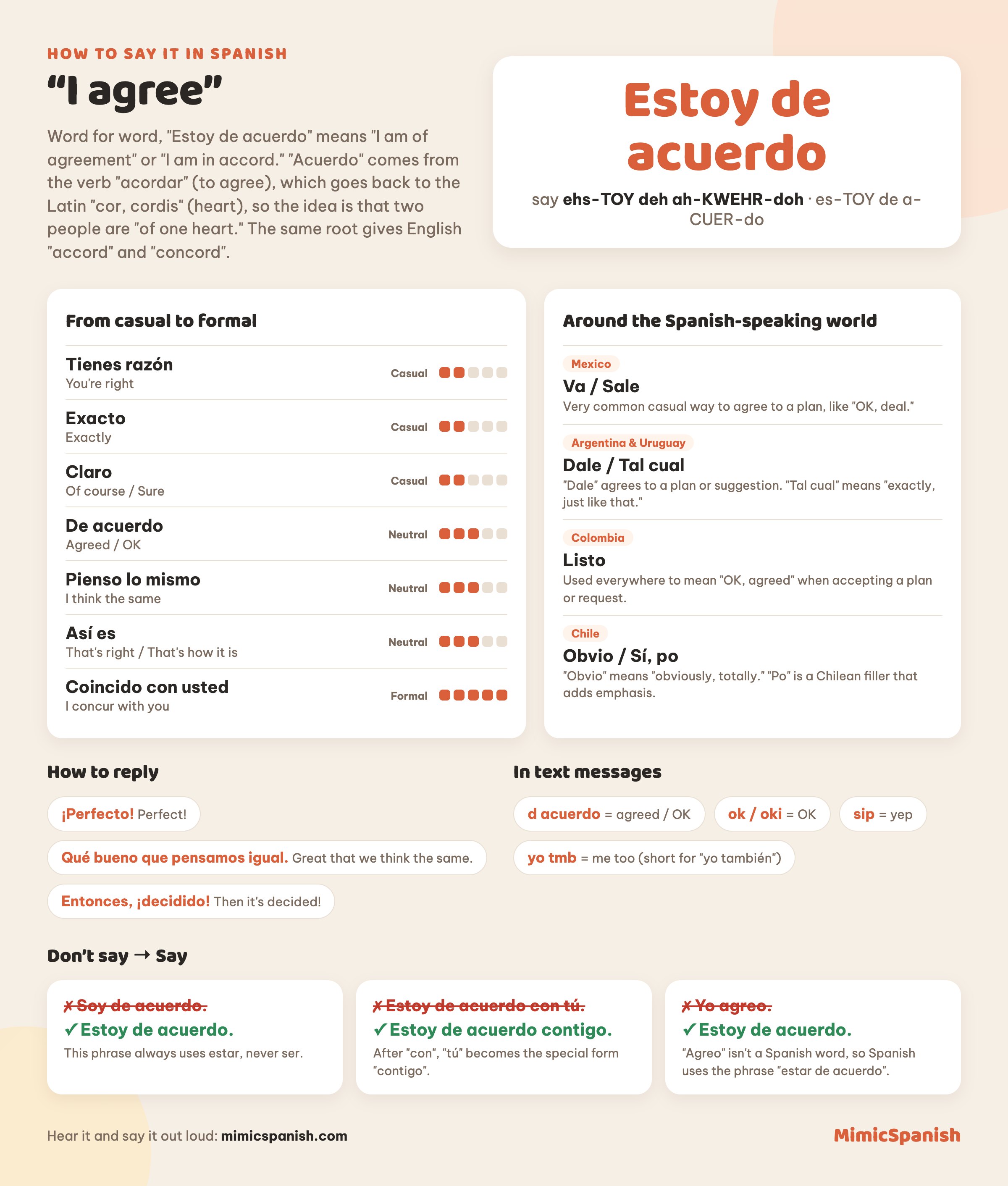
The most common way to say "I agree" in Spanish is "Estoy de acuerdo" (ehs-TOY deh ah-KWEHR-doh). To say who you agree with, add "con": "Estoy de acuerdo contigo" (I agree with you) or, formally, "Estoy de acuerdo con usted." In casual conversation many people shorten it to "De acuerdo" or say "Tienes razón" (You're right).
How to pronounce “Estoy de acuerdo”
- Say the 'e' in 'estoy' and 'de' short and clean, like the 'e' in 'bet', with no 'ay' glide at the end.
- Run 'de acuerdo' together smoothly as 'deh-ah-KWEHR-doh', and pronounce 'cue' like the 'qu' in 'quest'.
- The 'r' in 'acuerdo' is a single quick tap of the tongue, and the 'd' in 'acuerdo' is soft, almost like the 'th' in 'this'.
What it literally means
Word for word, "Estoy de acuerdo" means "I am of agreement" or "I am in accord." "Acuerdo" comes from the verb "acordar" (to agree), which goes back to the Latin "cor, cordis" (heart), so the idea is that two people are "of one heart." The same root gives English "accord" and "concord".
Other ways to say it, from casual to formal
- Tienes razónYou're right · admitting someone has a good pointCasual
- ExactoExactly · quick reaction while someone is talkingCasual
- ClaroOf course / Sure · everyday casual agreementCasual
- De acuerdoAgreed / OK · accepting a plan or instructionNeutral
- Totalmente de acuerdoI totally agree · strong agreement in a conversationNeutral
- Pienso lo mismoI think the same · sharing an opinion with friends or coworkersNeutral
- Así esThat's right / That's how it is · confirming what someone saidNeutral
- Coincido con ustedI concur with you · meetings, emails, formal discussionsFormal
By country
- Va / SaleMexico · Very common casual way to agree to a plan, like "OK, deal."
- Dale / Tal cualArgentina & Uruguay · "Dale" agrees to a plan or suggestion. "Tal cual" means "exactly, just like that."
- ListoColombia · Used everywhere to mean "OK, agreed" when accepting a plan or request.
- Obvio / Sí, poChile · "Obvio" means "obviously, totally." "Po" is a Chilean filler that adds emphasis.
- ValeSpain · The standard everyday "OK, agreed" in Spain. You'll rarely hear it this way in Latin America.
In text messages
Example sentences
- Estoy de acuerdo contigo.I agree with you.
- ¿Vamos al cine el sábado? —De acuerdo.Shall we go to the movies on Saturday? —OK, agreed.
- Tienes razón, es muy tarde.You're right, it's very late.
- No estoy de acuerdo con el precio.I don't agree with the price.
- Mi hermana y yo estamos de acuerdo: la pizza es mejor.My sister and I agree: pizza is better.
- Estoy de acuerdo en que necesitamos más tiempo para el proyecto.I agree that we need more time for the project.
Mini dialogue: Choosing a restaurant
How to reply
- ¡Perfecto!Perfect!
- Qué bueno que pensamos igual.Great that we think the same.
- Entonces, ¡decidido!Then it's decided!
Grammar: Use ESTAR (not SER) + de acuerdo + con / en
"To agree" in Spanish is a phrase with the verb estar: estoy, estás, está, estamos, están de acuerdo. Use "con" before a person or thing (con mi jefe, contigo, con la idea). Use "en que" before a full sentence (en que es caro). Note the special forms: "with you" is "contigo" and "with me" is "conmigo".
- ¿Estás de acuerdo conmigo?Do you agree with me?
- Estamos de acuerdo en que el hotel es bonito.We agree that the hotel is nice.
Common mistakes
Culture tip
Spanish speakers show agreement a lot during a conversation, often with quick words like "claro", "exacto", "sí, sí" or "ajá" while the other person is still talking. This isn't rude interrupting. It shows you're engaged. "Estoy de acuerdo" works with anyone, but among friends a short "tienes razón" or a regional word like "va", "dale" or "listo" sounds more natural. Nodding while saying "sí, sí" is the most common nonverbal way to agree.