How to say “speak slowly” in Spanish
"Speak slowly" in Spanish is "habla más despacio" with friends (tú) or "hable más despacio" to strangers and older people (usted). Natives almost always add "más" ("more"), so the phrase literally means "speak more slowly." Learners often ask politely: "¿Puede hablar más despacio, por favor?"
How to pronounce “Habla más despacio”
- The h in 'habla' is always silent, so start the word with a clear 'ah' sound.
- In 'despacio', the ending '-cio' is one quick syllable that sounds like 'syoh', not 'see-oh'.
- Keep every s a crisp hiss, never a buzzing English z, and keep the vowels short and pure ('dehs', not 'dess-ay').
What it literally means
"Habla" is the tú command of "hablar" (to speak), and "despacio" means "slowly." "Despacio" comes from "de espacio," meaning "with space" or "taking room/time," so the idea is to speak with more space between your words.
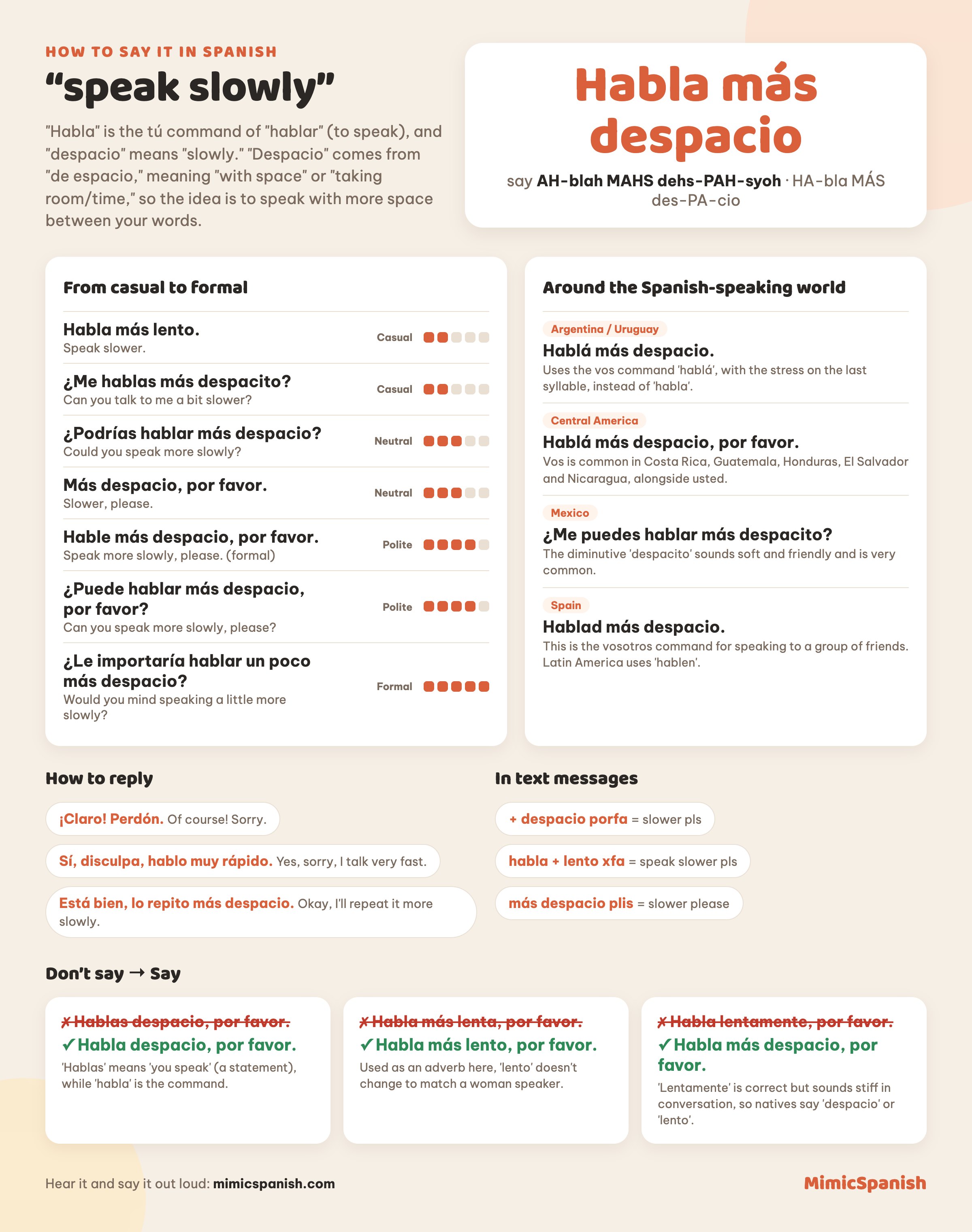
Other ways to say it, from casual to formal
- Habla más lento.Speak slower. · casual, very common in Latin AmericaCasual
- ¿Me hablas más despacito?Can you talk to me a bit slower? · friendly and soft, with friendsCasual
- ¿Podrías hablar más despacio?Could you speak more slowly? · polite but friendly, with peersNeutral
- Más despacio, por favor.Slower, please. · quick, short request in any situationNeutral
- Hable más despacio, por favor.Speak more slowly, please. (formal) · with strangers, older people, officialsPolite
- ¿Puede hablar más despacio, por favor?Can you speak more slowly, please? · the safest polite request for travelersPolite
- ¿Le importaría hablar un poco más despacio?Would you mind speaking a little more slowly? · very polite, at work or formal settingsFormal
By country
- Hablá más despacio.Argentina / Uruguay · Uses the vos command 'hablá', with the stress on the last syllable, instead of 'habla'.
- Hablá más despacio, por favor.Central America · Vos is common in Costa Rica, Guatemala, Honduras, El Salvador and Nicaragua, alongside usted.
- ¿Me puedes hablar más despacito?Mexico · The diminutive 'despacito' sounds soft and friendly and is very common.
- Hablad más despacio.Spain · This is the vosotros command for speaking to a group of friends. Latin America uses 'hablen'.
In text messages
Example sentences
- Perdón, no entiendo. ¿Puede hablar más despacio?Sorry, I don't understand. Can you speak more slowly?
- Habla más despacio, por favor. Estoy aprendiendo español.Speak more slowly, please. I'm learning Spanish.
- Mi profesora siempre habla despacio en clase.My teacher always speaks slowly in class.
- Más despacio, por favor. ¿Cuál es la dirección?Slower, please. What's the address?
- Cuando hablas por teléfono, habla más lento para que te entiendan.When you talk on the phone, speak slower so they understand you.
- Si la gente habla más despacio, entiendo casi todo.If people speak more slowly, I understand almost everything.
Mini dialogue: Asking for directions
How to reply
- ¡Claro! Perdón.Of course! Sorry.
- Sí, disculpa, hablo muy rápido.Yes, sorry, I talk very fast.
- Está bien, lo repito más despacio.Okay, I'll repeat it more slowly.
Grammar: Giving commands: habla (tú) vs. hable (usted)
To tell someone to do something, Spanish uses the imperative. For -ar verbs like 'hablar', the tú form is 'habla' and the usted form is 'hable'. 'Despacio' is an adverb, so it never changes for gender or number.
- Ana, habla más despacio, por favor.Ana, speak more slowly, please.
- Señor, hable más despacio, por favor.Sir, speak more slowly, please.
Common mistakes
Culture tip
Native speakers are usually happy to slow down for learners, and asking with "por favor" plus a smile is completely normal. Many people will slow down for a sentence or two and then speed up again, so you may need to ask more than once. Don't worry about that. Speakers from places like the Caribbean, Chile or Andalusia talk fast and drop sounds, so you'll probably need this phrase most there.