How to say “you're welcome” in Spanish
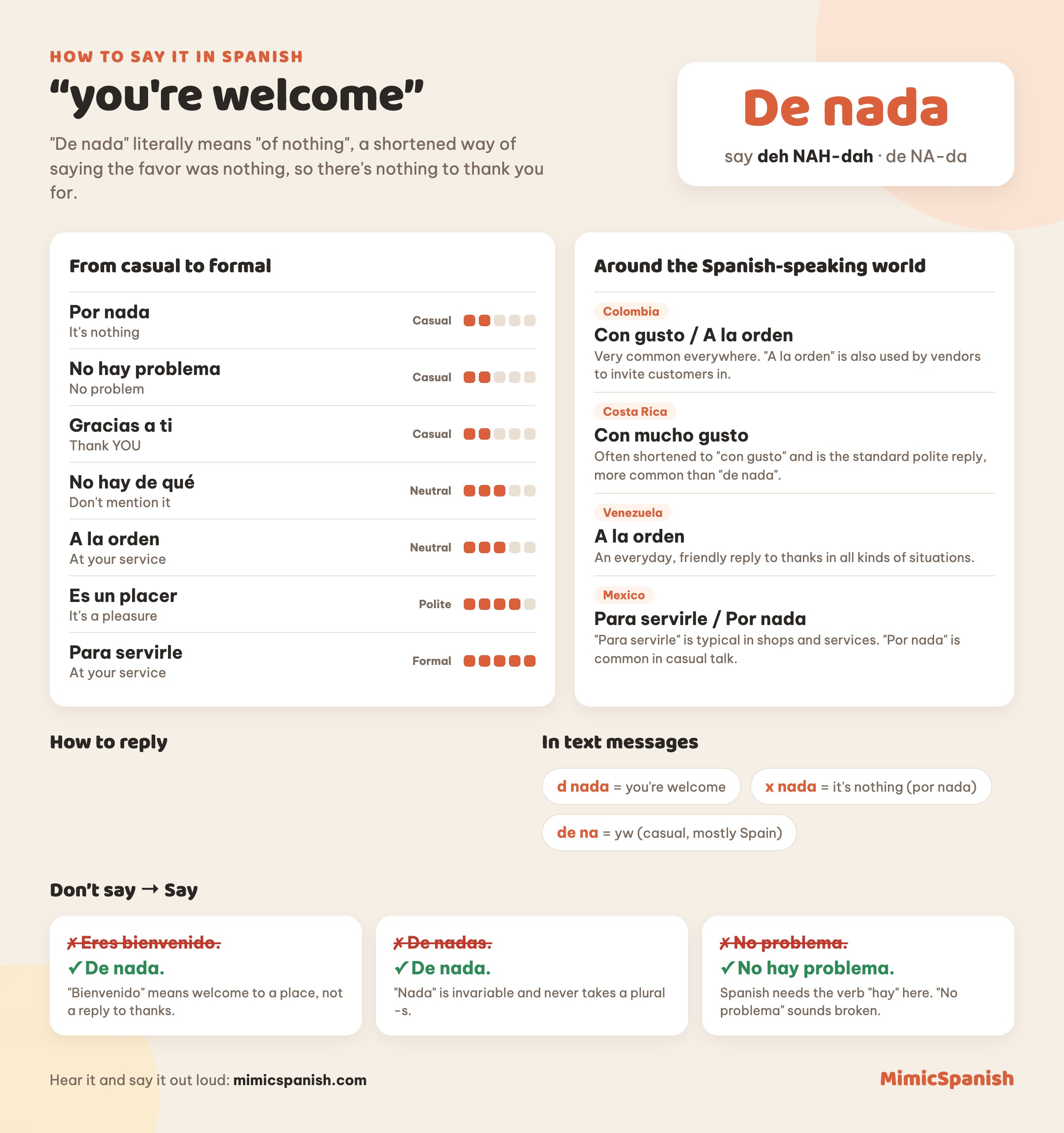
The most common way to say "you're welcome" in Spanish is "de nada" (deh NAH-dah). It works in every Spanish-speaking country and in almost any situation, from casual to polite. Other common options include "no hay de qué" and "con gusto", which is especially common in Colombia and Central America.
How to pronounce “De nada”
- The d between vowels in 'nada' is very soft, close to the 'th' in English 'this', not a hard English d.
- Both a's are open and short like the 'a' in 'father', so avoid 'NAY-duh' or 'NAD-uh'.
- Say 'de' as a short, clean 'deh' with no 'ay' glide, and link it smoothly to 'nada' so it sounds like one word: 'deNAda'.
What it literally means
"De nada" literally means "of nothing", a shortened way of saying the favor was nothing, so there's nothing to thank you for. "No hay de qué" works the same way. It means "there's nothing to (thank me) for".
Other ways to say it, from casual to formal
- Por nadaIt's nothing · casual, everyday thanksCasual
- No hay problemaNo problem · casual, after a small favorCasual
- Gracias a tiThank YOU · when the other person also helped youCasual
- No hay de quéDon't mention it · slightly more polite or warm replyNeutral
- Con gustoWith pleasure · service situations, friendly and politeNeutral
- A la ordenAt your service · shops, restaurants, everyday courtesy in some countriesNeutral
- Es un placerIt's a pleasure · formal or warm, e.g. hosts or customer servicePolite
- Para servirleAt your service · formal service, speaking to customers (usted)Formal
By country
- Con gusto / A la ordenColombia · Very common everywhere. "A la orden" is also used by vendors to invite customers in.
- Con mucho gustoCosta Rica · Often shortened to "con gusto" and is the standard polite reply, more common than "de nada".
- A la ordenVenezuela · An everyday, friendly reply to thanks in all kinds of situations.
- Para servirle / Por nadaMexico · "Para servirle" is typical in shops and services. "Por nada" is common in casual talk.
- De nada / No hay de quéSpain · Same as Latin America. "Con gusto" and "a la orden" sound unusual there.
In text messages
Example sentences
- —Gracias por la ayuda. —¡De nada!—Thanks for the help. —You're welcome!
- De nada, fue un placer.You're welcome, it was a pleasure.
- No hay de qué, para eso están los amigos.Don't mention it, that's what friends are for.
- Con gusto, señora. ¡Que tenga buen día!You're welcome, ma'am. Have a nice day!
- De nada. Si necesitas algo más, me avisas.You're welcome. If you need anything else, let me know.
- No tienes que agradecerme, lo hice con mucho gusto.You don't have to thank me, I was happy to do it.
Mini dialogue: Asking for directions
Grammar: "De nada" never changes, but tú/usted matters in other replies
"De nada" is a fixed expression. It never changes for gender, number or formality, so you can say it to anyone. Some alternatives do change: use "para servirte" or "gracias a ti" with tú (friends, peers), and "para servirle" or "gracias a usted" with usted (customers, older people, strangers).
- Gracias a ti, Ana.Thank you, Ana (informal).
- Para servirle, señor.At your service, sir (formal).
Common mistakes
Culture tip
Native speakers say "de nada" quickly and casually, often with a smile, and sometimes add a wish like "¡que te vaya bien!". In many Latin American countries, especially Colombia and Costa Rica, "con gusto" sounds warmer and more polite than "de nada". For tiny favors, like holding a door, people often just nod or say a quick "nada".