
Days of the Week and Months in Spanish (and How to Say the Date)
The seven days, the twelve months, the four seasons and the simple pattern for saying any date in Spanish — plus the small rules that make you sound natural.

Making plans, booking a table, telling someone your birthday — you need days, months and dates all the time. They are easy to learn, and a few small rules (no capital letters, el lunes means "on Monday") will make you sound natural from day one.
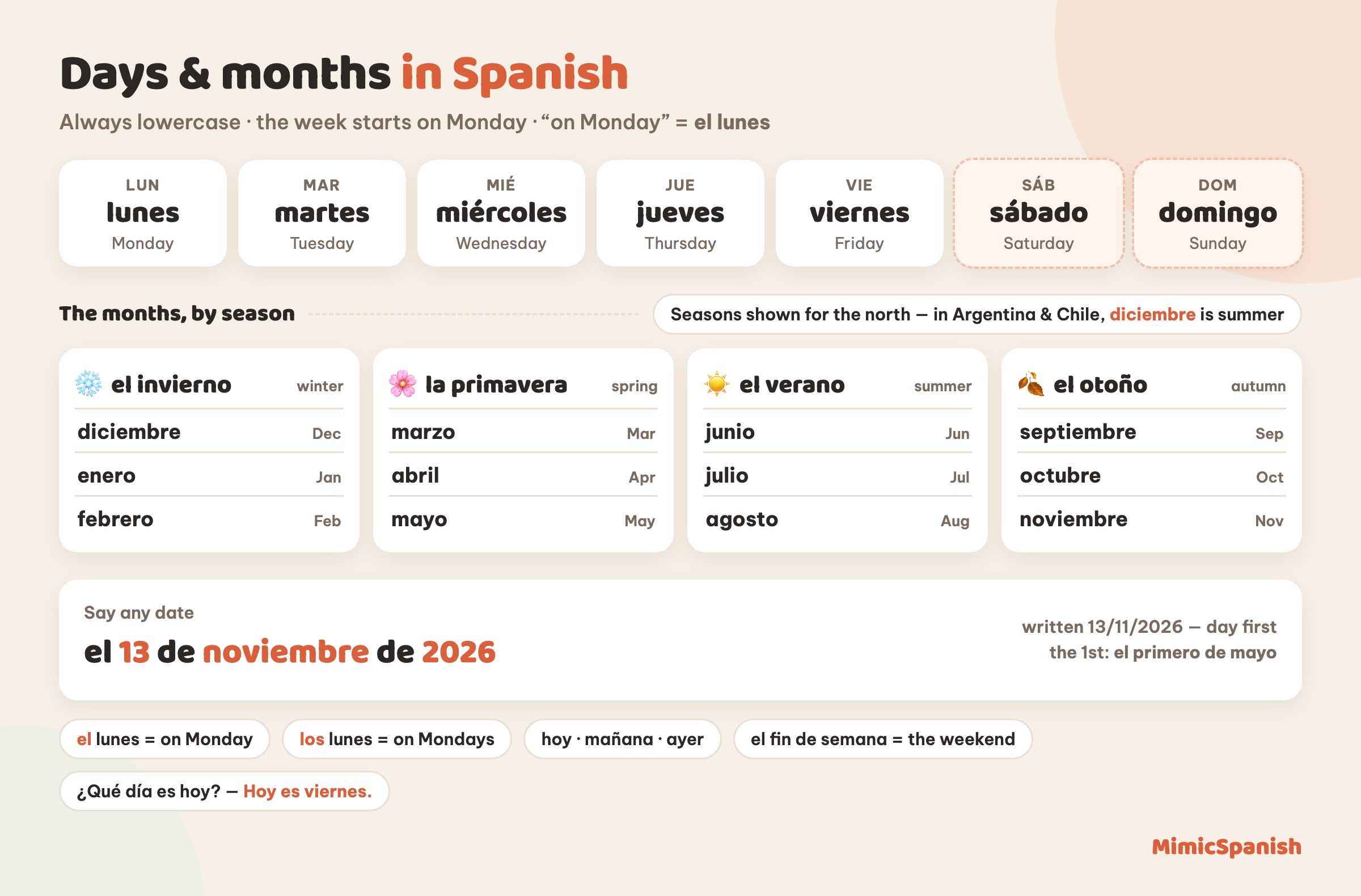
The days of the week
| English | Spanish |
|---|---|
| Monday | lunes |
| Tuesday | martes |
| Wednesday | miércoles |
| Thursday | jueves |
| Friday | viernes |
| Saturday | sábado |
| Sunday | domingo |
Three things to know:
- No capital letters. Days and months are written in lowercase in Spanish: el lunes, en enero.
- The week starts on Monday on most Spanish-language calendars.
- Lunes to viernes don't change in the plural: el lunes, los lunes. Only sábados and domingos add an -s.
"On Monday" = el lunes
Spanish does not use a word for "on" with days. Use the article instead:
- el lunes — on Monday (this coming Monday, or a specific one)
- los lunes — on Mondays (every Monday)
- Tengo clase el martes. — I have class on Tuesday.
- Voy al gimnasio los jueves. — I go to the gym on Thursdays.
Useful words: hoy (today), mañana (tomorrow), ayer (yesterday), pasado mañana (the day after tomorrow), el fin de semana (the weekend), entre semana (on weekdays).
The months
enero, febrero, marzo, abril, mayo, junio, julio, agosto, septiembre, octubre, noviembre, diciembre.
Septiembre is also written setiembre in some countries — both are correct. For "in March" use en: en marzo.
The seasons
la primavera (spring), el verano (summer), el otoño (autumn), el invierno (winter). Remember that in Argentina, Chile and the rest of the Southern Hemisphere, diciembre is summer.
How to say the date
The pattern is el + day number + de + month (+ de + year):
- el 13 de noviembre — November 13th
- el 5 de mayo de 2026 — May 5th, 2026 (dos mil veintiséis)
- The 1st: el primero de mayo in most of Latin America, el uno de mayo in Spain.
Ask the date with ¿Qué fecha es hoy? or ¿A cuántos estamos? — and the day with ¿Qué día es hoy? — Hoy es viernes.
Written dates use day/month/year: 13/11/2026. This is a classic source of mistakes for American learners, so read dates twice.
Time expressions you'll hear a lot
- la semana pasada / que viene — last week / next week
- el mes pasado / el próximo mes — last month / next month
- a principios / a mediados / a finales de mes — at the beginning / middle / end of the month
- cada dos semanas — every two weeks
- dentro de tres días — in three days
You can hear days and dates in action in our shadowing lesson Birthdays in the break room: repeat each line and get your pronunciation scored.
How to remember them
- Learn the sound, not just the spelling. Miércoles has the stress on MIÉR; sábado on SÁ. Repeat them out loud.
- Use them in your plans. Say your week in Spanish every morning: Hoy es martes. El jueves tengo una reunión.
- Type what you hear. Our dictation exercises include dates and appointments at A1 and A2.
- Review with spaced repetition in the Core A1 vocabulary set.
Frequently asked questions
Are days of the week capitalized in Spanish?
No — lunes, martes, enero, febrero are all lowercase, unless they start a sentence.
How do you say "on the weekend" in Spanish?
El fin de semana — no preposition needed: ¿Qué haces el fin de semana?
Why is Wednesday "X" on some Spanish calendars?
In Spain, calendars often use L M X J V S D, with X for miércoles to avoid confusion with martes.