
Spanish Numbers: How to Count from 0 to a Million (with Prices, Years and Phone Numbers)
Learn Spanish numbers the way you will use them — counting, prices, ages, years, phone numbers and dates — plus the few spelling rules that trip learners up.

Numbers are everywhere in real life: prices at the market, the time of your bus, your phone number, your age. The good news is that Spanish numbers follow clear patterns. Learn 0 to 20, the tens, and a handful of exceptions, and you can say any number.
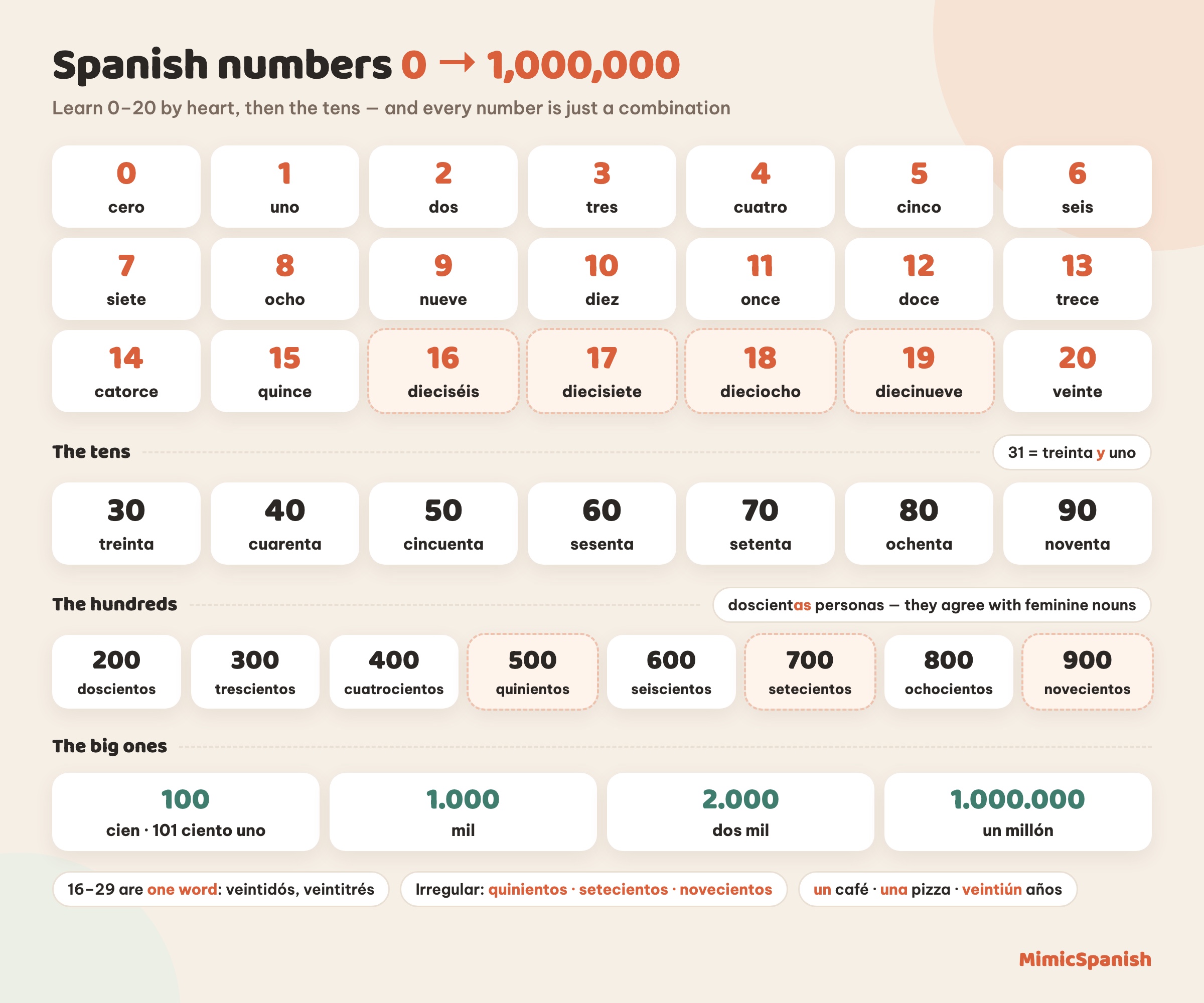
0 to 15: learn these by heart
| Number | Spanish | Number | Spanish |
|---|---|---|---|
| 0 | cero | 8 | ocho |
| 1 | uno | 9 | nueve |
| 2 | dos | 10 | diez |
| 3 | tres | 11 | once |
| 4 | cuatro | 12 | doce |
| 5 | cinco | 13 | trece |
| 6 | seis | 14 | catorce |
| 7 | siete | 15 | quince |
16 to 29: one word, with an accent sometimes
From 16, Spanish joins the pieces into a single word: diez y seis became dieciséis.
- 16 dieciséis, 17 diecisiete, 18 dieciocho, 19 diecinueve
- 20 veinte, 21 veintiuno, 22 veintidós, 23 veintitrés, 24 veinticuatro, 25 veinticinco, 26 veintiséis, 27 veintisiete, 28 veintiocho, 29 veintinueve
The accents on dieciséis, veintidós, veintitrés and veintiséis are part of the spelling — they show where the stress falls.
30 to 99: tens + "y" + units
From 30, numbers are written as three words: the ten, y (and), then the unit.
- 30 treinta, 40 cuarenta, 50 cincuenta, 60 sesenta, 70 setenta, 80 ochenta, 90 noventa
- 31 treinta y uno, 45 cuarenta y cinco, 99 noventa y nueve
Careful with 60 sesenta and 70 setenta — they sound alike when spoken fast. Stress is on SEN and TEN: se-SEN-ta, se-TEN-ta.
100 and up: cien, ciento and the hundreds
- 100 = cien on its own: cien pesos.
- 101–199 = ciento: ciento uno, ciento veinte, ciento noventa y nueve.
- Hundreds: 200 doscientos, 300 trescientos, 400 cuatrocientos, 500 quinientos, 600 seiscientos, 700 setecientos, 800 ochocientos, 900 novecientos.
The three in bold are irregular, so learn them separately. And hundreds agree with feminine nouns: doscientos libros but doscientas personas.
Thousands and millions
- 1,000 mil (never un mil), 2,000 dos mil, 10,000 diez mil, 500,000 quinientos mil
- 1,000,000 un millón, 2,000,000 dos millones
- With a noun, millions take de: un millón de personas, tres millones de dólares.
Uno, un or una?
Uno becomes un before a masculine noun and una before a feminine noun — also inside bigger numbers:
- un café, una pizza, veintiún años, treinta y una semanas
Real-life numbers
Prices. Son ciento veinte pesos. For cents: veinte con cincuenta (20.50). Mexico writes decimals with a point (20.50); many other countries use a comma (20,50).
Age. Spanish uses tener, not ser: Tengo veintiocho años. — I'm 28.
Years. Say them like a normal number: 1995 = mil novecientos noventa y cinco, 2026 = dos mil veintiséis.
Phone numbers. Most people read them in pairs or single digits: 55 21 43 87 09 → cincuenta y cinco, veintiuno, cuarenta y tres, ochenta y siete, cero nueve.
Time. Son las tres y media (3:30), a las ocho (at 8). See our lesson Booking a haircut to hear times and days in a real conversation.
Ordinal numbers (first, second…)
primero, segundo, tercero, cuarto, quinto, sexto, séptimo, octavo, noveno, décimo. Primero and tercero drop the -o before a masculine noun: el primer día, el tercer piso. After ten, people normally use cardinal numbers: el piso doce.
How to make numbers automatic
Reading a number chart is not the same as understanding numbers at speed — that is what fails at the market. Try this:
- Dictation: listen to a sentence with prices or times and type what you hear. Our dictation lessons start at A1 with numbers and dates.
- Shadowing: repeat dialogues that contain numbers, at normal speed, until you no longer translate in your head. Start with the Numbers & dates topic.
- Count everyday things out loud: steps, prices in the supermarket, the time on your phone.
Frequently asked questions
Is it "cien" or "ciento"?
Cien for exactly 100 (and before mil and millones: cien mil). Ciento for 101–199.
Why is 21 "veintiún" sometimes?
Before a masculine noun, uno shortens to un, so veintiuno becomes veintiún: veintiún años.
How do you say "zero" in Spanish?
Cero. In phone numbers and scores it is also cero.