How to say “what time is it” in Spanish
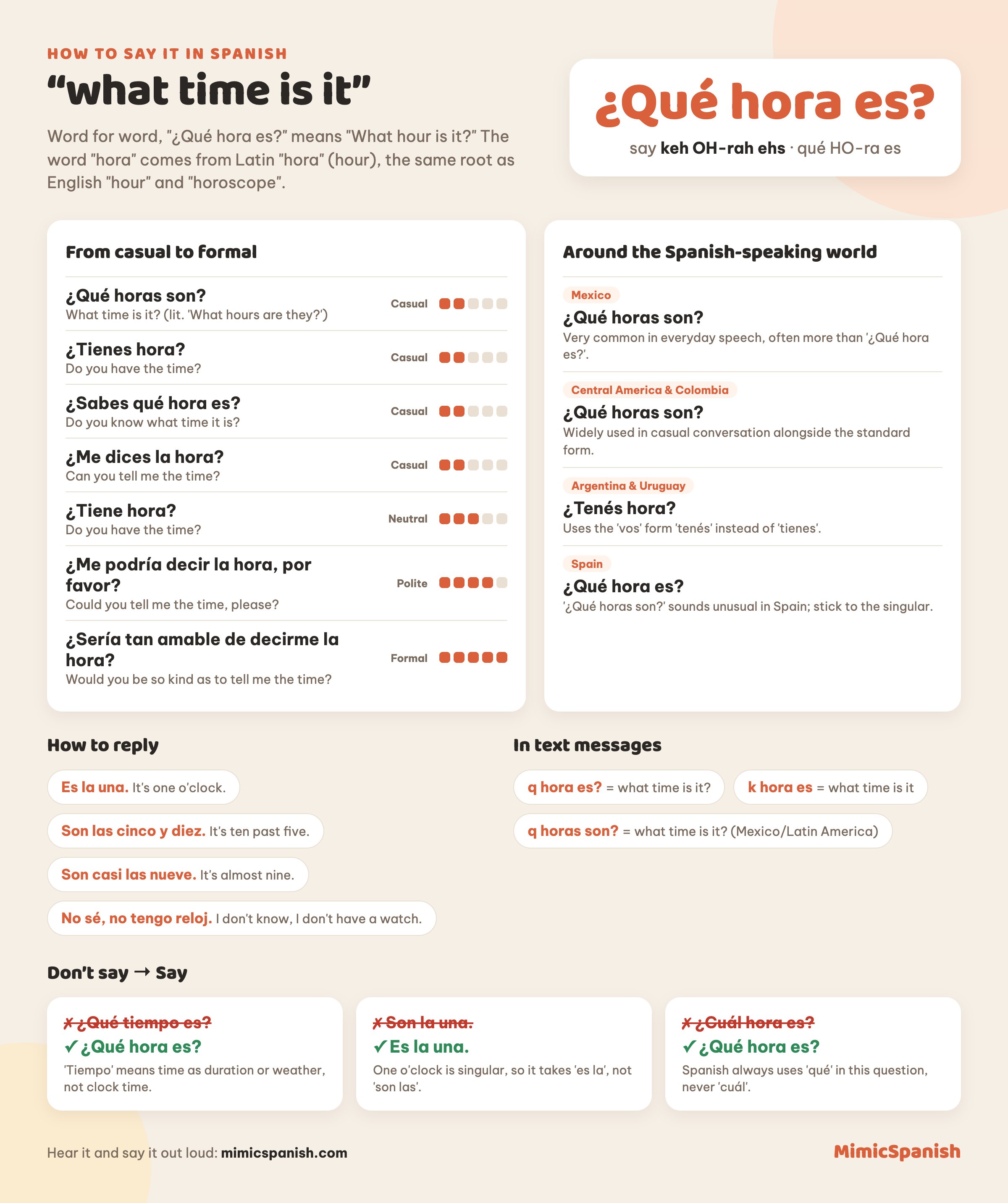
"What time is it?" in Spanish is "¿Qué hora es?" (keh OH-rah ehs). It works everywhere in the Spanish-speaking world, with friends or strangers. In Mexico and much of Latin America you'll also hear "¿Qué horas son?", and to politely ask a stranger people often say "¿Tiene hora?"
How to pronounce “¿Qué hora es?”
- The 'h' in 'hora' is completely silent, so say 'OH-rah', not 'HOH-rah'.
- The single 'r' in 'hora' is a quick tap of the tongue, like the 'dd' in American 'ladder'.
- 'Qué' sounds like 'keh', with no 'w' sound even though it's spelled with 'qu'.
What it literally means
Word for word, "¿Qué hora es?" means "What hour is it?" The word "hora" comes from Latin "hora" (hour), the same root as English "hour" and "horoscope".
Other ways to say it, from casual to formal
- ¿Qué horas son?What time is it? (lit. 'What hours are they?') · everyday speech in Mexico, Central America, Colombia and moreCasual
- ¿Tienes hora?Do you have the time? · asking a friend or someone your ageCasual
- ¿Sabes qué hora es?Do you know what time it is? · casual, or when someone is running lateCasual
- ¿Me dices la hora?Can you tell me the time? · friendly request to someone you knowCasual
- ¿Tiene hora?Do you have the time? · politely asking a stranger on the streetNeutral
- ¿Me podría decir la hora, por favor?Could you tell me the time, please? · very polite, with strangers or older peoplePolite
- ¿Sería tan amable de decirme la hora?Would you be so kind as to tell me the time? · extra formal or polite situationsFormal
By country
- ¿Qué horas son?Mexico · Very common in everyday speech, often more than '¿Qué hora es?'.
- ¿Qué horas son?Central America & Colombia · Widely used in casual conversation alongside the standard form.
- ¿Tenés hora?Argentina & Uruguay · Uses the 'vos' form 'tenés' instead of 'tienes'.
- ¿Qué hora es?Spain · '¿Qué horas son?' sounds unusual in Spain; stick to the singular.
In text messages
Example sentences
- Perdón, ¿qué hora es?Excuse me, what time is it?
- ¿Qué hora es? Tengo clase a las diez.What time is it? I have class at ten.
- Disculpe, ¿tiene hora?Excuse me, do you have the time?
- Son las tres y media.It's three thirty.
- No sé qué hora es; mi celular no tiene batería.I don't know what time it is; my phone is dead.
- ¿Sabes qué hora es? Ya vamos tarde para la película.Do you know what time it is? We're already late for the movie.
Mini dialogue: At the bus stop
How to reply
- Es la una.It's one o'clock.
- Son las cinco y diez.It's ten past five.
- Son casi las nueve.It's almost nine.
- No sé, no tengo reloj.I don't know, I don't have a watch.
Grammar: Es la una vs. Son las…
To tell the time, use 'es la' only for one o'clock, because 'una' is singular. For every other hour, use 'son las' because the number is plural. Add 'y' for minutes past the hour and 'menos' for minutes before it.
- Es la una y cuarto.It's a quarter past one.
- Son las siete menos diez.It's ten to seven.
Common mistakes
Culture tip
Asking a stranger for the time is completely normal, and starting with "Disculpe" or "Perdón" makes it polite. Many people tap their wrist while asking, even if nobody wears a watch anymore. In many Latin American countries social timing is relaxed, so "a las ocho" for a party often means people arrive later. Business meetings and appointments are usually expected to start on time.