How to say “wait” in Spanish
The most common way to say "wait" in Spanish is "¡Espera!" (es-PEH-rah), the informal command you use with friends and family. With strangers or in polite situations, say "Espere" (usted), and to a group, say "Esperen". To politely ask someone to wait, "Un momento" (one moment) works almost everywhere.
How to pronounce “Espera”
- The single r in 'espera' is a quick tap of the tongue, like the 'dd' in American 'ladder', not an English r.
- Keep the 'e' sounds short and pure, like the 'e' in 'pet', without sliding into 'ay'.
- Say the 'p' without the puff of air English speakers usually add, more like the 'p' in 'spin' than in 'pin'.
What it literally means
"Espera" comes from the verb "esperar", from Latin "sperare", meaning "to hope". That is why "esperar" still means "to wait", "to hope" and "to expect" in Spanish, and context tells you which one.
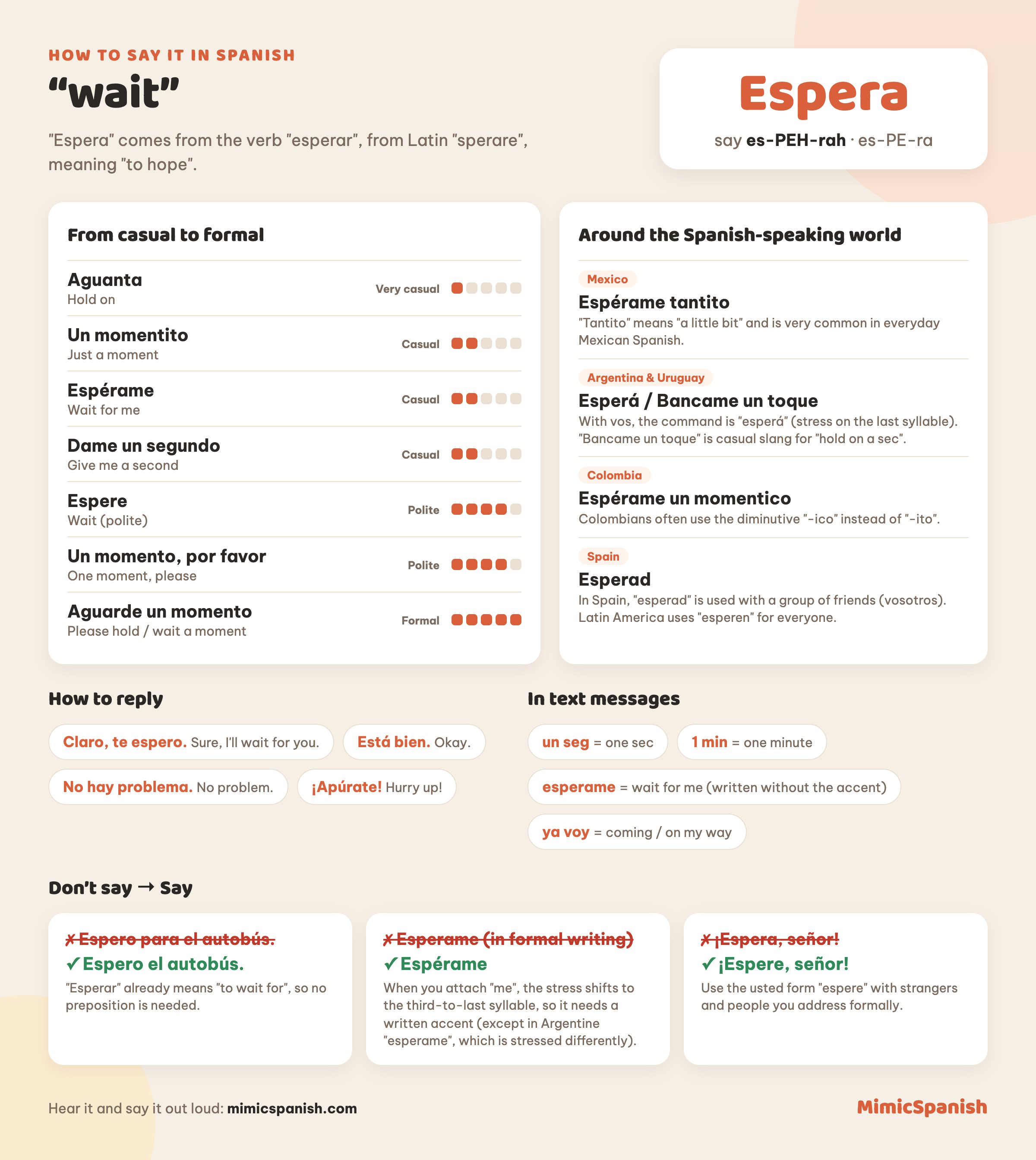
Other ways to say it, from casual to formal
- AguantaHold on · very casual, among friendsVery casual
- Un momentitoJust a moment · friendly, softer request to waitCasual
- EspérameWait for me · when someone is leaving without youCasual
- Dame un segundoGive me a second · casual, when you need a momentCasual
- EsperenWait (to a group) · talking to two or more peopleNeutral
- EspereWait (polite) · with strangers, older people, customersPolite
- Un momento, por favorOne moment, please · shops, phone calls, officesPolite
- Aguarde un momentoPlease hold / wait a moment · formal settings, customer service, ArgentinaFormal
By country
- Espérame tantitoMexico · "Tantito" means "a little bit" and is very common in everyday Mexican Spanish.
- Esperá / Bancame un toqueArgentina & Uruguay · With vos, the command is "esperá" (stress on the last syllable). "Bancame un toque" is casual slang for "hold on a sec".
- Espérame un momenticoColombia · Colombians often use the diminutive "-ico" instead of "-ito".
- EsperadSpain · In Spain, "esperad" is used with a group of friends (vosotros). Latin America uses "esperen" for everyone.
In text messages
Example sentences
- ¡Espera! Se te olvidaron las llaves.Wait! You forgot your keys.
- Espere aquí, por favor.Please wait here.
- Estoy esperando el autobús.I'm waiting for the bus.
- Espérame en la puerta, ya bajo.Wait for me at the door, I'm coming down.
- Un momento, por favor. Ahora lo atiendo.One moment, please. I'll be right with you.
- No me gusta esperar mucho en el médico.I don't like waiting a long time at the doctor's.
Mini dialogue: Leaving the house
How to reply
- Claro, te espero.Sure, I'll wait for you.
- Está bien.Okay.
- No hay problema.No problem.
- ¡Apúrate!Hurry up!
Grammar: Command forms of "esperar" (and adding "me")
To tell someone to wait, use the command form: "espera" (tú), "espere" (usted) or "esperen" (ustedes). To say "wait for me", attach "me" to the end of the command, and add a written accent to keep the original stress: "espérame", "espéreme", "espérenme". Also note that "esperar" already includes "for", so you don't need "por" or "para" before the person or thing.
- Espéreme un momento, señora.Wait for me a moment, ma'am.
- Esperamos el tren.We're waiting for the train.
Common mistakes
Culture tip
Spanish speakers often soften "espera" with diminutives like "un momentito" or "tantito" to sound friendly rather than bossy. A common gesture is raising the index finger, or holding the thumb and index finger close together to mean "just a little moment". In Mexico, "ahorita" (literally "right now") can actually mean "in a while", so don't be surprised if you end up waiting longer than expected.