How to say “hello” in Spanish
The most common way to say "hello" in Spanish is "hola" (pronounced OH-lah, with a silent h). It works in almost any situation, with friends, coworkers or strangers. In more polite or formal settings, people often pair it with a time-of-day greeting, such as "Hola, buenos días."
How to pronounce “Hola”
- The h in Spanish is always silent, so 'hola' starts with the vowel sound 'oh'.
- Keep the 'o' short and pure. Don't let it glide into a 'w' sound the way English 'oh' often does.
- The 'l' is light and clear, with the tongue tip touching just behind your top teeth, not the heavy 'l' of English 'ball'.
What it literally means
"Hola" is just an interjection, a greeting word with no other literal meaning, much like English "hello." Its exact origin is uncertain; it most likely began as a call to get someone's attention, similar to old English "hallo" or "hollo."
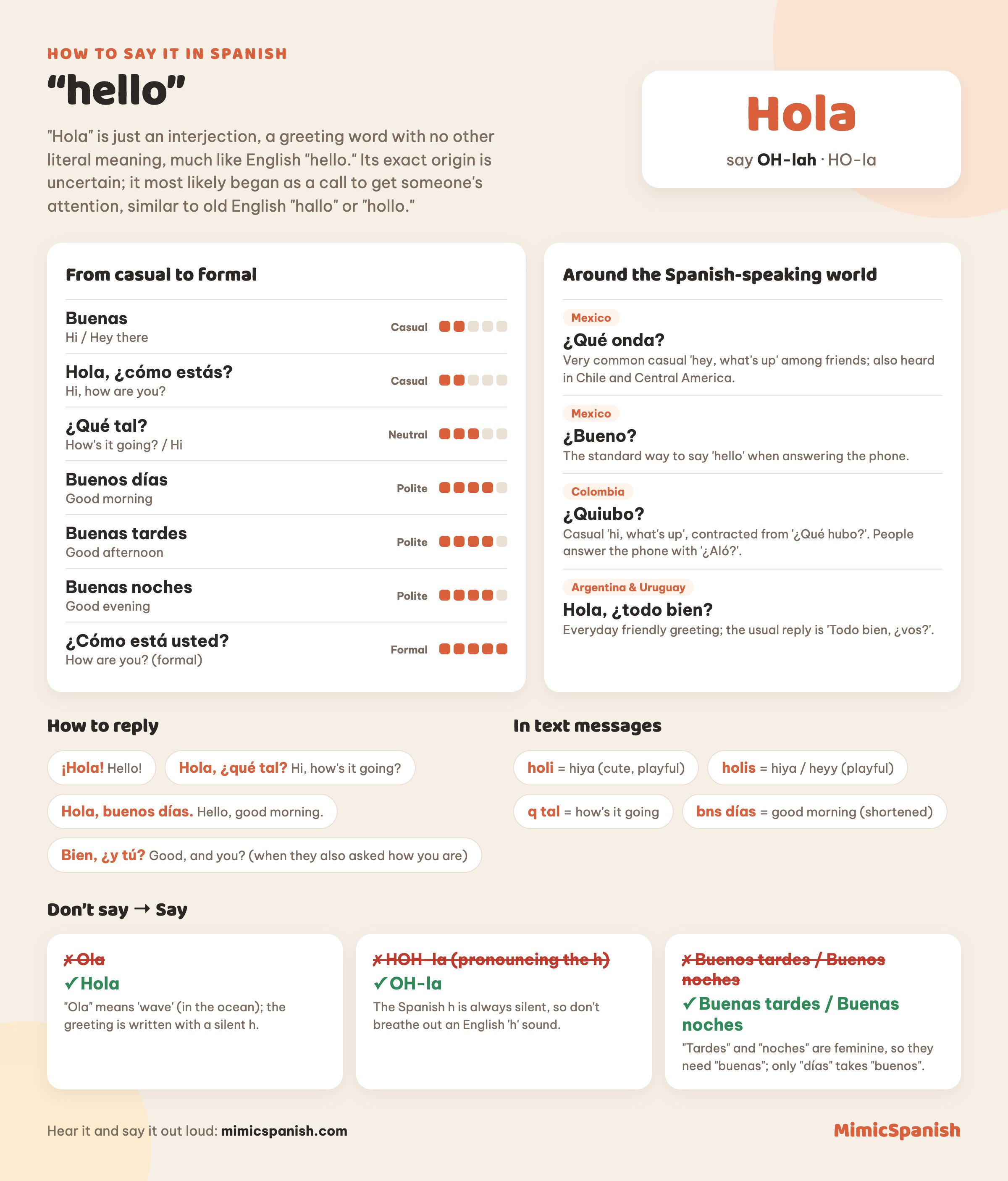
Other ways to say it, from casual to formal
- BuenasHi / Hey there · Casual greeting any time of day, e.g. entering a shopCasual
- Hola, ¿cómo estás?Hi, how are you? · Greeting friends, family or peersCasual
- ¿Qué tal?How's it going? / Hi · Friendly hello with acquaintances or coworkersNeutral
- Buenos díasGood morning · From morning until about noonPolite
- Buenas tardesGood afternoon · From noon until it gets darkPolite
- Buenas nochesGood evening · Greeting someone after dark (it also means good night)Polite
- ¿Cómo está usted?How are you? (formal) · Greeting older people, clients or officialsFormal
By country
- ¿Qué onda?Mexico · Very common casual 'hey, what's up' among friends; also heard in Chile and Central America.
- ¿Bueno?Mexico · The standard way to say 'hello' when answering the phone.
- ¿Quiubo?Colombia · Casual 'hi, what's up', contracted from '¿Qué hubo?'. People answer the phone with '¿Aló?'.
- Hola, ¿todo bien?Argentina & Uruguay · Everyday friendly greeting; the usual reply is 'Todo bien, ¿vos?'.
- ¿Diga? / ¿Dígame?Spain · Common way to answer the phone; in person, 'Hola, buenas' is very typical.
In text messages
Example sentences
- ¡Hola! ¿Cómo estás?Hello! How are you?
- Hola, me llamo Ana. ¿Y tú?Hi, my name is Ana. And you?
- Hola, buenos días. Una mesa para dos, por favor.Hello, good morning. A table for two, please.
- Hola a todos, gracias por venir.Hello everyone, thanks for coming.
- Saluda a tu mamá de mi parte.Say hello to your mom for me.
- Entré a la tienda y nadie me dijo hola.I walked into the store and nobody said hello to me.
Mini dialogue: Running into a neighbor
How to reply
- ¡Hola!Hello!
- Hola, ¿qué tal?Hi, how's it going?
- Hola, buenos días.Hello, good morning.
- Bien, ¿y tú?Good, and you? (when they also asked how you are)
Grammar: Following "hola" with tú or usted
"Hola" never changes, but the question you usually add after it does. Use the tú form with friends, family, kids and people your age, and the usted form with older people, strangers in formal settings, clients and officials. If you're unsure, start with usted and let the other person invite you to use tú.
- Hola, Carlos, ¿cómo estás?Hi, Carlos, how are you? (informal)
- Hola, señora López, ¿cómo está usted?Hello, Mrs. López, how are you? (formal)
Common mistakes
Culture tip
In Latin America, people greet everyone when they walk into a small shop, a waiting room, an elevator or a taxi, and a plain "hola" to a stranger can sound a bit abrupt, so many add "buenos días" or "buenas tardes." Among friends and acquaintances, "hola" usually comes with a single light cheek kiss (women, and men greeting women) or a handshake or hug between men; in Spain it's two kisses. Spanish speakers greet more often and more warmly than many English speakers, so saying hello is a key part of being polite.