
Spanish for Beginners: What to Learn First (and What to Ignore)
A beginner's roadmap for Spanish — the sounds, the first 100 words, the five verbs you need, the grammar that matters at A1, and the mistakes that waste months.
Most beginners don't fail because Spanish is hard. They fail because they start with the wrong things: long vocabulary lists, every tense at once, grammar tables they never use in conversation. This guide shows what to learn first, in a sensible order, so you can hold a simple conversation within a few weeks.
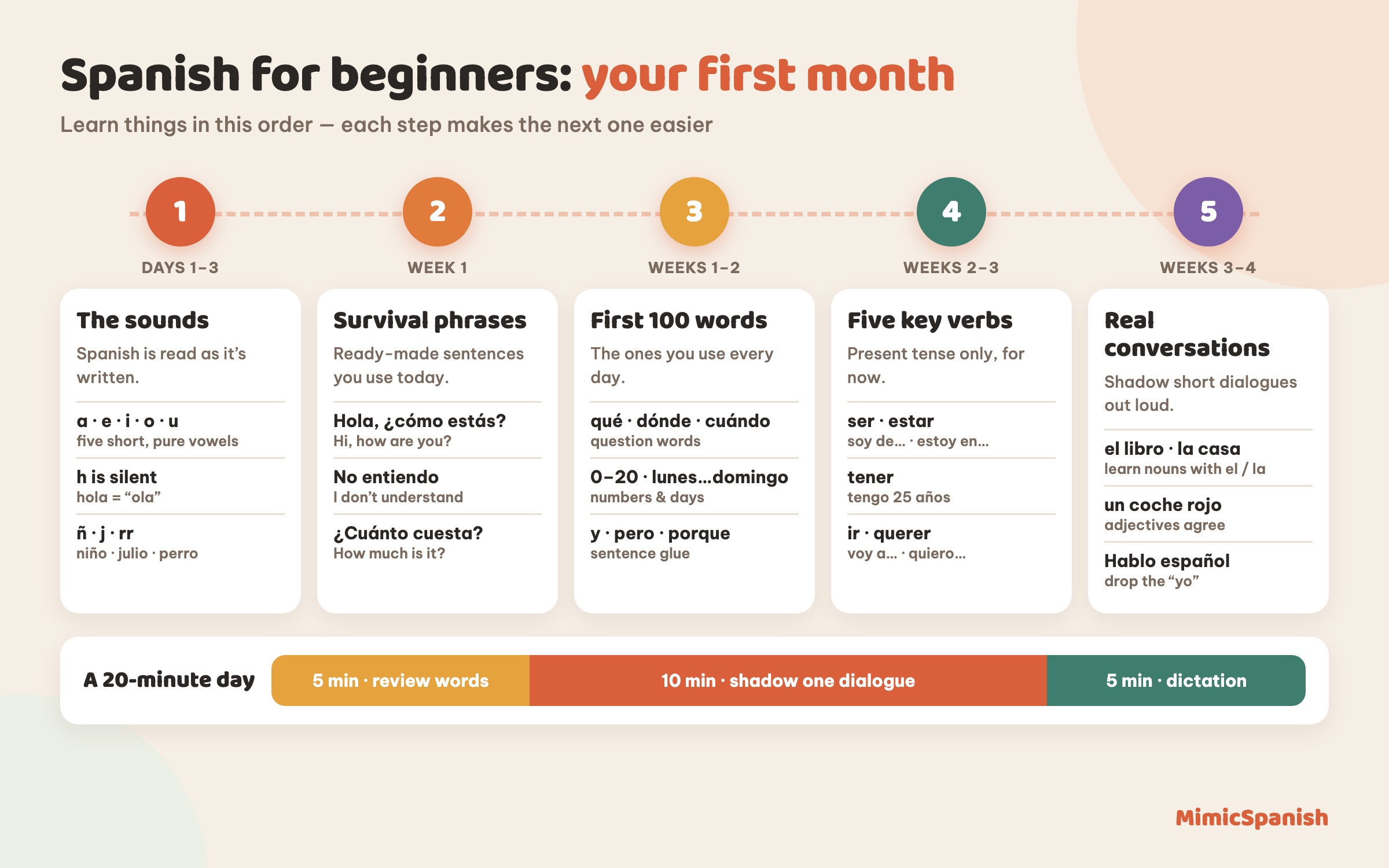
Step 1: the sounds (days 1–3)
Spanish spelling is very regular, so learning the sounds pays off immediately. Focus on:
- The five pure vowels — a, e, i, o, u — short and clean.
- The letters that differ from English: silent h, raspy j, ñ, the tapped r and rolled rr.
- Stress: teléfono, café, hablar.
Our Spanish alphabet guide covers every letter, with names and sounds.
Step 2: survival phrases (week 1)
Before grammar, learn ready-made sentences you can use today: Hola, ¿cómo estás? · Me llamo… · Mucho gusto · Por favor / gracias · ¿Cuánto cuesta? · No entiendo · ¿Puede repetir, por favor? · ¿Dónde está…?
You'll find 60 of them in our common Spanish phrases list. Learn them as sounds: listen, repeat, say them out loud.
Step 3: the first 100 words (weeks 1–2)
Don't learn words at random. The first 100 should be the ones you use every day:
- People: yo, tú, usted, él, ella, nosotros, amigo, familia
- Question words: qué, quién, dónde, cuándo, cómo, cuánto, por qué
- Numbers 0–20 (see Spanish numbers) and days of the week (see days and months)
- Everyday nouns: casa, trabajo, agua, comida, café, día, hora, ciudad
- Small words that glue sentences together: y, pero, porque, con, sin, para, también, muy
Our Core A1 vocabulary set gives you the most frequent beginner words with audio and spaced review.
Step 4: five verbs that carry most conversations (weeks 2–3)
You don't need 50 verbs to start. These five, in the present tense, cover a huge share of beginner conversation:
- ser — to be (identity, origin): Soy de Canadá.
- estar — to be (location, state): Estoy en casa. Estoy cansado.
- tener — to have (and age): Tengo dos hermanos. Tengo 25 años.
- ir — to go (and the future): Voy al mercado. Voy a comer.
- querer — to want: Quiero un café.
Ser vs estar confuses everyone at first; our grammar page Ser vs estar explains it simply. Every verb's full table is in Spanish conjugation.
Step 5: a little grammar, then conversation (weeks 3–4)
At A1, three grammar ideas matter most:
- Nouns have gender: el libro, la casa. Learn each noun with its article.
- Adjectives agree: un coche rojo, una casa roja.
- Subject pronouns are usually dropped: Hablo español (not Yo hablo every time).
Then start talking — even alone. Shadowing short dialogues lets you practise real conversations before you have a partner. The Greetings and Food & drink topics are good first stops.
What to ignore at the beginning
- The subjunctive, the future tense and the conditional. Useful later; ir a + infinitive covers the future for now.
- Long word lists without audio. If you can't say a word, you can't use it.
- Perfect grammar before speaking. Native speakers understand Yo querer café — and you'll correct it with practice.
- Choosing between Spain and Latin American Spanish forever. Both understand each other perfectly; pick the one you'll use and move on.
A simple daily routine (20 minutes)
- 5 min — review words with spaced repetition
- 10 min — shadow one short dialogue, line by line, until you can say it at normal speed
- 5 min — dictation: listen and type one or two sentences
For a full week-by-week schedule, see How to learn Spanish fast: a 30-day shadowing plan.
Frequently asked questions
How long does it take a beginner to hold a basic conversation?
With 20–30 minutes of daily practice focused on speaking and listening, most learners can handle simple everyday conversations (A1–A2) in two to three months.
Should beginners learn grammar first?
Learn just enough grammar to understand the sentences you use. Phrases and listening first; grammar explains them afterwards.
Is Spanish easy for English speakers?
It's one of the easiest major languages for English speakers: thousands of shared words (hotel, problema, importante), regular spelling and a familiar alphabet.