How to say “friend” in Spanish
The most common way to say "friend" in Spanish is amigo for a male friend and amiga for a female friend. The plural is amigos (all men or a mixed group) and amigas (all women). It works in every Spanish-speaking country and in any situation.
How to pronounce “Amigo”
- The 'g' between vowels is soft, so let air flow through without fully closing your throat, like a gentle 'g' that almost disappears.
- Keep the final 'o' short and pure, without gliding into an 'oo' sound like the English 'go'.
- Every 'a' is an open 'ah' sound, as in 'father', never the 'a' of 'cat'.
What it literally means
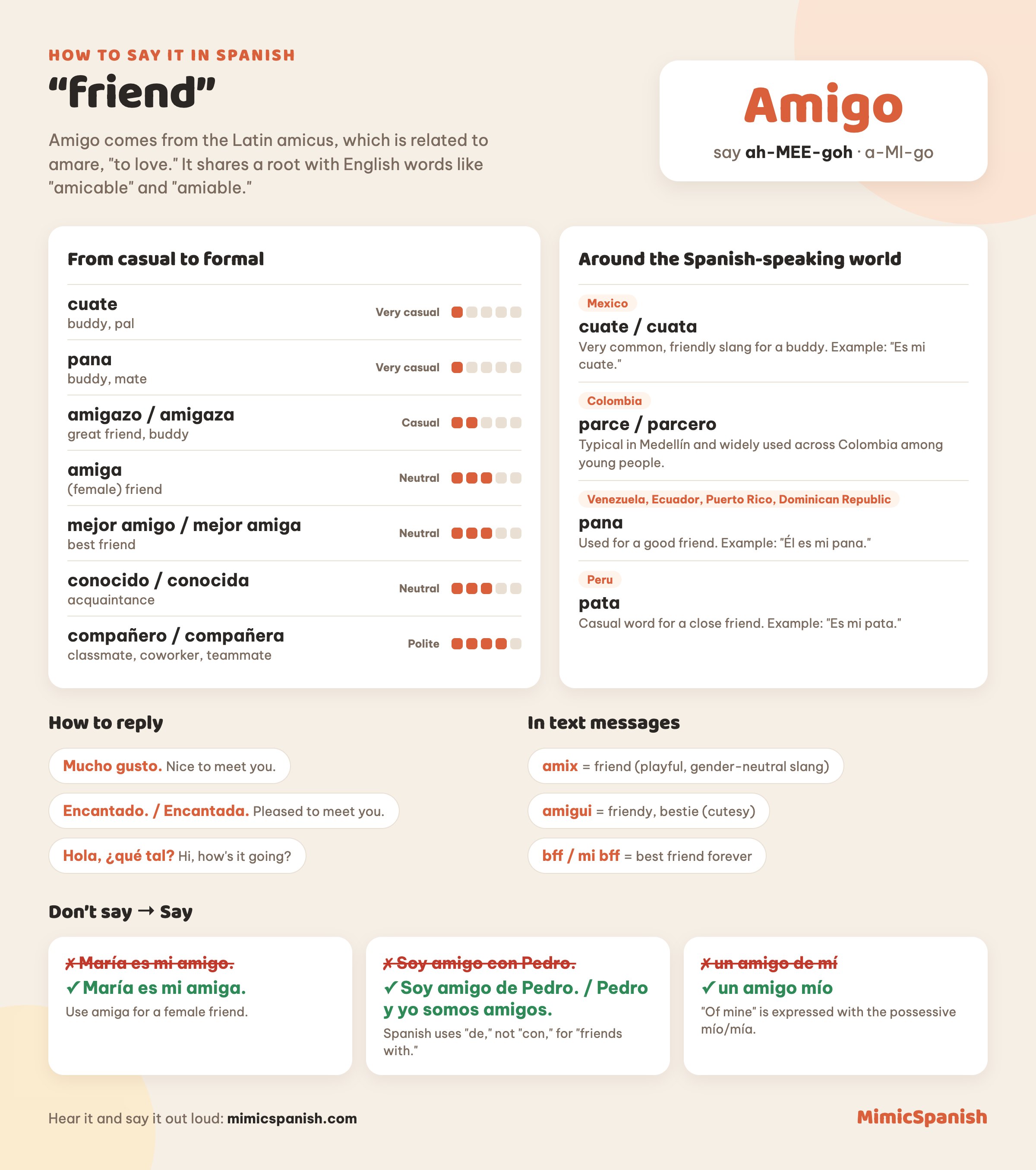
Amigo comes from the Latin amicus, which is related to amare, "to love." It shares a root with English words like "amicable" and "amiable."
Other ways to say it, from casual to formal
- cuatebuddy, pal · casual chat in MexicoVery casual
- panabuddy, mate · casual chat in Venezuela, Ecuador, Colombia, Puerto RicoVery casual
- amigazo / amigazagreat friend, buddy · affectionate praise for a good friendCasual
- amiga(female) friend · talking about a woman or girlNeutral
- mejor amigo / mejor amigabest friend · your closest friendNeutral
- conocido / conocidaacquaintance · someone you know but aren't close toNeutral
- compañero / compañeraclassmate, coworker, teammate · people you study or work withPolite
By country
- cuate / cuataMexico · Very common, friendly slang for a buddy. Example: "Es mi cuate."
- parce / parceroColombia · Typical in Medellín and widely used across Colombia among young people.
- panaVenezuela, Ecuador, Puerto Rico, Dominican Republic · Used for a good friend. Example: "Él es mi pana."
- pataPeru · Casual word for a close friend. Example: "Es mi pata."
- colegaSpain · Casual word for a mate or pal. "Tío / tía" is also used to address friends, like "dude."
In text messages
Example sentences
- Él es mi amigo Carlos.This is my friend Carlos.
- Ana es mi mejor amiga.Ana is my best friend.
- Voy al cine con mis amigos.I'm going to the movies with my friends.
- ¿Tienes muchos amigos en la ciudad?Do you have a lot of friends in the city?
- Un amigo mío trabaja en ese restaurante.A friend of mine works at that restaurant.
- Nos hicimos amigos en la universidad.We became friends at university.
Mini dialogue: Introducing a friend at a party
How to reply
- Mucho gusto.Nice to meet you.
- Encantado. / Encantada.Pleased to meet you.
- Hola, ¿qué tal?Hi, how's it going?
Grammar: Gender and number: amigo, amiga, amigos, amigas
Amigo changes its ending to match the person: amigo (male), amiga (female), amigos (several males or a mixed group), amigas (only females). Words like mi, un, and adjectives must agree too, so you say mis amigos and una amiga simpática. To say "a friend of mine," use un amigo mío or una amiga mía.
- Mis amigas son muy divertidas.My (female) friends are very fun.
- Es una amiga mía de Chile.She's a friend of mine from Chile.
Common mistakes
Culture tip
Latin Americans often say amigo or amiga to address strangers politely, for example "Disculpe, amigo, ¿dónde está la estación?" Friend groups are close and greetings usually include a hug or a kiss on the cheek. In Argentina and Uruguay, people celebrate Día del Amigo (Friendship Day) on July 20 with messages and get-togethers.