How to say “good luck” in Spanish
"Good luck" in Spanish is "¡Buena suerte!" (BWEH-nah SWEHR-teh). In everyday conversation, people often shorten it to just "¡Suerte!" or make it warmer with "¡Mucha suerte!" All three work in every Spanish-speaking country.
How to pronounce “¡Buena suerte!”
- The 'ue' in both words is a quick glide like the 'we' in 'wet', so say 'BWEH' and 'SWEHR', not 'boo-EH' or 'soo-EHR'.
- The 'r' in 'suerte' is a single quick tap of the tongue, like the 'tt' in American 'butter', and never the English 'r'.
- End both words with a short, clean vowel ('-nah', '-teh') and don't let it glide into 'nay' or 'tay'.
What it literally means
"Buena" means "good" and "suerte" means "luck" or "fate." "Suerte" comes from the Latin "sors, sortis" (a lot drawn to decide something), the same root as the English word "sort."
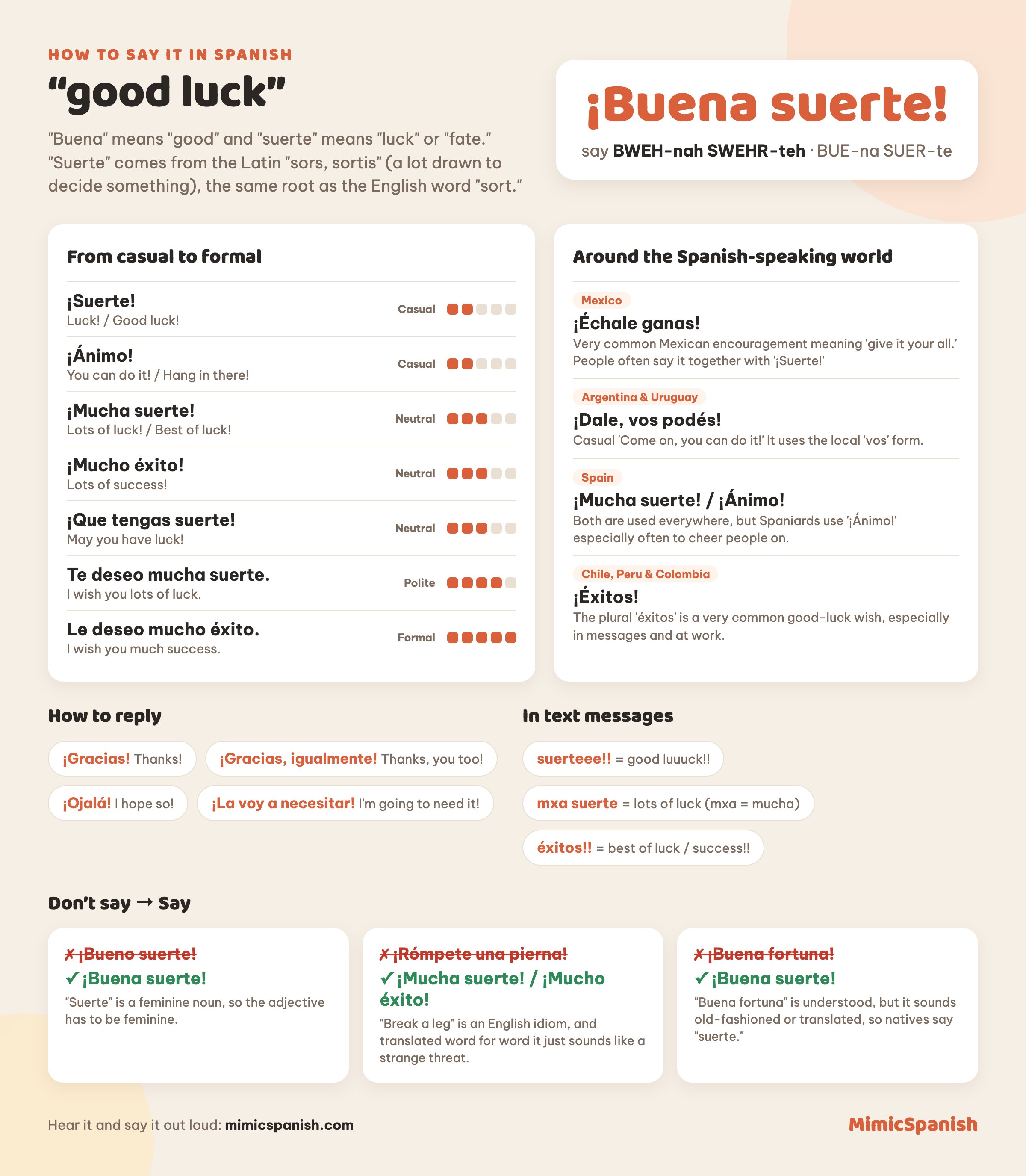
Other ways to say it, from casual to formal
- ¡Suerte!Luck! / Good luck! · quick, everyday wish to anyoneCasual
- ¡Ánimo!You can do it! / Hang in there! · encouraging someone who is nervousCasual
- ¡Mucha suerte!Lots of luck! / Best of luck! · warmer wish before an exam, trip or interviewNeutral
- ¡Mucho éxito!Lots of success! · new job, business, project or performanceNeutral
- ¡Que te vaya bien!Hope it goes well for you! · saying goodbye before someone's eventNeutral
- ¡Que tengas suerte!May you have luck! · friendly wish, slightly more expressiveNeutral
- Te deseo mucha suerte.I wish you lots of luck. · sincere wish, in a card or messagePolite
- Le deseo mucho éxito.I wish you much success. · formal or professional situations (usted)Formal
By country
- ¡Échale ganas!Mexico · Very common Mexican encouragement meaning 'give it your all.' People often say it together with '¡Suerte!'
- ¡Dale, vos podés!Argentina & Uruguay · Casual 'Come on, you can do it!' It uses the local 'vos' form.
- ¡Mucha suerte! / ¡Ánimo!Spain · Both are used everywhere, but Spaniards use '¡Ánimo!' especially often to cheer people on.
- ¡Éxitos!Chile, Peru & Colombia · The plural 'éxitos' is a very common good-luck wish, especially in messages and at work.
In text messages
Example sentences
- ¡Buena suerte en tu examen!Good luck on your exam!
- Mañana tienes la entrevista, ¿no? ¡Mucha suerte!You have the interview tomorrow, right? Best of luck!
- ¡Suerte con el partido!Good luck with the game!
- Te deseo mucha suerte en tu nuevo trabajo.I wish you lots of luck in your new job.
- ¡Que te vaya bien en el viaje!Hope your trip goes well!
- Le deseamos mucho éxito en este nuevo proyecto.We wish you much success in this new project.
Mini dialogue: Before a job interview
How to reply
- ¡Gracias!Thanks!
- ¡Gracias, igualmente!Thanks, you too!
- ¡Ojalá!I hope so!
- ¡La voy a necesitar!I'm going to need it!
Grammar: Wishing someone well with "que" + subjunctive
"Buena suerte" never changes, but many good-luck wishes use "que" followed by a verb in the subjunctive, like "¡Que te vaya bien!" or "¡Que tengas suerte!". Think of it as a short form of "I hope that...". Also remember that "suerte" is feminine, so the adjectives are feminine too: "buena suerte" and "mucha suerte."
- ¡Que tengas mucha suerte mañana!I hope you have lots of luck tomorrow!
- ¡Que les vaya bien en la competencia!Hope it goes well for you all in the competition!
Common mistakes
Culture tip
Spanish speakers say "¡Suerte!" constantly: before exams, games, interviews, trips, or even when a friend goes to a hard appointment. It's often paired with a gesture or phrase such as crossing your fingers ("cruzar los dedos") or knocking on wood ("tocar madera"). In work emails and formal cards, "Mucho éxito" or "Le deseo mucho éxito" sounds more polished than "buena suerte."