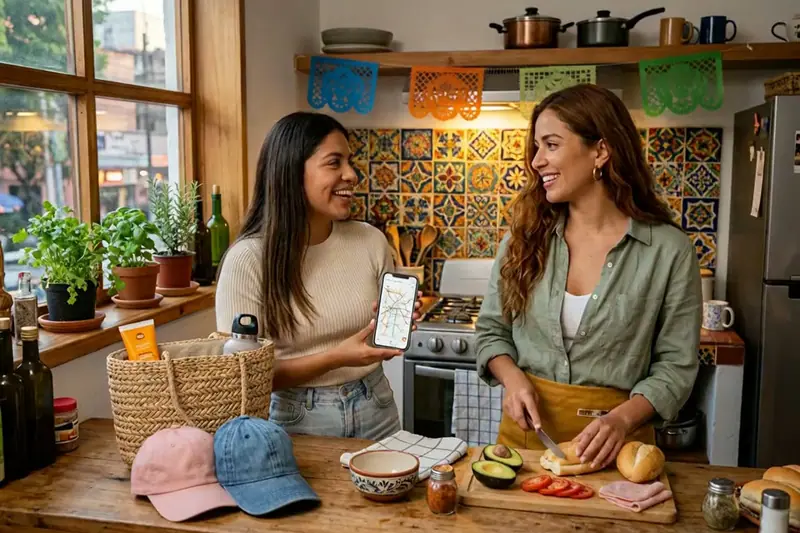
How to say “of course” in Spanish
The most common way to say "of course" in Spanish is "claro" (KLAH-roh), often stretched to "¡claro que sí!" for extra enthusiasm. For a slightly more formal or emphatic "of course", use "por supuesto". Both are understood and used everywhere in the Spanish-speaking world.
How to pronounce “Claro”
- The single 'r' in 'claro' is a quick tap of the tongue, like the 'dd' in American 'ladder', not an English 'r'.
- Say 'cla' with an open 'ah', and end with a short, pure 'o' without gliding into 'oh-w'.
- In 'por supuesto', blend 'ue' into one quick syllable: soo-PWEHS-toh.
What it literally means
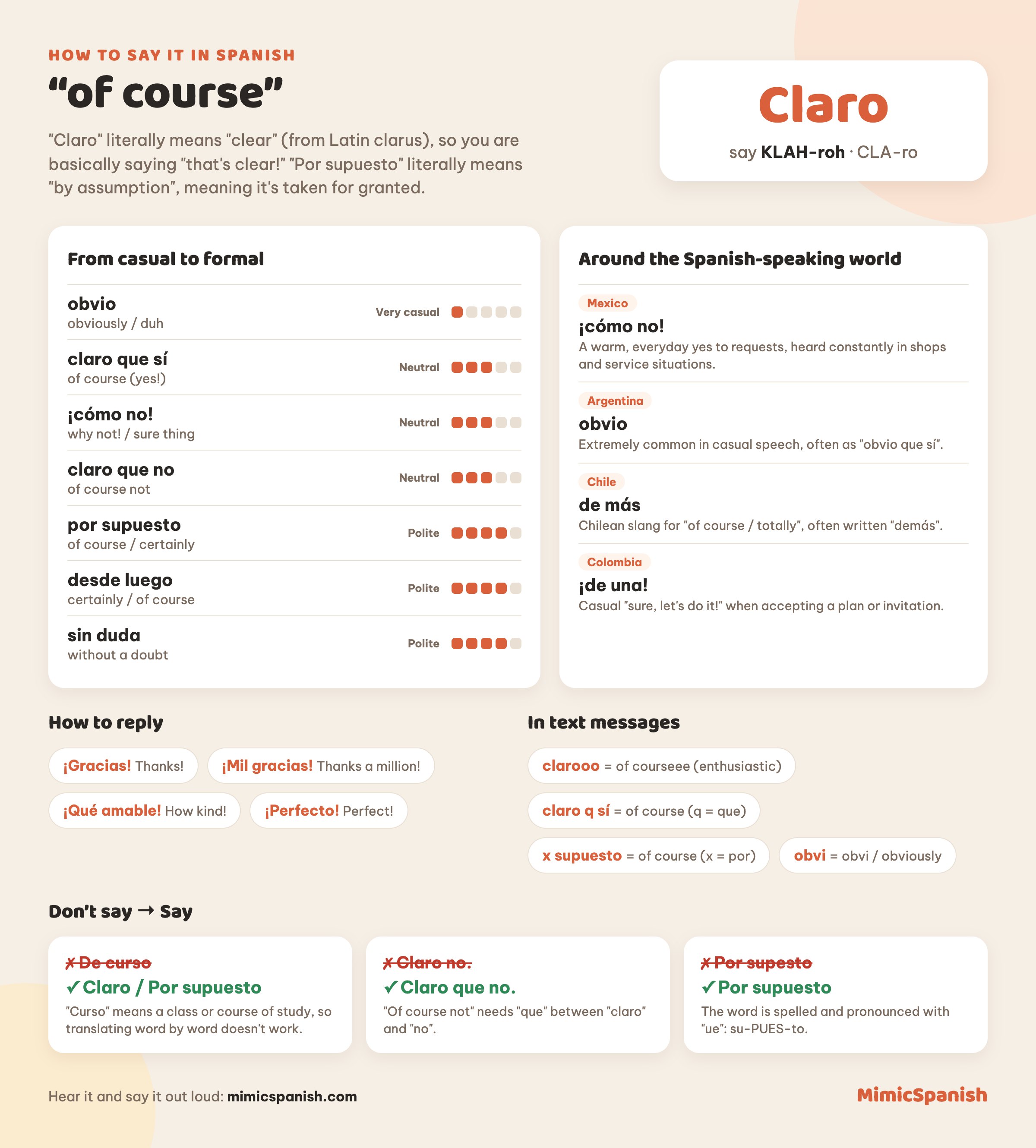
"Claro" literally means "clear" (from Latin clarus), so you are basically saying "that's clear!" "Por supuesto" literally means "by assumption", meaning it's taken for granted.
Other ways to say it, from casual to formal
- obvioobviously / duh · casual chat with friends, especially among young peopleVery casual
- claro que síof course (yes!) · enthusiastic agreement or saying yes to a requestNeutral
- ¡cómo no!why not! / sure thing · friendly yes to a favor (very common in Latin America)Neutral
- claro que noof course not · a firm no or reassuring denialNeutral
- por supuestoof course / certainly · polite or emphatic yes, at work or with strangersPolite
- desde luegocertainly / of course · firm agreement; more common in SpainPolite
- sin dudawithout a doubt · strongly agreeing with an opinionPolite
By country
- ¡cómo no!Mexico · A warm, everyday yes to requests, heard constantly in shops and service situations.
- obvioArgentina · Extremely common in casual speech, often as "obvio que sí".
- de másChile · Chilean slang for "of course / totally", often written "demás".
- ¡de una!Colombia · Casual "sure, let's do it!" when accepting a plan or invitation.
- desde luegoSpain · Much more frequent than in Latin America. Note that "¡cómo no!" in Spain is often sarcastic.
In text messages
Example sentences
- ¿Me ayudas con la tarea? —¡Claro!Will you help me with the homework? —Of course!
- Claro que sí, puedes venir con nosotros.Of course you can come with us.
- ¿Puedo pagar con tarjeta? —Por supuesto.Can I pay by card? —Of course.
- Claro que no estoy enojado contigo.Of course I'm not mad at you.
- ¿Te gusta el chocolate? —¡Obvio!Do you like chocolate? —Obviously!
- Por supuesto que te voy a llamar cuando llegue.Of course I'll call you when I arrive.
Mini dialogue: Asking a neighbor for a favor
How to reply
- ¡Gracias!Thanks!
- ¡Mil gracias!Thanks a million!
- ¡Qué amable!How kind!
- ¡Perfecto!Perfect!
Grammar: Claro que / Por supuesto que + sentence
To say "of course" + a full sentence, add "que" after "claro" or "por supuesto", then continue with a normal verb. With "sí" or "no", you get short answers: "claro que sí" (of course) and "claro que no" (of course not). Don't drop the "que": "claro yo voy" sounds incomplete.
- Claro que te entiendo.Of course I understand you.
- Por supuesto que no es tu culpa.Of course it's not your fault.
Common mistakes
Culture tip
"Claro" is one of the most frequent words in spoken Spanish. Natives use it all day as a friendly "sure", and also as a filler meaning "right, I see" while listening.In Latin America, "¡cómo no!" sounds warm and helpful, but in Spain the same phrase is often ironic, as in "yeah, right".Be careful with "obvio" or a flat "claro" in a tone that suggests the question was silly. With bosses or strangers, "por supuesto" or "claro que sí" sounds kinder.