How to say “yes” in Spanish
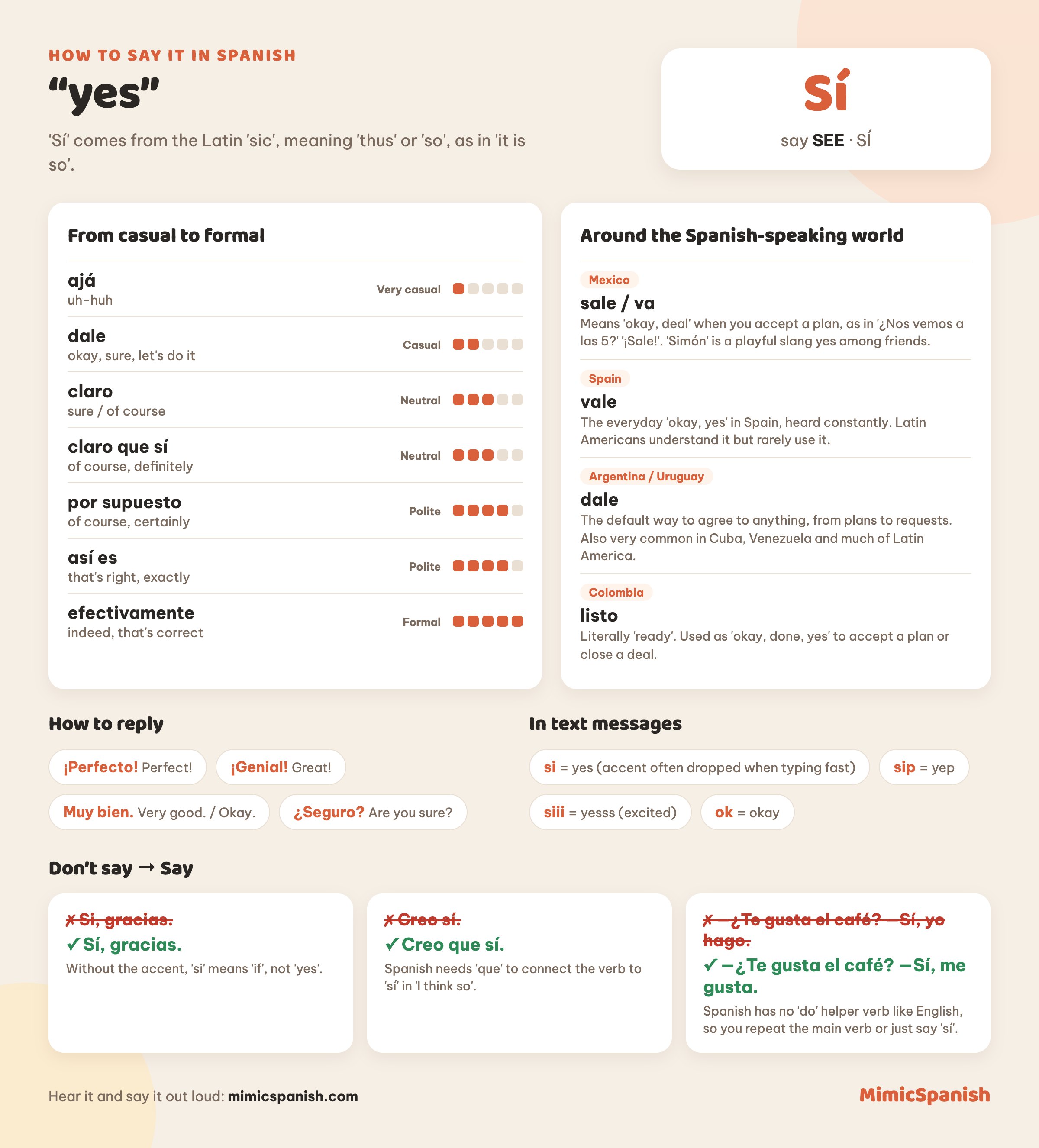
'Yes' in Spanish is 'sí' (pronounced SEE), always written with an accent mark on the i. It works in every situation, formal or casual, in every Spanish-speaking country. To sound more natural or enthusiastic, natives often say 'claro' (sure) or 'claro que sí' (of course).
How to pronounce “Sí”
- Keep the vowel short and pure, like the 'ee' in 'see' but cut off quickly, with no 'y' glide at the end.
- The 's' is always a crisp, clear 's' as in 'sun', never a 'z' or 'sh' sound.
- When you mean 'yes', say it with a little stress and a falling tone; a rising tone ('¿sí?') turns it into a question like 'really?' or 'right?'.
What it literally means
'Sí' comes from the Latin 'sic', meaning 'thus' or 'so', as in 'it is so'. The accent mark (tilde) separates it from 'si', which means 'if'. The two words sound the same.
Other ways to say it, from casual to formal
- ajáuh-huh · casual listening or quick agreementVery casual
- daleokay, sure, let's do it · agreeing to a plan or suggestion with friendsCasual
- clarosure / of course · friendly agreement, very common everywhereNeutral
- claro que síof course, definitely · enthusiastic or reassuring yesNeutral
- por supuestoof course, certainly · polite yes, at work or with strangersPolite
- así esthat's right, exactly · confirming that something is truePolite
- efectivamenteindeed, that's correct · formal confirmation, meetings, customer serviceFormal
By country
- sale / vaMexico · Means 'okay, deal' when you accept a plan, as in '¿Nos vemos a las 5?' '¡Sale!'. 'Simón' is a playful slang yes among friends.
- valeSpain · The everyday 'okay, yes' in Spain, heard constantly. Latin Americans understand it but rarely use it.
- daleArgentina / Uruguay · The default way to agree to anything, from plans to requests. Also very common in Cuba, Venezuela and much of Latin America.
- listoColombia · Literally 'ready'. Used as 'okay, done, yes' to accept a plan or close a deal.
- ya / ya poChile · 'Ya' means 'okay, yes' when agreeing. 'Ya po' adds the typical Chilean 'po' (from 'pues').
In text messages
Example sentences
- Sí, gracias.Yes, thank you.
- —¿Hablas inglés? —Sí, un poco."Do you speak English?" "Yes, a little."
- Sí, quiero un café, por favor.Yes, I want a coffee, please.
- —¿Está abierto? —Sí, hasta las ocho."Is it open?" "Yes, until eight."
- Creo que sí, pero no estoy seguro.I think so, but I'm not sure.
- Mi hermana dice que no, pero yo digo que sí.My sister says no, but I say yes.
Mini dialogue: Making weekend plans
How to reply
- ¡Perfecto!Perfect!
- ¡Genial!Great!
- Muy bien.Very good. / Okay.
- ¿Seguro?Are you sure?
Grammar: Sí (yes) vs. si (if)
With an accent, 'sí' means 'yes'. Without an accent, 'si' means 'if'. They sound identical, so the accent only matters in writing. Also remember to use 'que' in phrases like 'creo que sí' (I think so) and 'claro que sí' (of course).
- Sí, voy a la fiesta.Yes, I'm going to the party.
- Si llueve, no voy a la fiesta.If it rains, I'm not going to the party.
Common mistakes
Culture tip
Spanish speakers often answer yes-no questions by repeating the verb instead of saying only 'sí', for example '¿Vienes?' '¡Vengo!' or '¿Puedes?' 'Sí, puedo.' People often double it ('sí, sí') to show eagerness, or say '¡que sí!' to insist. A quick 'sí' is often paired with a nod. In many countries '¿Sí?' is also a common way to answer the phone or to check someone agrees ('Vamos mañana, ¿sí?').