How to say “what's your name” in Spanish
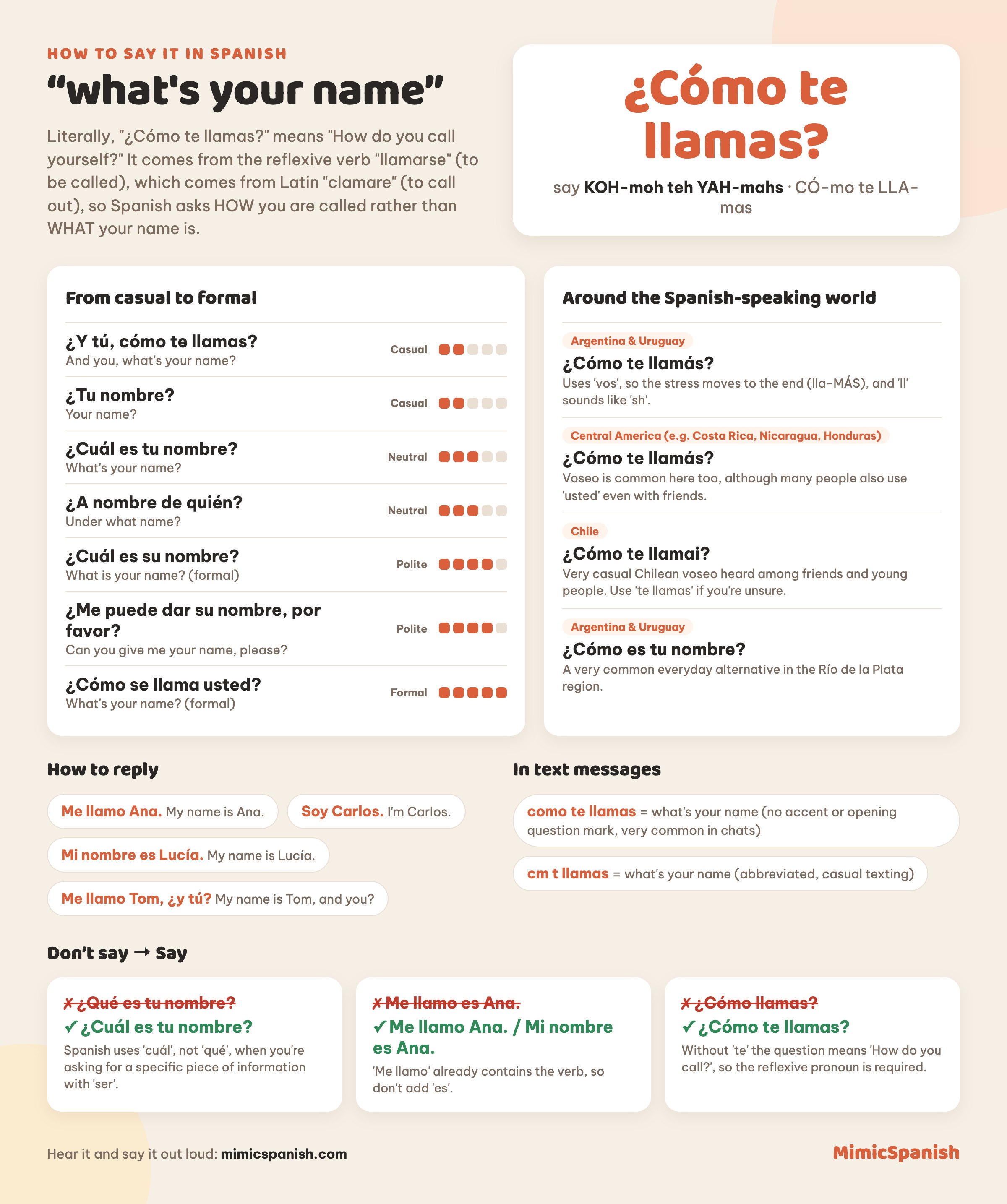
The most common way to say "what's your name" in Spanish is "¿Cómo te llamas?" (KOH-moh teh YAH-mahs). It's the friendly, informal version you use with people your age, kids and anyone in a relaxed setting. In formal situations, or with older people you don't know, say "¿Cómo se llama usted?" instead.
How to pronounce “¿Cómo te llamas?”
- The Spanish 'll' in 'llamas' sounds like the English 'y' in 'yes' in most of Latin America, but in Argentina and Uruguay it sounds like 'sh' or the 's' in 'measure'.
- Keep each vowel short and pure: 'cómo' is 'KOH-moh', not 'KOH-moh-oo' with an English glide at the end.
- Say the 't' in 'te' with your tongue touching the back of your upper teeth and without the puff of air an English 't' has.
What it literally means
Literally, "¿Cómo te llamas?" means "How do you call yourself?" It comes from the reflexive verb "llamarse" (to be called), which comes from Latin "clamare" (to call out), so Spanish asks HOW you are called rather than WHAT your name is.
Other ways to say it, from casual to formal
- ¿Y tú, cómo te llamas?And you, what's your name? · after introducing yourself firstCasual
- ¿Tu nombre?Your name? · quick and casual, like in a game or a lineCasual
- ¿Cuál es tu nombre?What's your name? · neutral alternative, common in classroomsNeutral
- ¿A nombre de quién?Under what name? · reservations, orders and pickupsNeutral
- ¿Cuál es su nombre?What is your name? (formal) · receptionists, forms, offices, phone callsPolite
- ¿Me puede dar su nombre, por favor?Can you give me your name, please? · at a front desk, bank or doctor's officePolite
- ¿Cómo se llama usted?What's your name? (formal) · with older people, officials or customersFormal
By country
- ¿Cómo te llamás?Argentina & Uruguay · Uses 'vos', so the stress moves to the end (lla-MÁS), and 'll' sounds like 'sh'.
- ¿Cómo te llamás?Central America (e.g. Costa Rica, Nicaragua, Honduras) · Voseo is common here too, although many people also use 'usted' even with friends.
- ¿Cómo te llamai?Chile · Very casual Chilean voseo heard among friends and young people. Use 'te llamas' if you're unsure.
- ¿Cómo es tu nombre?Argentina & Uruguay · A very common everyday alternative in the Río de la Plata region.
- ¿Cómo se llama usted?Colombia · 'Usted' is used very widely, even among friends and family in some areas, so you'll hear this form a lot.
In text messages
Example sentences
- Hola, soy Laura. ¿Cómo te llamas?Hi, I'm Laura. What's your name?
- Disculpe, señor, ¿cómo se llama usted?Excuse me, sir, what's your name?
- ¿Cómo se llama tu perro?What's your dog's name?
- ¿Cómo se llama tu hermana?What's your sister's name?
- Perdón, ¿cómo me dijiste que te llamabas?Sorry, what did you say your name was?
- Buenas tardes, ¿a nombre de quién está la reservación?Good afternoon, under what name is the reservation?
Mini dialogue: First day of Spanish class
How to reply
- Me llamo Ana.My name is Ana.
- Soy Carlos.I'm Carlos.
- Mi nombre es Lucía.My name is Lucía.
- Me llamo Tom, ¿y tú?My name is Tom, and you?
Grammar: The reflexive verb 'llamarse'
Spanish uses the reflexive verb 'llamarse' (to be called) for names, so you need a reflexive pronoun (me, te, se…) before the verb. 'Te' goes with 'tú' (informal) and 'se' goes with 'usted' (formal) or with he/she. Change the pronoun and the verb ending together: me llamo, te llamas, se llama.
- Me llamo Andrea.My name is Andrea. (I call myself Andrea.)
- Mi profesor se llama Jorge.My teacher's name is Jorge.
Common mistakes
Culture tip
Latin Americans usually ask for your name right after a greeting, often followed by "Mucho gusto" and a handshake. In many countries the handshake is replaced by a single cheek kiss between women or between a man and a woman. With older people, customers or officials, people start with "usted" ("¿Cómo se llama usted?") and switch to "tú" only when invited or when the tone gets friendlier. In shops and restaurants you'll often hear the practical "¿A nombre de quién?" instead of a full question.