How to say “beautiful” in Spanish
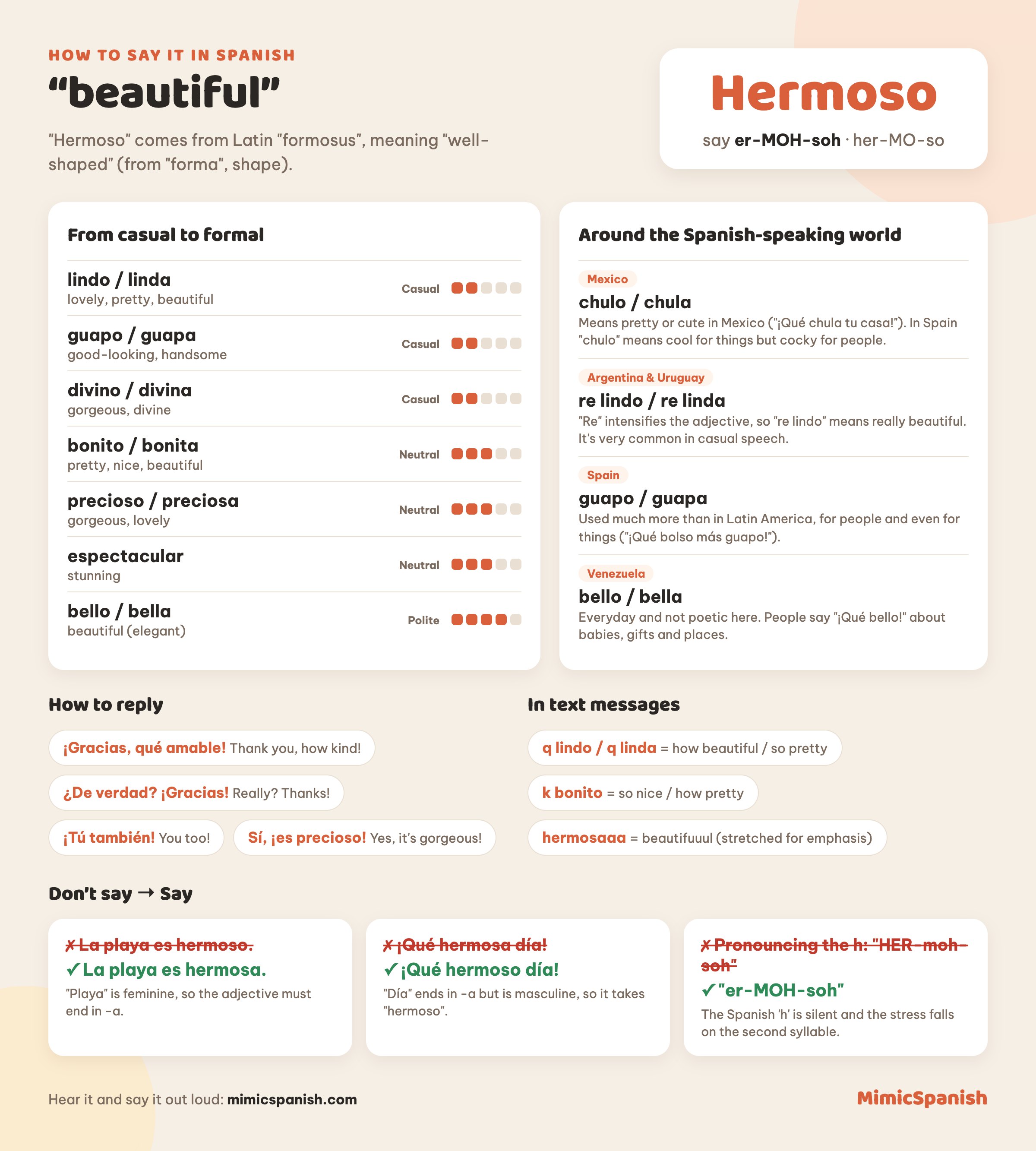
The most common way to say "beautiful" in Spanish is "hermoso" (masculine) or "hermosa" (feminine), as in "¡Qué día tan hermoso!" (What a beautiful day!). In everyday conversation you'll also hear "bonito/a" and, especially in Latin America, "lindo/a" all the time. Remember that the ending changes to match the person or thing you're describing.
How to pronounce “Hermoso”
- The 'h' is always silent in Spanish, so start the word with the vowel: 'er-MOH-soh'.
- The single 'r' is a quick tap of the tongue behind your top teeth, like the 'tt' in American 'butter'.
- Keep the 's' a crisp hiss, not a 'z' sound, and make both 'o' sounds short and pure, without gliding into 'oh-oo'.
What it literally means
"Hermoso" comes from Latin "formosus", meaning "well-shaped" (from "forma", shape). The Latin 'f' turned into the Spanish 'h', which later became silent. The same thing happened in "hacer" (from Latin "facere").
Other ways to say it, from casual to formal
- lindo / lindalovely, pretty, beautiful · very frequent in Latin America, warm and friendlyCasual
- guapo / guapagood-looking, handsome · complimenting a person's looksCasual
- divino / divinagorgeous, divine · enthusiastic praise for clothes, decor or a personCasual
- bonito / bonitapretty, nice, beautiful · everyday default for things, places and peopleNeutral
- precioso / preciosagorgeous, lovely · showing strong admiration for a baby, a view or a giftNeutral
- espectacularstunning · an amazing view, outfit or eventNeutral
- bello / bellabeautiful (elegant) · poetic, artistic or slightly elevated speechPolite
By country
- chulo / chulaMexico · Means pretty or cute in Mexico ("¡Qué chula tu casa!"). In Spain "chulo" means cool for things but cocky for people.
- re lindo / re lindaArgentina & Uruguay · "Re" intensifies the adjective, so "re lindo" means really beautiful. It's very common in casual speech.
- guapo / guapaSpain · Used much more than in Latin America, for people and even for things ("¡Qué bolso más guapo!").
- bello / bellaVenezuela · Everyday and not poetic here. People say "¡Qué bello!" about babies, gifts and places.
In text messages
Example sentences
- ¡Qué día tan hermoso!What a beautiful day!
- Tu casa es muy bonita.Your house is very beautiful.
- Esta playa es hermosa.This beach is beautiful.
- Tienes unos ojos muy lindos.You have very beautiful eyes.
- Las montañas se ven preciosas desde aquí.The mountains look beautiful from here.
- Fue una de las ciudades más bellas que he visitado.It was one of the most beautiful cities I've visited.
Mini dialogue: At a viewpoint on a trip
How to reply
- ¡Gracias, qué amable!Thank you, how kind!
- ¿De verdad? ¡Gracias!Really? Thanks!
- ¡Tú también!You too!
- Sí, ¡es precioso!Yes, it's gorgeous!
Grammar: Make the adjective agree in gender and number
Spanish adjectives change their ending to match the noun: -o for masculine, -a for feminine, and add -s for plural. So you say "hermoso" for a masculine noun like "el día" and "hermosa" for a feminine noun like "la playa". Words ending in -e or a consonant, like "espectacular", don't change for gender, only for number.
- Las flores son hermosas.The flowers are beautiful.
- Los jardines son muy bonitos.The gardens are very beautiful.
Common mistakes
Culture tip
Spanish speakers give compliments freely, and "¡Qué lindo!" or "¡Qué bonito!" comes up constantly for babies, gifts, food, places and photos. "Hermoso/a" sounds warmer and stronger than "bonito". Calling a partner "hermosa" or "preciosa" is common and affectionate. For a stranger's looks, a friendly "¡Qué guapa!" among friends is fine, but avoid commenting on strangers in the street.