How to say “delicious” in Spanish
"Delicious" in Spanish is "delicioso" (deliciosa for feminine nouns). In everyday conversation, though, native speakers most often say "¡Qué rico!" (How delicious!) or "Está riquísimo" (It's really delicious). Use "está" to react to food you're eating right now: "La comida está deliciosa."
How to pronounce “Delicioso”
- In Latin America the "ci" sounds like an English "s" (SYOH), while in most of Spain it sounds like the "th" in "think" (THYOH).
- Keep every "o" short and pure, like the "o" in "or" cut short, never the gliding "oh-oo" of English "go."
- The "d" at the start is soft, with your tongue touching the back of your upper teeth, and the "s" between vowels stays a clean "s," never a "z."
What it literally means
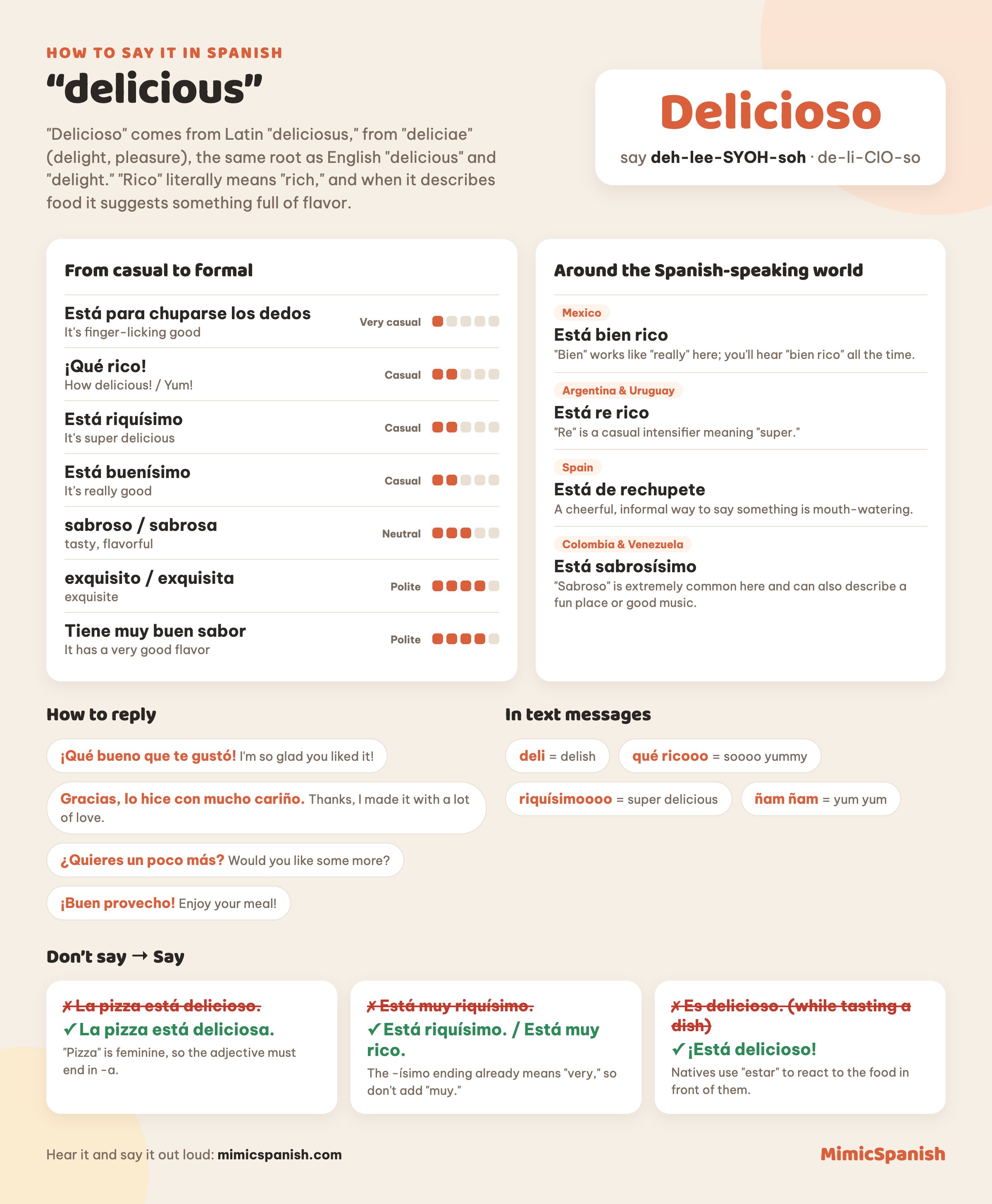
"Delicioso" comes from Latin "deliciosus," from "deliciae" (delight, pleasure), the same root as English "delicious" and "delight." "Rico" literally means "rich," and when it describes food it suggests something full of flavor.
Other ways to say it, from casual to formal
- Está para chuparse los dedosIt's finger-licking good · playful praise for home cookingVery casual
- ¡Qué rico!How delicious! / Yum! · the go-to everyday reaction to foodCasual
- Está riquísimoIt's super delicious · praising a meal enthusiasticallyCasual
- Está buenísimoIt's really good · casual praise, very common in SpainCasual
- sabroso / sabrosatasty, flavorful · describing well-seasoned foodNeutral
- exquisito / exquisitaexquisite · elegant dinners, reviews, polite complimentsPolite
- Tiene muy buen saborIt has a very good flavor · a neutral, slightly more formal commentPolite
By country
- Está bien ricoMexico · "Bien" works like "really" here; you'll hear "bien rico" all the time.
- Está re ricoArgentina & Uruguay · "Re" is a casual intensifier meaning "super."
- Está de rechupeteSpain · A cheerful, informal way to say something is mouth-watering.
- Está sabrosísimoColombia & Venezuela · "Sabroso" is extremely common here and can also describe a fun place or good music.
In text messages
Example sentences
- La sopa está deliciosa.The soup is delicious.
- ¡Qué rico huele!It smells so good!
- Estos tacos están riquísimos.These tacos are really delicious.
- Mi abuela hace un pastel delicioso.My grandma makes a delicious cake.
- ¿Conoces un restaurante con comida sabrosa por aquí?Do you know a restaurant with tasty food around here?
- La cena estuvo exquisita; gracias por invitarnos.Dinner was exquisite; thanks for inviting us.
Mini dialogue: Dinner at a friend's house
How to reply
- ¡Qué bueno que te gustó!I'm so glad you liked it!
- Gracias, lo hice con mucho cariño.Thanks, I made it with a lot of love.
- ¿Quieres un poco más?Would you like some more?
- ¡Buen provecho!Enjoy your meal!
Grammar: Agreement and "estar" vs. "ser"
"Delicioso" is an adjective, so it must match the noun in gender and number: delicioso, deliciosa, deliciosos, deliciosas. Use "estar" (está) to react to food you're tasting right now, and "ser" (es) to describe a dish that is delicious in general.
- Las empanadas están deliciosas.The empanadas are delicious (right now, as I eat them).
- La comida peruana es deliciosa.Peruvian food is delicious (in general).
Common mistakes
Culture tip
Complimenting the food is an important part of eating with others in Latin America, especially at someone's home, and a warm "¡Qué rico!" or "¡Está delicioso!" will make your host very happy. In everyday speech, "rico" is far more common than "delicioso," which can sound a little more deliberate or polite. People often say "rico" or "sabroso" while eating, and asking for seconds is the biggest compliment of all.