How to say “thank you” in Spanish
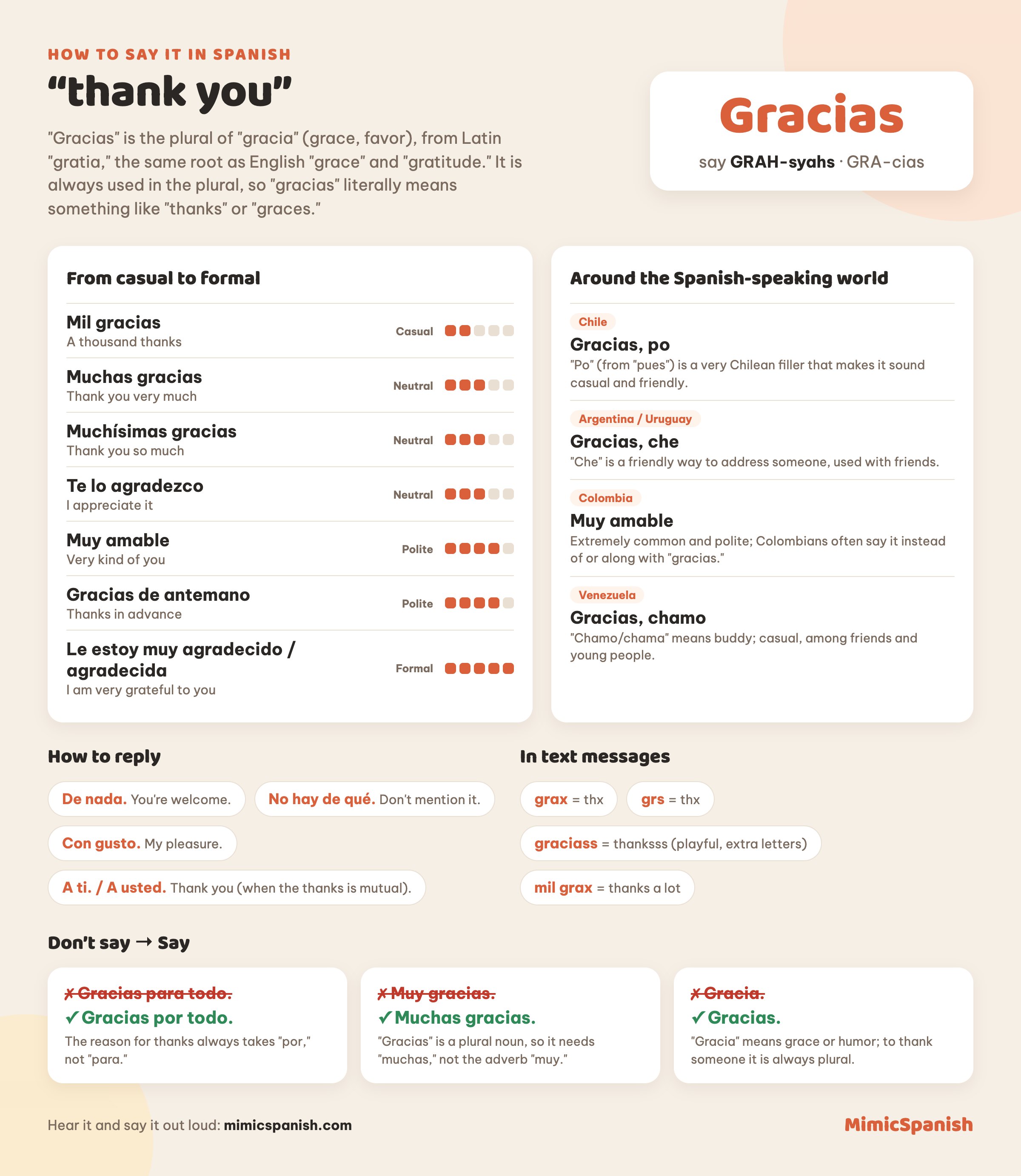
"Thank you" in Spanish is "gracias" (GRAH-syahs). It works in every Spanish-speaking country and in any situation, formal or casual. To say "thank you very much," use "muchas gracias."
How to pronounce “Gracias”
- The Spanish 'r' in 'gra' is a single quick tap of the tongue behind the top teeth, like the 'tt' in American 'butter.'
- In Latin America 'ci' sounds like 'see,' so it's 'GRAH-syahs'; in most of Spain the 'c' is pronounced like 'th' in 'think': 'GRAH-thyahs.'
- Say 'cias' as one quick syllable ('syahs'), not two ('see-ahs'), and keep the 'a' sounds open like 'ah.'
What it literally means
"Gracias" is the plural of "gracia" (grace, favor), from Latin "gratia," the same root as English "grace" and "gratitude." It is always used in the plural, so "gracias" literally means something like "thanks" or "graces."
Other ways to say it, from casual to formal
- Mil graciasA thousand thanks · warm, enthusiastic thanksCasual
- Muchas graciasThank you very much · everyday, any situationNeutral
- Muchísimas graciasThank you so much · big favors, heartfelt thanksNeutral
- Te lo agradezcoI appreciate it · thanking a friend for a favorNeutral
- Se lo agradezco muchoI really appreciate it (formal) · with strangers, older people, clientsPolite
- Muy amableVery kind of you · when someone helps or offers somethingPolite
- Gracias de antemanoThanks in advance · emails and written requestsPolite
- Le estoy muy agradecido / agradecidaI am very grateful to you · formal letters, serious favorsFormal
By country
- Gracias, poChile · "Po" (from "pues") is a very Chilean filler that makes it sound casual and friendly.
- Gracias, cheArgentina / Uruguay · "Che" is a friendly way to address someone, used with friends.
- Muy amableColombia · Extremely common and polite; Colombians often say it instead of or along with "gracias."
- Gracias, chamoVenezuela · "Chamo/chama" means buddy; casual, among friends and young people.
- Gracias, tío / tíaSpain · "Tío/tía" here means dude or girl, not uncle or aunt; very informal.
In text messages
Example sentences
- Gracias por tu ayuda.Thank you for your help.
- Muchas gracias, está delicioso.Thank you very much, it's delicious.
- —¿Quieres más café? —No, gracias."Do you want more coffee?" "No, thank you."
- Gracias por venir a mi fiesta.Thanks for coming to my party.
- Mil gracias por el regalo, me encanta.Thanks so much for the gift, I love it.
- Le agradezco mucho su paciencia.I really appreciate your patience.
Mini dialogue: At a café
How to reply
- De nada.You're welcome.
- No hay de qué.Don't mention it.
- Con gusto.My pleasure.
- A ti. / A usted.Thank you (when the thanks is mutual).
Grammar: Gracias por + noun or infinitive
To say what you are thankful for, use "gracias por," never "gracias para." After "por" you can put a noun (gracias por la cena) or a verb in the infinitive (gracias por venir). To refer to something that already happened, you can use "por haber" + past participle.
- Gracias por la información.Thanks for the information.
- Gracias por esperarme.Thanks for waiting for me.
Common mistakes
Culture tip
Spanish speakers say "gracias" constantly: to waiters, drivers, shop clerks and family members. It's often paired with a warm tone, a smile or eye contact, and in many countries "muy amable" or "con gusto" makes the exchange feel extra polite. Between very close friends and family, people sometimes thank less explicitly, since big favors are simply expected, but you'll never sound wrong by saying it.