How to say “excuse me” in Spanish
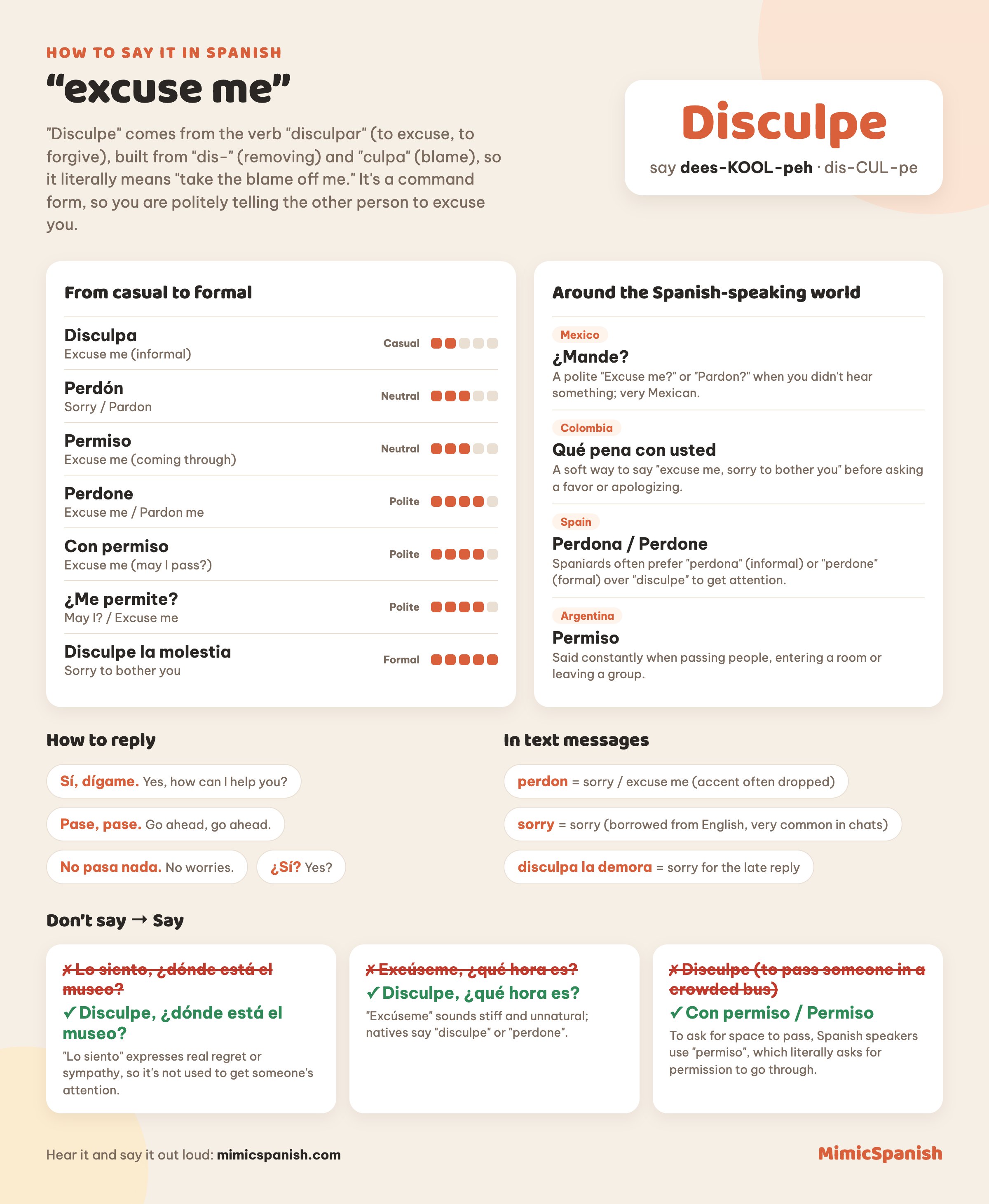
The most common way to say "excuse me" in Spanish is "disculpe" (dees-KOOL-peh), used politely with strangers to get their attention or apologize for a small inconvenience. With friends or people your age, say "disculpa". To get past someone in a crowd, say "con permiso" or just "permiso".
How to pronounce “Disculpe”
- The 'u' is always a pure 'oo' as in 'food', never the 'uh' in 'cult'.
- End with a short, crisp 'eh' and don't glide it into 'ay' as in 'day'.
- The 'd' is softer than in English: touch your tongue to the back of your top teeth, not the ridge behind them.
What it literally means
"Disculpe" comes from the verb "disculpar" (to excuse, to forgive), built from "dis-" (removing) and "culpa" (blame), so it literally means "take the blame off me." It's a command form, so you are politely telling the other person to excuse you.
Other ways to say it, from casual to formal
- DisculpaExcuse me (informal) · with friends, peers or young peopleCasual
- PerdónSorry / Pardon · bumping into someone or interrupting brieflyNeutral
- PermisoExcuse me (coming through) · passing quickly through a crowd or on the busNeutral
- PerdoneExcuse me / Pardon me · getting a stranger's attention, very common in SpainPolite
- Con permisoExcuse me (may I pass?) · squeezing past someone or leaving a room or tablePolite
- ¿Me permite?May I? / Excuse me · reaching past someone or taking something near themPolite
- Disculpe la molestiaSorry to bother you · interrupting someone who is busyFormal
By country
- ¿Mande?Mexico · A polite "Excuse me?" or "Pardon?" when you didn't hear something; very Mexican.
- Qué pena con ustedColombia · A soft way to say "excuse me, sorry to bother you" before asking a favor or apologizing.
- Perdona / PerdoneSpain · Spaniards often prefer "perdona" (informal) or "perdone" (formal) over "disculpe" to get attention.
- PermisoArgentina · Said constantly when passing people, entering a room or leaving a group.
In text messages
Example sentences
- Disculpe, ¿dónde está el baño?Excuse me, where is the bathroom?
- Con permiso, voy a pasar.Excuse me, I'm coming through.
- Disculpa, ¿tienes hora?Excuse me, do you have the time?
- Perdón, no te vi.Sorry, I didn't see you.
- Disculpe, ¿este asiento está libre?Excuse me, is this seat free?
- Disculpe la molestia, ¿me podría ayudar con la maleta?Sorry to bother you, could you help me with my suitcase?
Mini dialogue: Asking for directions on the street
How to reply
- Sí, dígame.Yes, how can I help you?
- Pase, pase.Go ahead, go ahead.
- No pasa nada.No worries.
- ¿Sí?Yes?
Grammar: Disculpe (usted) vs. disculpa (tú)
"Disculpe" and "disculpa" are command forms of the verb "disculpar". Use "disculpe" with strangers, older people, staff and anyone you'd address as "usted", and use "disculpa" with friends, family and people your age ("tú"). The same pattern works for "perdone" (usted) and "perdona" (tú).
- Disculpe, señor, ¿me puede ayudar?Excuse me, sir, can you help me?
- Disculpa, ¿me pasas la sal?Excuse me, can you pass me the salt?
Common mistakes
Culture tip
Latin Americans say "con permiso" or "permiso" much more often than English speakers say "excuse me": when passing someone, leaving the table, entering a home or even walking between two people talking. Saying "disculpe" before asking a question is expected, and skipping it can sound abrupt. In Mexico, you'll often hear "¿Mande?" as a polite "Pardon?" instead of "¿Qué?", which can sound rude.