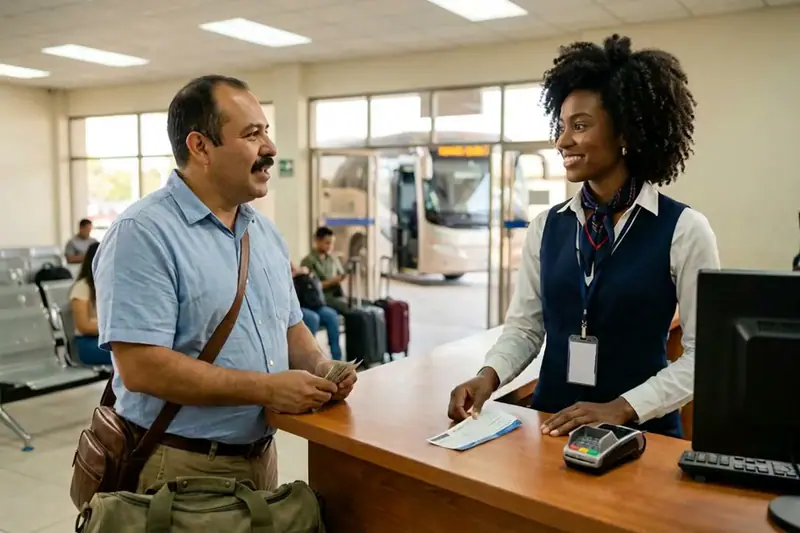
How to say “where is the bathroom” in Spanish
"Where is the bathroom?" in Spanish is "¿Dónde está el baño?" (DOHN-deh ehs-TAH ehl BAH-nyoh). It is understood everywhere and is the standard phrase across Latin America. In Spain you will also often hear "¿Dónde está el servicio?" or "¿Dónde está el aseo?"
How to pronounce “¿Dónde está el baño?”
- The ñ in baño sounds like the "ny" in "canyon," so say BAH-nyoh, not BAH-noh.
- The d in dónde is soft: touch your tongue to the back of your top teeth, not the gum ridge as in English.
- Stress the last syllable of está (es-TÁ); putting the stress on the first syllable sounds like esta ("this").
What it literally means
Word for word it means "Where is the bath?" Dónde means "where," está is the verb estar ("to be," used for location), and baño comes from Latin balneum, "bath." Like English "bathroom," Spanish politely names the room after bathing rather than the toilet.
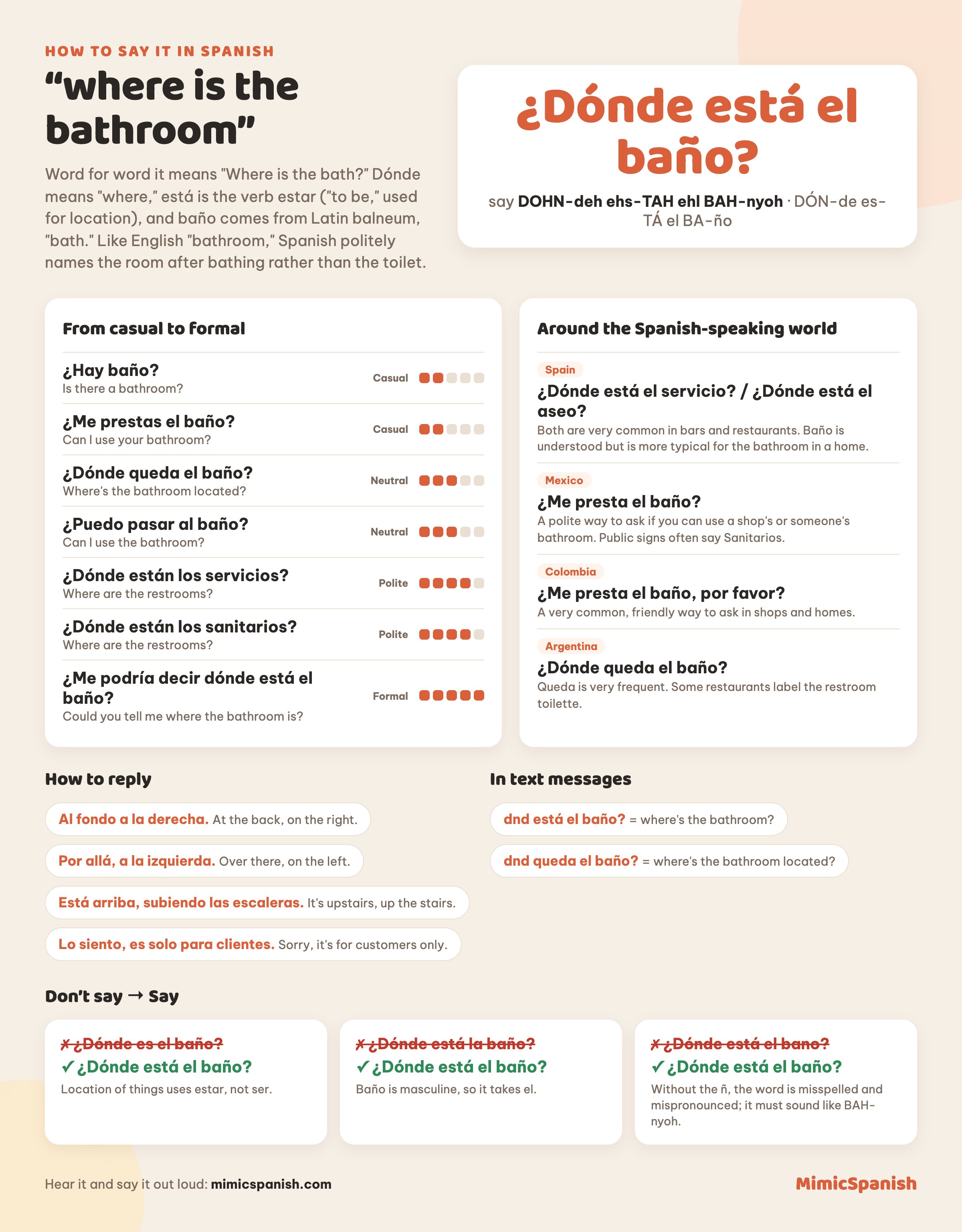
Other ways to say it, from casual to formal
- ¿Hay baño?Is there a bathroom? · shops, gas stations, small placesCasual
- ¿Me prestas el baño?Can I use your bathroom? · at a friend's house (Latin America)Casual
- ¿Dónde queda el baño?Where's the bathroom located? · very common in Latin America, any situationNeutral
- ¿Puedo pasar al baño?Can I use the bathroom? · asking permission at a store, class or someone's homeNeutral
- Disculpe, ¿dónde está el baño?Excuse me, where is the bathroom? · asking a stranger, waiter or staffPolite
- ¿Dónde están los servicios?Where are the restrooms? · Spain, restaurants and public placesPolite
- ¿Dónde están los sanitarios?Where are the restrooms? · formal, signs and public buildings, especially MexicoPolite
- ¿Me podría decir dónde está el baño?Could you tell me where the bathroom is? · extra polite, hotels or officesFormal
By country
- ¿Dónde está el servicio? / ¿Dónde está el aseo?Spain · Both are very common in bars and restaurants. Baño is understood but is more typical for the bathroom in a home.
- ¿Me presta el baño?Mexico · A polite way to ask if you can use a shop's or someone's bathroom. Public signs often say Sanitarios.
- ¿Me presta el baño, por favor?Colombia · A very common, friendly way to ask in shops and homes.
- ¿Dónde queda el baño?Argentina · Queda is very frequent. Some restaurants label the restroom toilette.
In text messages
Example sentences
- Perdón, ¿dónde está el baño?Sorry, where is the bathroom?
- ¿El baño está arriba o abajo?Is the bathroom upstairs or downstairs?
- Señorita, ¿dónde está el baño de mujeres?Miss, where is the women's bathroom?
- ¿Hay baño en el autobús?Is there a bathroom on the bus?
- Necesito ir al baño. ¿Sabes dónde está?I need to go to the bathroom. Do you know where it is?
- ¿Me podría decir si el baño es solo para clientes?Could you tell me if the bathroom is only for customers?
Mini dialogue: At a restaurant
How to reply
- Al fondo a la derecha.At the back, on the right.
- Por allá, a la izquierda.Over there, on the left.
- Está arriba, subiendo las escaleras.It's upstairs, up the stairs.
- Lo siento, es solo para clientes.Sorry, it's for customers only.
Grammar: Use estar (not ser) for location
To say where something is, Spanish uses estar: está for one thing and están for more than one. Learners often use es because "is" looks like ser, but ¿Dónde es...? sounds wrong when you mean a physical place. The question word dónde always carries an accent mark in questions.
- ¿Dónde está el baño?Where is the bathroom?
- ¿Dónde están los baños?Where are the bathrooms?
Common mistakes
Culture tip
Asking for the bathroom is completely normal and not embarrassing. Just start with "Disculpe" or "Perdón" to sound polite. In many Latin American bus stations and markets, public bathrooms charge a small fee, and you may need to buy toilet paper at the entrance. Doors are usually marked Damas/Caballeros or Mujeres/Hombres (often M/H in Spain), so don't confuse M for "men."