How to say “help” in Spanish
"Help" in Spanish is "ayuda" (ah-YOO-dah). It's the noun ("I need help" = "Necesito ayuda") and what you shout in an emergency ("¡Ayuda!"). To ask someone for help, use the verb ayudar: "¿Me ayudas?" (informal) or "¿Me puede ayudar?" (polite).
How to pronounce “Ayuda”
- The 'y' sounds like the English 'y' in 'yes' in most of Latin America, but in Argentina and Uruguay it sounds like 'sh' (ah-SHOO-dah).
- The 'd' between two vowels is soft, close to the 'th' in 'this', so don't hit it hard like the English 'd' in 'dog'.
- Keep every vowel short and pure: the final 'a' is a clear 'ah', never 'uh'.
What it literally means
"Ayuda" comes from the verb "ayudar", from Latin "adiutare" (to assist), which is also the root of English "adjutant" and "aid". The same word works as the noun (la ayuda) and as the tú command (¡ayuda! = help!).
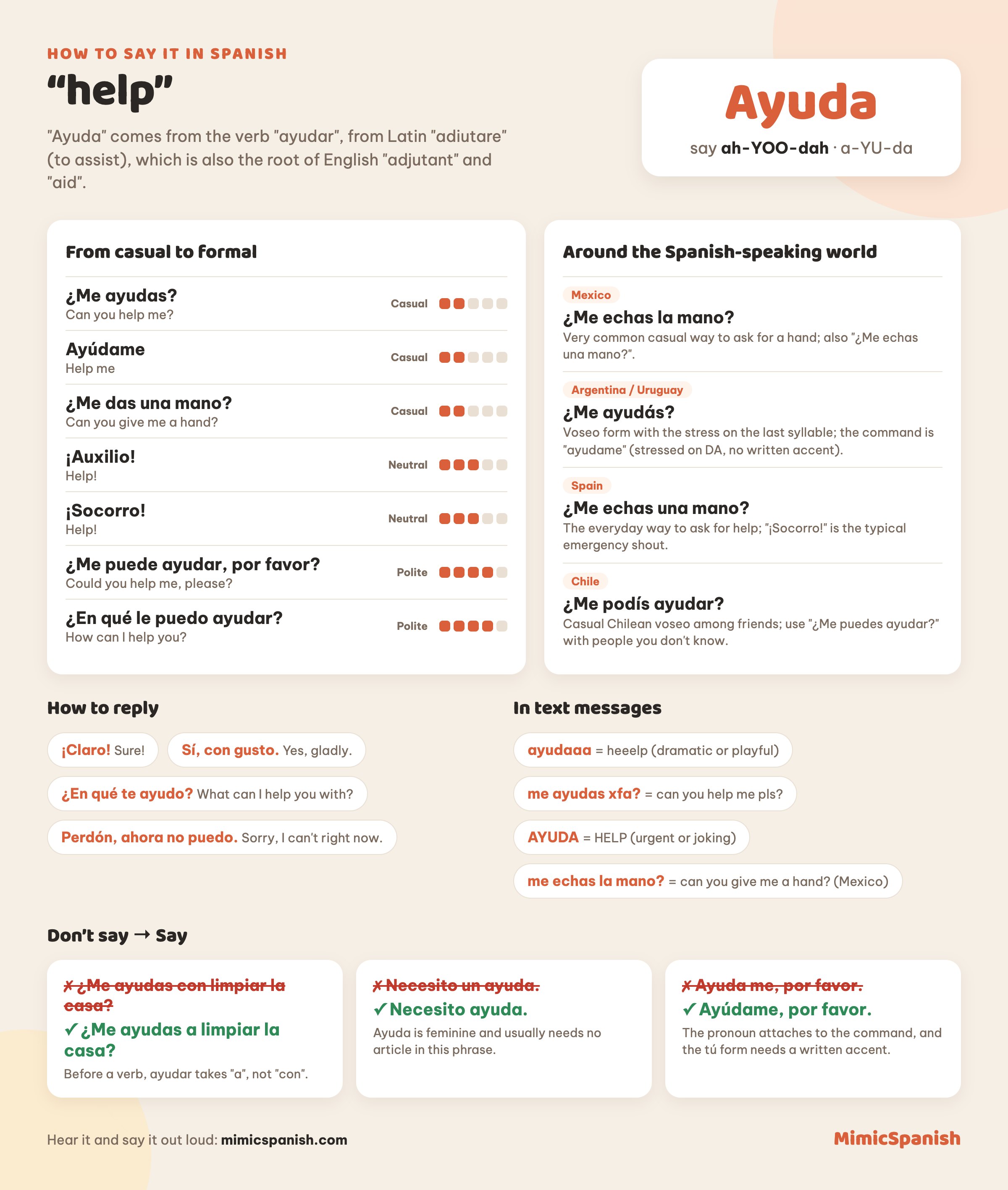
Other ways to say it, from casual to formal
- ¿Me ayudas?Can you help me? · asking a friend or family memberCasual
- AyúdameHelp me · direct request to someone you knowCasual
- ¿Me das una mano?Can you give me a hand? · small favors, carrying thingsCasual
- ¡Auxilio!Help! · real emergency, calling for rescueNeutral
- ¡Socorro!Help! · emergency; very common in SpainNeutral
- ¿Me puede ayudar, por favor?Could you help me, please? · asking a stranger, staff or an older personPolite
- ¿En qué le puedo ayudar?How can I help you? · staff speaking to customersPolite
By country
- ¿Me echas la mano?Mexico · Very common casual way to ask for a hand; also "¿Me echas una mano?".
- ¿Me ayudás?Argentina / Uruguay · Voseo form with the stress on the last syllable; the command is "ayudame" (stressed on DA, no written accent).
- ¿Me echas una mano?Spain · The everyday way to ask for help; "¡Socorro!" is the typical emergency shout.
- ¿Me podís ayudar?Chile · Casual Chilean voseo among friends; use "¿Me puedes ayudar?" with people you don't know.
In text messages
Example sentences
- Necesito ayuda, por favor.I need help, please.
- ¿Me puedes ayudar con mis maletas?Can you help me with my suitcases?
- Muchas gracias por tu ayuda.Thank you so much for your help.
- Buenas tardes, ¿en qué le puedo ayudar?Good afternoon, how can I help you?
- Mi hermano me ayuda a estudiar inglés.My brother helps me study English.
- Si necesitas ayuda con la mudanza, avísame.If you need help with the move, let me know.
Mini dialogue: At the train station
How to reply
- ¡Claro!Sure!
- Sí, con gusto.Yes, gladly.
- ¿En qué te ayudo?What can I help you with?
- Perdón, ahora no puedo.Sorry, I can't right now.
Grammar: Ayuda (noun) vs. ayudar (verb) + a + infinitive
Use "ayuda" when you mean the thing (I need help, thanks for your help), and the verb "ayudar" when someone does the helping. To say "help someone do something", use ayudar + a + infinitive, not "con" + a verb. Object pronouns go before the conjugated verb or attach to the infinitive or command: "¿Me ayudas?", "¿Puedes ayudarme?", "Ayúdame".
- ¿Me ayudas a cocinar?Will you help me cook?
- Gracias por la ayuda con la tarea.Thanks for the help with the homework.
Common mistakes
Culture tip
Before asking a stranger for help, Latin Americans almost always start with "Disculpe" or "Perdón" and use the polite usted form. In stores you'll constantly hear "¿En qué le puedo ayudar?" or, in Mexico, "¿En qué le puedo servir?". Among friends, "¿Me echas la mano?" or "¿Me das una mano?" sounds warmer and more natural than a plain "Ayúdame".