How to say “I don't understand” in Spanish
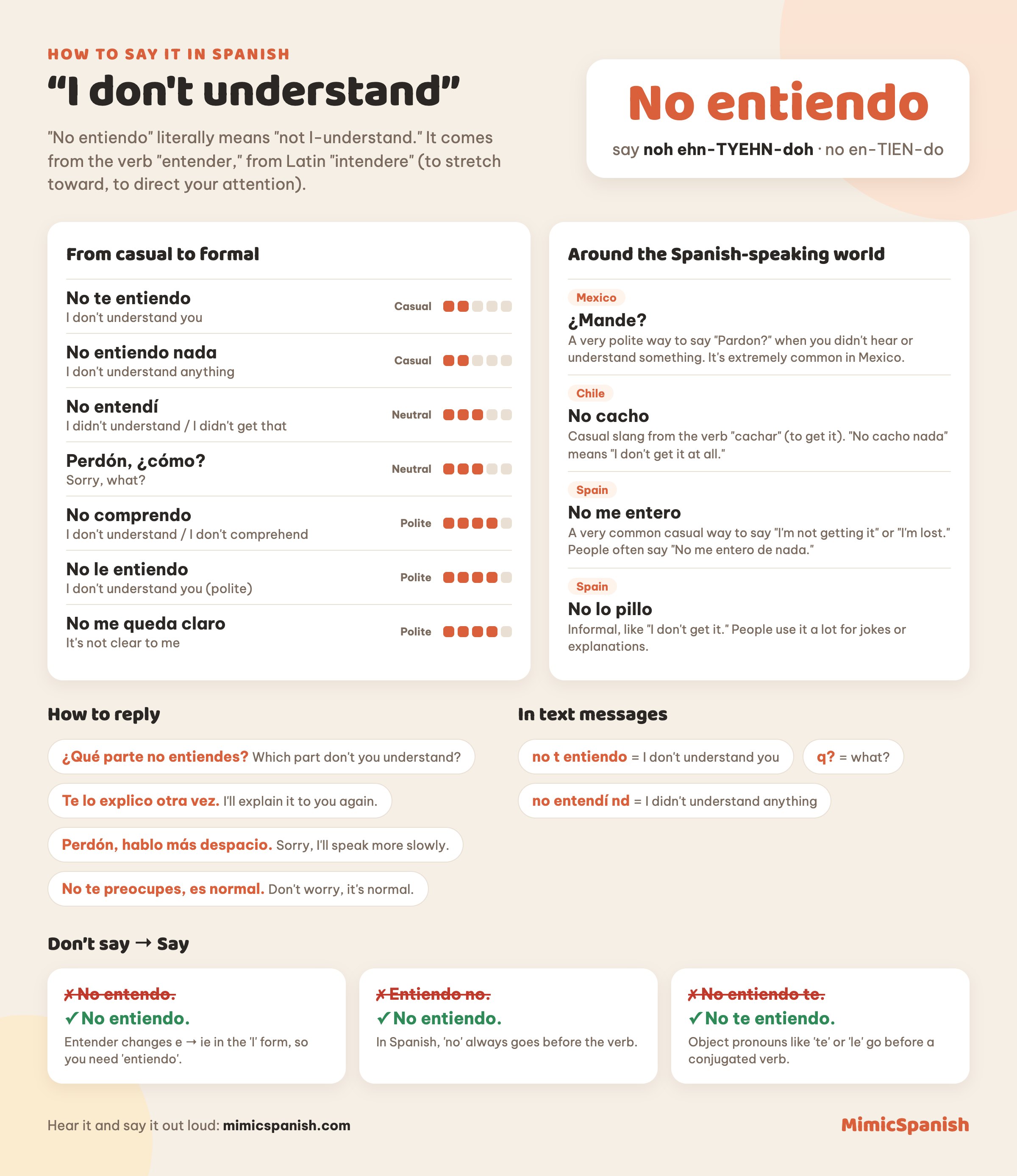
The most common way to say "I don't understand" in Spanish is "No entiendo" (noh ehn-TYEHN-doh). It works with anyone, in any Spanish-speaking country. To say "I don't understand you," use "No te entiendo" with friends or "No le entiendo" in polite situations.
How to pronounce “No entiendo”
- Say the 'ie' in 'entiendo' as one quick glide, like the 'ye' in 'yes', not two separate vowels.
- Keep the 'd' soft, with your tongue lightly touching the back of your top teeth, almost like a gentle 'th' in 'this'.
- Natives usually blend 'no' and 'entiendo' together, so it sounds like 'noen-TYEN-do' with no pause.
What it literally means
"No entiendo" literally means "not I-understand." It comes from the verb "entender," from Latin "intendere" (to stretch toward, to direct your attention). Spanish doesn't need the word "yo" (I) because the ending "-o" already shows who is speaking.
Other ways to say it, from casual to formal
- No te entiendoI don't understand you · talking to a friend or family memberCasual
- No entiendo nadaI don't understand anything · when you're completely lostCasual
- No entendíI didn't understand / I didn't get that · right after someone says somethingNeutral
- Perdón, ¿cómo?Sorry, what? · when you didn't catch what someone saidNeutral
- No te sigoI'm not following you · when an explanation loses youNeutral
- No comprendoI don't understand / I don't comprehend · slightly more formal or careful speechPolite
- No le entiendoI don't understand you (polite) · talking to a stranger, older person or clientPolite
- No me queda claroIt's not clear to me · at work, in class or in meetingsPolite
By country
- ¿Mande?Mexico · A very polite way to say "Pardon?" when you didn't hear or understand something. It's extremely common in Mexico.
- No cachoChile · Casual slang from the verb "cachar" (to get it). "No cacho nada" means "I don't get it at all."
- No me enteroSpain · A very common casual way to say "I'm not getting it" or "I'm lost." People often say "No me entero de nada."
- No lo pilloSpain · Informal, like "I don't get it." People use it a lot for jokes or explanations.
- No le entiendoColombia · Colombians often use "usted" (le) even with friends and family, so you'll hear this form a lot in casual speech.
In text messages
Example sentences
- Perdón, no entiendo.Sorry, I don't understand.
- No entiendo esta palabra.I don't understand this word.
- Hablo un poco de español, pero no entiendo todo.I speak a little Spanish, but I don't understand everything.
- No te entiendo, ¿puedes hablar más despacio?I don't understand you, can you speak more slowly?
- No entiendo cómo funciona esta máquina.I don't understand how this machine works.
- Lo siento, no entendí bien lo que dijo. ¿Me lo puede repetir?I'm sorry, I didn't quite understand what you said. Could you repeat it for me?
Mini dialogue: Asking for directions
How to reply
- ¿Qué parte no entiendes?Which part don't you understand?
- Te lo explico otra vez.I'll explain it to you again.
- Perdón, hablo más despacio.Sorry, I'll speak more slowly.
- No te preocupes, es normal.Don't worry, it's normal.
Grammar: Entender is a stem-changing verb (e → ie)
In the present tense, the 'e' in the stem of "entender" changes to 'ie' when it's stressed: entiendo, entiendes, entiende, entienden. The forms for "we" and "you all" in Spain keep the 'e' (entendemos, entendéis). To say "I didn't understand" about something just said, use the past tense "entendí," which has no stem change.
- ¿Entiendes? — Sí, entiendo.Do you understand? — Yes, I understand.
- Nosotros no entendemos la pregunta.We don't understand the question.
Common mistakes
Culture tip
Native speakers are usually very patient with learners, and saying "No entiendo" with a smile often makes people slow down or rephrase kindly. Starting with "Perdón" or "Disculpe" makes it sound softer and more polite. In everyday conversation, natives often say "No entendí" or just "¿Cómo?" when they miss something, and in Mexico you'll constantly hear the polite "¿Mande?"