How to say “can you repeat that” in Spanish
The most common neutral way to say "can you repeat that" in Spanish is "¿Puede repetirlo, por favor?" This form uses usted and is safe with strangers, staff, and older people. With friends or people your age, say "¿Puedes repetirlo?" or, more casually, "¿Me lo repites?"
How to pronounce “¿Puede repetirlo, por favor?”
- Say "pue" as one quick syllable, like "pweh", not "poo-eh".
- The r in "repetir" starts the word, so roll or trill it slightly, and tap the r at the end of "-tir" like the tt in American "butter".
- The v in "favor" sounds like a soft b with the lips barely touching, never like an English v.
What it literally means
Word for word, it means "Can (you) repeat it, please?": "puede" comes from poder (can), "repetir" means to repeat, and "lo" means "it" and is attached to the end of the verb. Repetir comes from Latin "repetere", meaning "to seek again" or "to go back to".
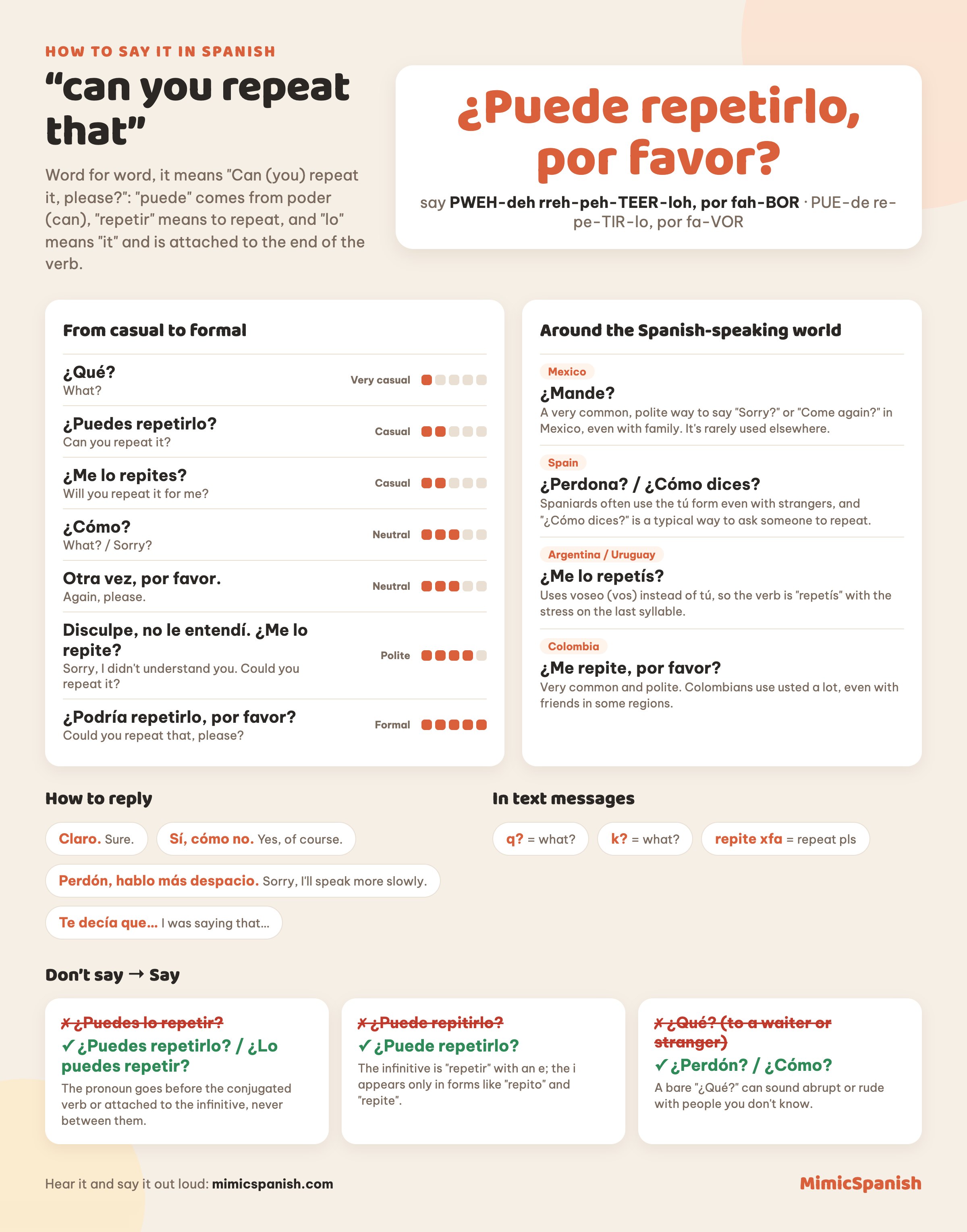
Other ways to say it, from casual to formal
- ¿Qué?What? · with close friends and family onlyVery casual
- ¿Puedes repetirlo?Can you repeat it? · with friends, classmates, people your ageCasual
- ¿Me lo repites?Will you repeat it for me? · casual, everyday conversationCasual
- ¿Cómo?What? / Sorry? · you didn't catch something, any contextNeutral
- ¿Perdón?Pardon? · polite reaction when you didn't hearNeutral
- Otra vez, por favor.Again, please. · short and simple, like in class or a shopNeutral
- Disculpe, no le entendí. ¿Me lo repite?Sorry, I didn't understand you. Could you repeat it? · polite request to a stranger or staffPolite
- ¿Podría repetirlo, por favor?Could you repeat that, please? · formal settings, work, interviews, officesFormal
By country
- ¿Mande?Mexico · A very common, polite way to say "Sorry?" or "Come again?" in Mexico, even with family. It's rarely used elsewhere.
- ¿Perdona? / ¿Cómo dices?Spain · Spaniards often use the tú form even with strangers, and "¿Cómo dices?" is a typical way to ask someone to repeat.
- ¿Me lo repetís?Argentina / Uruguay · Uses voseo (vos) instead of tú, so the verb is "repetís" with the stress on the last syllable.
- ¿Me repite, por favor?Colombia · Very common and polite. Colombians use usted a lot, even with friends in some regions.
In text messages
Example sentences
- Perdón, ¿puede repetirlo, por favor?Sorry, can you repeat that, please?
- No te escuché. ¿Me lo repites?I didn't hear you. Can you repeat it?
- ¿Puede repetir el número de teléfono?Can you repeat the phone number?
- Hablas muy rápido. ¿Puedes repetirlo más despacio?You speak very fast. Can you repeat it more slowly?
- Disculpe, ¿podría repetir la dirección? No la anoté.Excuse me, could you repeat the address? I didn't write it down.
- Hay mucho ruido aquí. ¿Me repites lo último que dijiste?It's really noisy here. Can you repeat the last thing you said?
Mini dialogue: On the phone with a clinic
How to reply
- Claro.Sure.
- Sí, cómo no.Yes, of course.
- Perdón, hablo más despacio.Sorry, I'll speak more slowly.
- Te decía que…I was saying that…
Grammar: Where to put "lo" (it)
With poder + infinitive, the object pronoun "lo" (it) can go either attached to the end of the infinitive or before the conjugated verb. Both options are correct and equally common, but the pronoun can never go between the two verbs. If you add "me" (for me), it comes before "lo", and the attached form needs a written accent: "repetírmelo".
- ¿Puedes repetirlo? = ¿Lo puedes repetir?Can you repeat it?
- ¿Puede repetírmelo? = ¿Me lo puede repetir?Can you repeat it for me?
Common mistakes
Culture tip
Native speakers ask for repetition all the time, especially on the phone or in noisy places, so don't feel embarrassed to use it. In casual speech, a short "¿Cómo?" or "¿Perdón?" with a slight forward lean is far more common than a full sentence. Learners can add "Estoy aprendiendo español" (I'm learning Spanish), and most people will gladly slow down.