How to say “I don't know” in Spanish
The most common way to say "I don't know" in Spanish is "No sé" (pronounced noh SEH). It is neutral and works in almost any situation, with friends, strangers, at work or in a shop. You can also say "No lo sé" (I don't know it) or, more casually, "Ni idea" (No idea).
How to pronounce “No sé”
- Say the Spanish 'o' in 'no' short and pure, without gliding into an 'oo' sound like English 'no-w'.
- The 'é' in 'sé' sounds like the 'e' in 'bet', not like 'say', so keep it short with no 'ee' at the end.
- Put the stress on 'sé' and make the 's' a clean, crisp hiss, never a 'z' or 'sh' sound.
What it literally means
"No sé" is literally "not I-know." "Sé" is the irregular yo-form of the verb saber (to know), which comes from Latin sapere, meaning 'to taste, to be wise.' The accent on "sé" separates it from the pronoun "se." Spanish usually drops the subject "yo" because the verb ending already shows who is speaking.
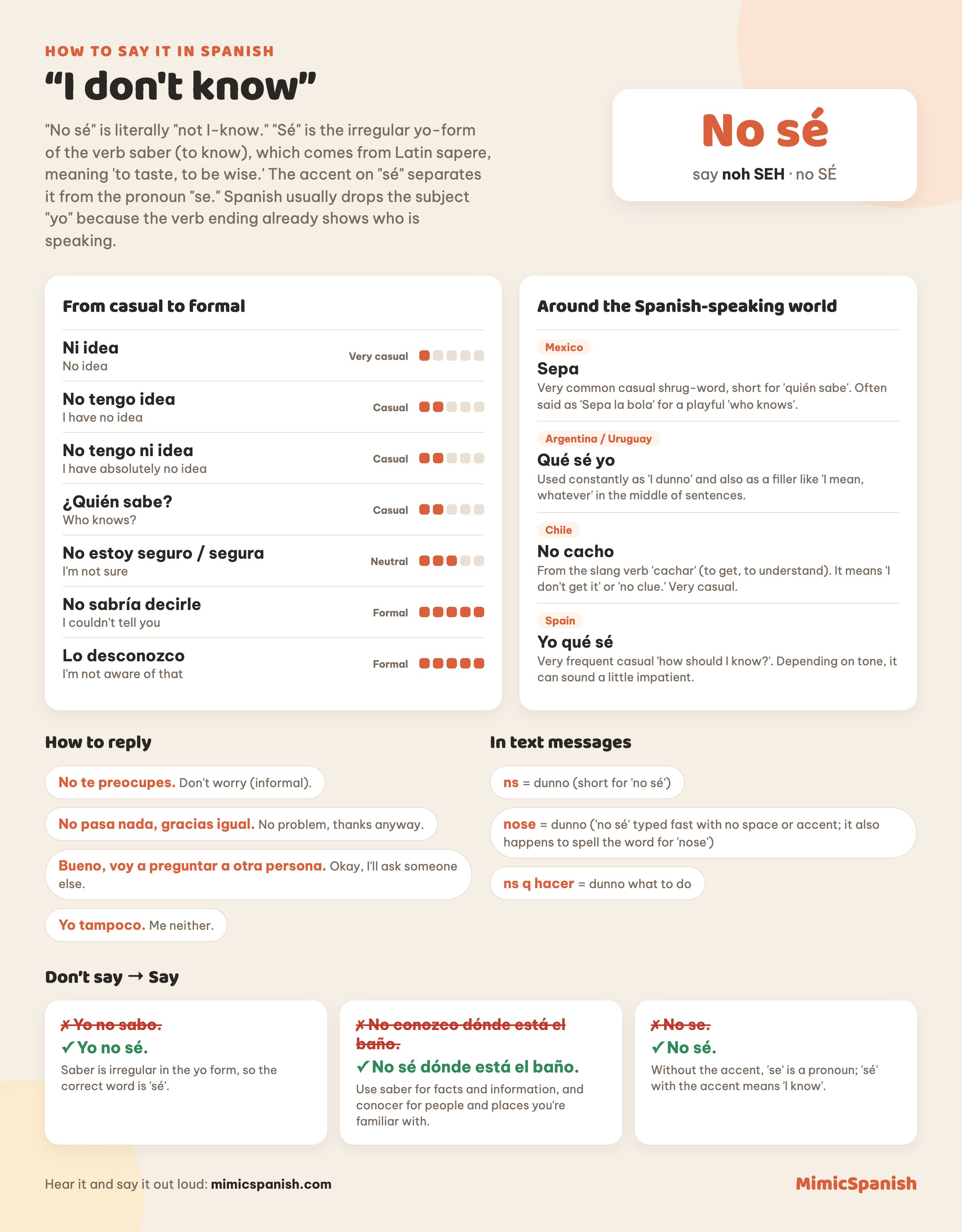
Other ways to say it, from casual to formal
- Ni ideaNo idea · casual chats with friends and familyVery casual
- No tengo ideaI have no idea · everyday conversation, a bit more emphaticCasual
- No tengo ni ideaI have absolutely no idea · stressing that you really don't knowCasual
- ¿Quién sabe?Who knows? · talking about the future or something nobody can knowCasual
- No lo séI don't know (it) · answering a specific question, slightly fuller and more carefulNeutral
- No estoy seguro / seguraI'm not sure · you have a guess but aren't certainNeutral
- No sabría decirleI couldn't tell you · polite answer to a customer, boss or stranger (usted)Formal
- Lo desconozcoI'm not aware of that · formal writing, offices, official contextsFormal
By country
- SepaMexico · Very common casual shrug-word, short for 'quién sabe'. Often said as 'Sepa la bola' for a playful 'who knows'.
- Qué sé yoArgentina / Uruguay · Used constantly as 'I dunno' and also as a filler like 'I mean, whatever' in the middle of sentences.
- No cachoChile · From the slang verb 'cachar' (to get, to understand). It means 'I don't get it' or 'no clue.' Very casual.
- Yo qué séSpain · Very frequent casual 'how should I know?'. Depending on tone, it can sound a little impatient.
In text messages
Example sentences
- —¿Dónde está Ana? —No sé."Where's Ana?" "I don't know."
- No sé qué hora es.I don't know what time it is.
- Lo siento, no sé dónde está la estación.Sorry, I don't know where the station is.
- No sé si voy a ir a la fiesta.I don't know if I'm going to go to the party.
- Ni idea, pregúntale a tu hermano.No idea, ask your brother.
- La verdad, no sabría decirle cuánto cuesta, pero puedo preguntar.Honestly, I couldn't tell you how much it costs, but I can ask.
Mini dialogue: Asking for directions on the street
How to reply
- No te preocupes.Don't worry (informal).
- No pasa nada, gracias igual.No problem, thanks anyway.
- Bueno, voy a preguntar a otra persona.Okay, I'll ask someone else.
- Yo tampoco.Me neither.
Grammar: Saber: 'sé' + question word
Saber (to know facts or information) is irregular in the yo form: 'sé', not 'sabo'. To say what you don't know, add a question word right after it (qué, dónde, cuándo, cómo, quién) or 'si' (if). These question words keep their accent. Use conocer, not saber, for people and places you aren't familiar with.
- No sé cómo se dice en español.I don't know how to say it in Spanish.
- No sé si tienen mesa libre.I don't know if they have a free table.
Common mistakes
Culture tip
Native speakers say "No sé" all the time, often with a shrug, raised eyebrows or a downturned mouth, and sometimes stretch it out as "No sééé" when they are unsure. With strangers, it sounds friendlier to soften it with "Lo siento, no sé" or "La verdad, no sé." A plain "Ni idea" can feel a bit abrupt in formal situations. In customer service, staff often say "No sabría decirle" and offer to find out.