How to say “the check please” in Spanish
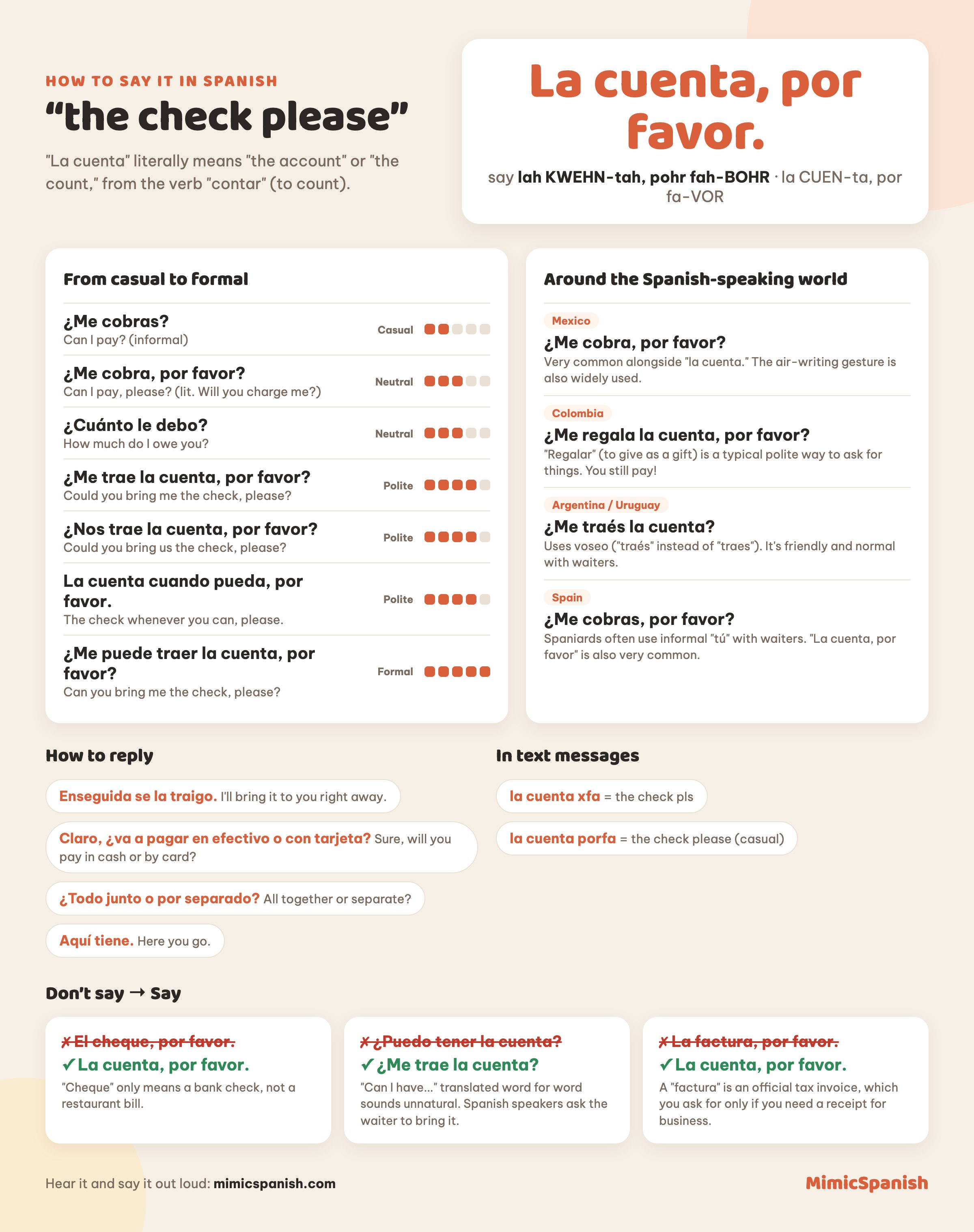
"The check, please" in Spanish is "La cuenta, por favor." It's polite, neutral and understood in every Spanish-speaking country, from Mexico to Argentina to Spain. For an even friendlier tone, ask "¿Me trae la cuenta, por favor?" ("Could you bring me the check?").
How to pronounce “La cuenta, por favor.”
- Say "cuen" as one quick syllable, KWEN, not "koo-EN."
- The "v" in "favor" sounds like a soft English "b" with the lips barely touching, never like an English "v."
- The final "r" in "favor" is a single quick tap of the tongue, like the "dd" in American "ladder."
What it literally means
"La cuenta" literally means "the account" or "the count," from the verb "contar" (to count). It is the total the restaurant has counted up for you. "Por favor" literally means "as a favor."
Other ways to say it, from casual to formal
- ¿Me cobras?Can I pay? (informal) · Casual cafés and bars, informal "tú" formCasual
- ¿Me cobra, por favor?Can I pay, please? (lit. Will you charge me?) · Cafés, street stalls, casual placesNeutral
- ¿Cuánto le debo?How much do I owe you? · Small shops, food stands, quick mealsNeutral
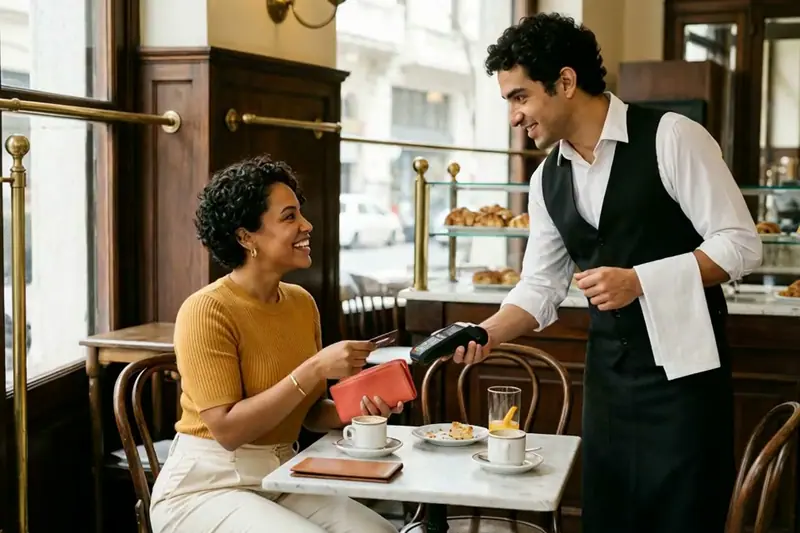
- ¿Me trae la cuenta, por favor?Could you bring me the check, please? · Polite request to a waiter, very commonPolite
- ¿Nos trae la cuenta, por favor?Could you bring us the check, please? · When you're eating with othersPolite
- La cuenta cuando pueda, por favor.The check whenever you can, please. · When the waiter is busy and there's no rushPolite
- ¿Me puede traer la cuenta, por favor?Can you bring me the check, please? · Extra polite, at nicer restaurantsFormal
By country
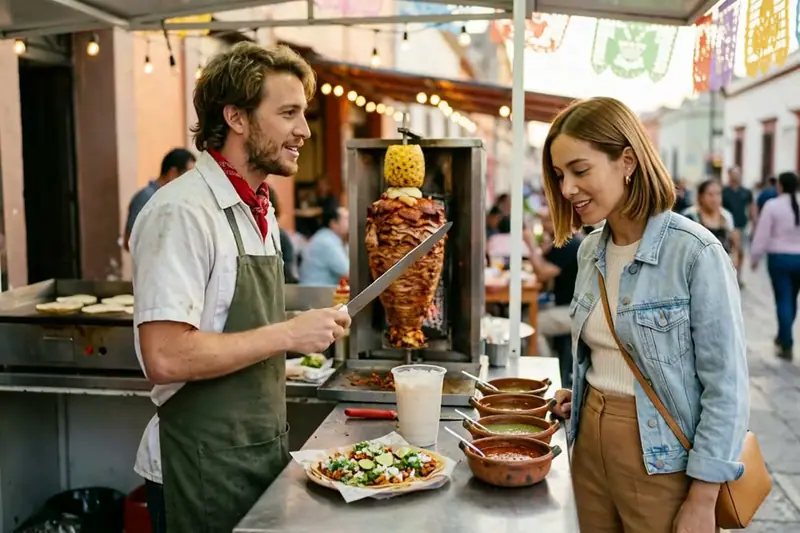
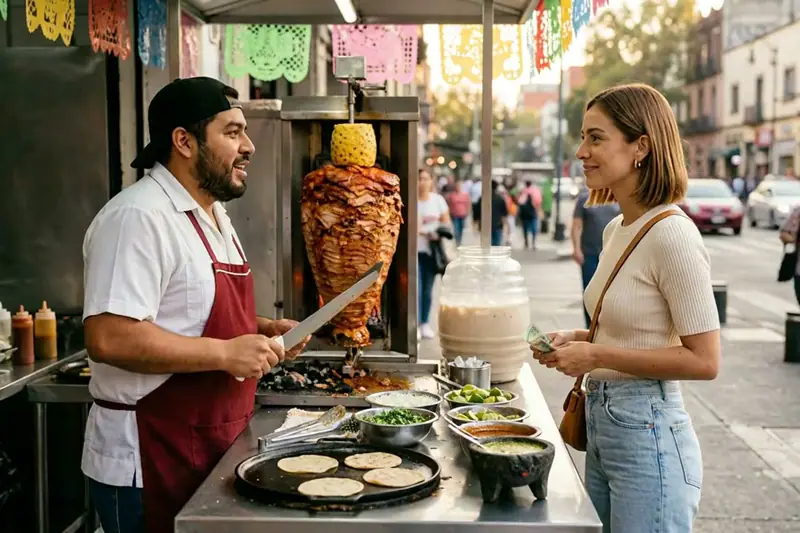
- ¿Me cobra, por favor?Mexico · Very common alongside "la cuenta." The air-writing gesture is also widely used.
- ¿Me regala la cuenta, por favor?Colombia · "Regalar" (to give as a gift) is a typical polite way to ask for things. You still pay!
- ¿Me traés la cuenta?Argentina / Uruguay · Uses voseo ("traés" instead of "traes"). It's friendly and normal with waiters.
- ¿Me cobras, por favor?Spain · Spaniards often use informal "tú" with waiters. "La cuenta, por favor" is also very common.
In text messages
Example sentences
- Disculpe, la cuenta, por favor.Excuse me, the check, please.
- ¿Nos trae la cuenta cuando pueda?Could you bring us the check when you can?
- Ya pedí la cuenta.I already asked for the check.
- ¿Se puede pagar con tarjeta?Can I pay by card?
- ¿La propina está incluida en la cuenta?Is the tip included in the check?
- ¿Podemos pagar la cuenta por separado?Can we split the check? (lit. pay separately)
Mini dialogue: Finishing lunch at a restaurant
How to reply
- Enseguida se la traigo.I'll bring it to you right away.
- Claro, ¿va a pagar en efectivo o con tarjeta?Sure, will you pay in cash or by card?
- ¿Todo junto o por separado?All together or separate?
- Aquí tiene.Here you go.
Grammar: Asking politely with "me/nos" + traer
To turn "la cuenta" into a full polite request, use "me" (to me) or "nos" (to us) before the verb "traer" (to bring). Use the "usted" form "trae" with waiters in most of Latin America. Phrasing it as a question sounds softer than a command.
- ¿Me trae la cuenta, por favor?Could you bring me the check, please?
- ¿Nos trae más agua, por favor?Could you bring us more water, please?
Common mistakes
Culture tip
In most Spanish-speaking countries, waiters won't bring the check until you ask, because rushing you is considered rude. Lingering at the table after a meal is normal and is even called "la sobremesa." To ask from across the room, make eye contact and mime writing a signature in the air. Tipping customs vary: around 10% is typical in Mexico and Argentina, and Colombia often adds an optional service charge.