How to say “how much is it” in Spanish
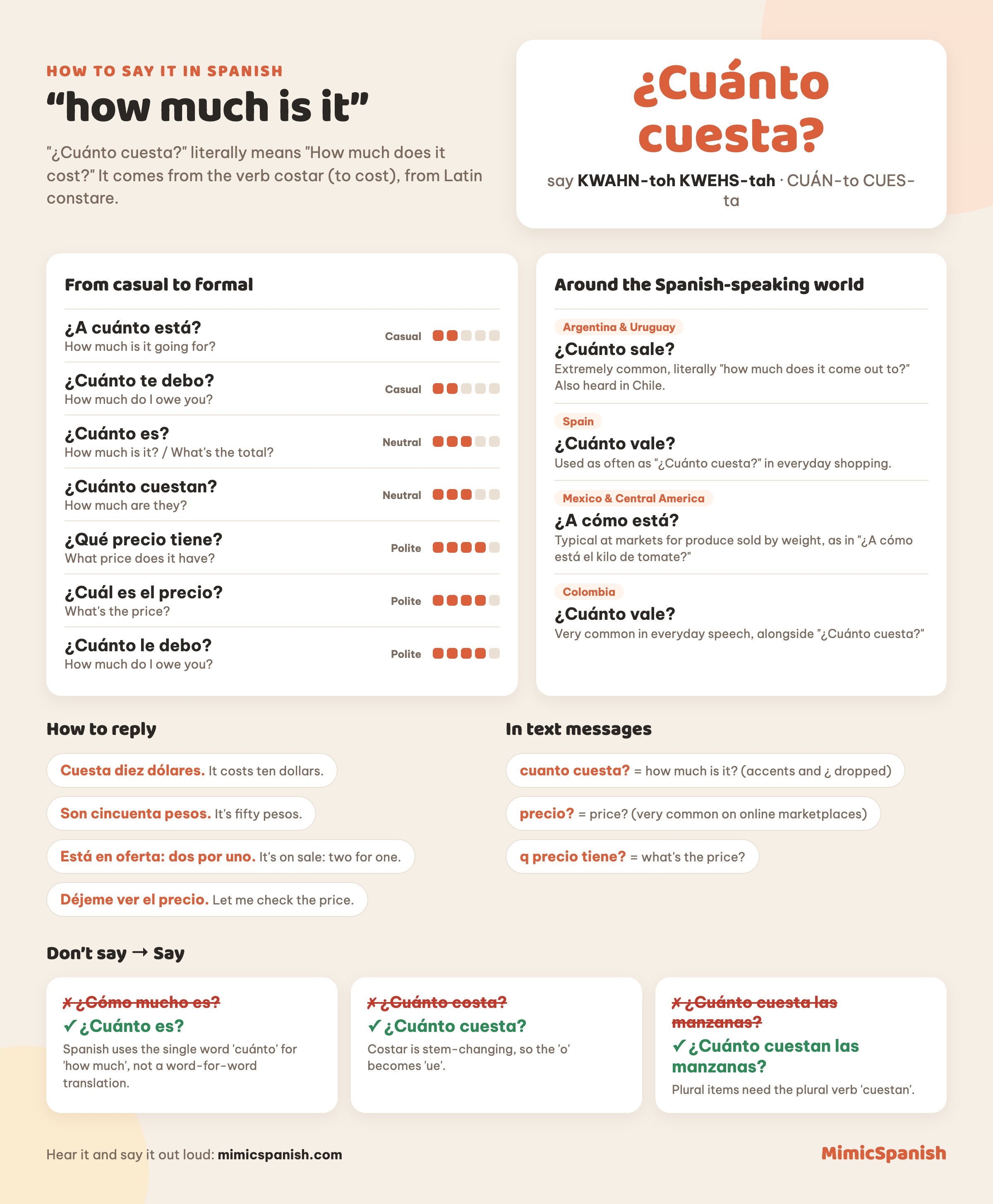
The most common way to say "how much is it?" in Spanish is "¿Cuánto cuesta?" (KWAHN-toh KWEHS-tah). If you're asking about more than one item, use "¿Cuánto cuestan?" When you're paying the total at a counter, people usually just say "¿Cuánto es?"
How to pronounce “¿Cuánto cuesta?”
- Say 'cuán' and 'cues' as one quick syllable each, gliding 'kw' together like in the English word 'quantity'.
- Keep the Spanish 't' soft and dental by touching your tongue to the back of your upper teeth, with no puff of air.
- End 'cuesta' with a short, clean 'ah' rather than the lazy 'uh' sound English speakers often use.
What it literally means
"¿Cuánto cuesta?" literally means "How much does it cost?" It comes from the verb costar (to cost), from Latin constare. There's no separate word for "it" because the verb ending already tells you the subject.
Other ways to say it, from casual to formal
- ¿A cuánto está?How much is it going for? · markets, produce and prices that changeCasual
- ¿Cuánto te debo?How much do I owe you? · paying a friend or a casual vendorCasual
- ¿Cuánto es?How much is it? / What's the total? · paying at a register or asking for the totalNeutral
- ¿Cuánto cuestan?How much are they? · asking about several itemsNeutral
- ¿Cuánto vale?How much is it worth? / How much is it? · very common in Spain, also used in Latin AmericaNeutral
- ¿Qué precio tiene?What price does it have? · asking politely in a shopPolite
- ¿Cuál es el precio?What's the price? · slightly formal, in stores or by emailPolite
- ¿Cuánto le debo?How much do I owe you? · paying for a service, a taxi or a mealPolite
By country
- ¿Cuánto sale?Argentina & Uruguay · Extremely common, literally "how much does it come out to?" Also heard in Chile.
- ¿Cuánto vale?Spain · Used as often as "¿Cuánto cuesta?" in everyday shopping.
- ¿A cómo está?Mexico & Central America · Typical at markets for produce sold by weight, as in "¿A cómo está el kilo de tomate?"
- ¿Cuánto vale?Colombia · Very common in everyday speech, alongside "¿Cuánto cuesta?"
In text messages
Example sentences
- Disculpe, ¿cuánto cuesta esta camisa?Excuse me, how much is this shirt?
- ¿Cuánto cuestan los zapatos negros?How much are the black shoes?
- Hola, ¿cuánto es todo?Hi, how much is everything?
- ¿Cuánto cuesta un boleto al centro?How much is a ticket downtown?
- ¿A cuánto está el kilo de aguacate hoy?How much is a kilo of avocado today?
- ¿Me podría decir cuánto cuesta enviar este paquete?Could you tell me how much it costs to send this package?
Mini dialogue: At a market stall
How to reply
- Cuesta diez dólares.It costs ten dollars.
- Son cincuenta pesos.It's fifty pesos.
- Está en oferta: dos por uno.It's on sale: two for one.
- Déjeme ver el precio.Let me check the price.
Grammar: Cuesta vs. cuestan (the stem-changing verb costar)
Costar changes o→ue when stressed, so it's cuesta (it costs) and cuestan (they cost), never 'costa'. Match the verb to the thing you're asking about: one item takes cuesta, two or more take cuestan. Cuánto always carries an accent in questions.
- ¿Cuánto cuesta el libro?How much is the book?
- ¿Cuánto cuestan los libros?How much are the books?
Common mistakes
Culture tip
You'll use this phrase constantly at markets, street stalls and small shops, where prices often aren't displayed. It's polite to start with "Disculpe" or a greeting like "Buenas" before asking, since jumping straight to the price can feel abrupt. At open-air markets, a friendly follow-up like "¿Me lo deja en...?" (Will you let me have it for...?) is a normal way to bargain, but haggling isn't expected in supermarkets or chain stores.