How to say “I'm fine” in Spanish
"I'm fine" in Spanish is "Estoy bien." In everyday conversation, people usually shorten it to "Bien, gracias" or "Bien, ¿y tú?" when someone asks how they are. You can also use "Estoy bien" to reassure someone, for example after a small accident: "Estoy bien, no te preocupes."
How to pronounce “Estoy bien”
- Say "bien" as one quick syllable, like "byen," not "bee-en."
- Make the "t" in "estoy" soft by touching your tongue to the back of your upper teeth, with no puff of air.
- The "oy" in "estoy" rhymes with English "boy," and the "b" in "bien" is soft, with your lips barely touching.
What it literally means
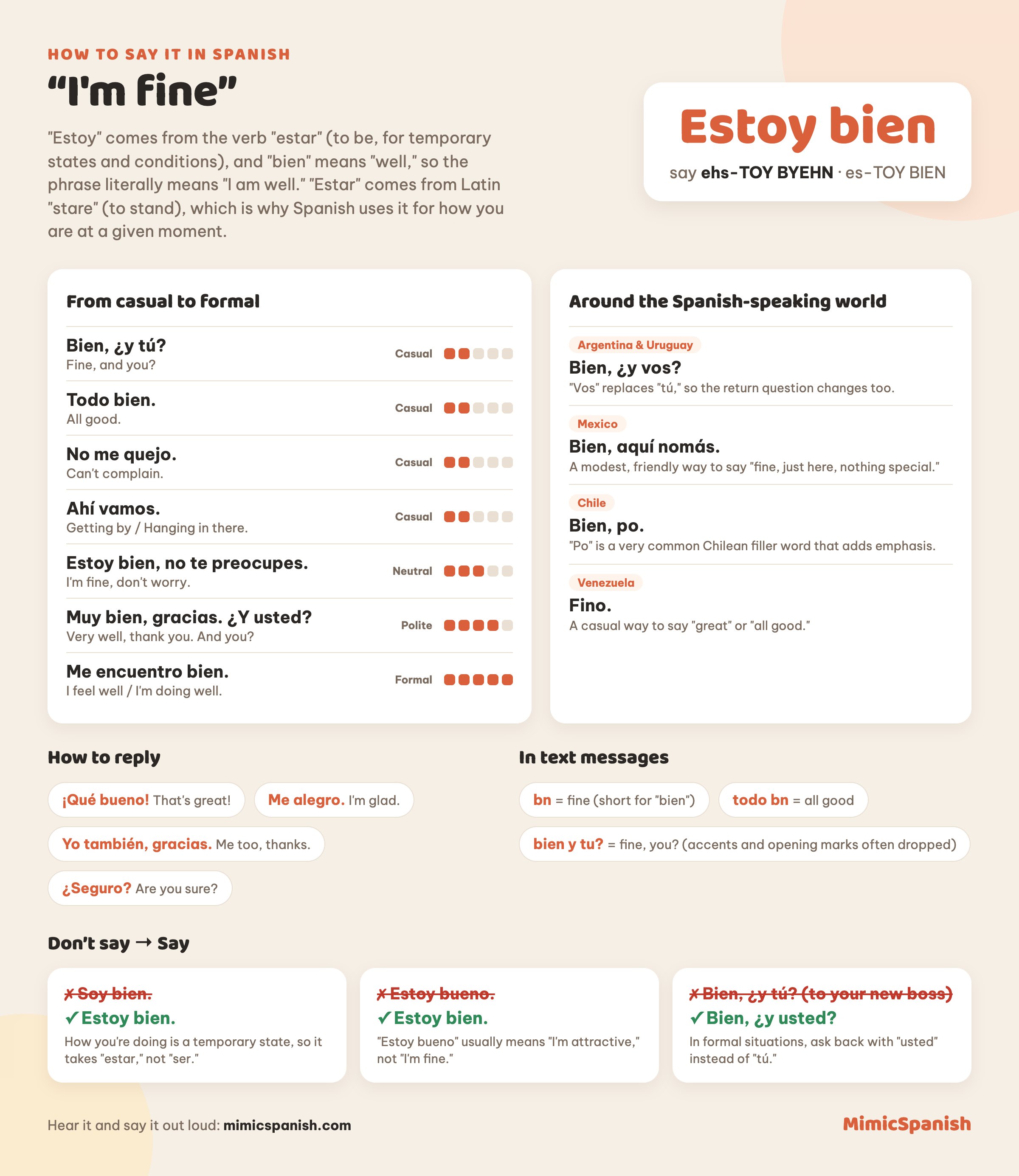
"Estoy" comes from the verb "estar" (to be, for temporary states and conditions), and "bien" means "well," so the phrase literally means "I am well." "Estar" comes from Latin "stare" (to stand), which is why Spanish uses it for how you are at a given moment.
Other ways to say it, from casual to formal
- Bien, ¿y tú?Fine, and you? · Casual chat with friends or peersCasual
- Todo bien.All good. · Relaxed, everyday conversationCasual
- No me quejo.Can't complain. · Light, friendly small talkCasual
- Ahí vamos.Getting by / Hanging in there. · When things are just okayCasual
- Bien, gracias.Fine, thanks. · Standard reply to "How are you?"Neutral
- Estoy bien, no te preocupes.I'm fine, don't worry. · Reassuring someone who is concernedNeutral
- Muy bien, gracias. ¿Y usted?Very well, thank you. And you? · With a boss, an older person or a strangerPolite
- Me encuentro bien.I feel well / I'm doing well. · Formal settings or at the doctor'sFormal
By country
- Bien, ¿y vos?Argentina & Uruguay · "Vos" replaces "tú," so the return question changes too.
- Bien, aquí nomás.Mexico · A modest, friendly way to say "fine, just here, nothing special."
- Bien, po.Chile · "Po" is a very common Chilean filler word that adds emphasis.
- Fino.Venezuela · A casual way to say "great" or "all good."
- Voy tirando.Spain · A common way to say "I'm getting by" when things are just okay.
In text messages
Example sentences
- —¿Cómo estás? —Estoy bien, gracias."How are you?" "I'm fine, thanks."
- Bien, ¿y tú? ¿Qué tal el trabajo?Fine, and you? How's work?
- No te preocupes, estoy bien.Don't worry, I'm fine.
- Estoy bien, solo un poco cansado.I'm fine, just a little tired.
- Me caí, pero estoy bien.I fell, but I'm fine.
- Ya estoy bien, el doctor dice que puedo volver a trabajar mañana.I'm fine now. The doctor says I can go back to work tomorrow.
Mini dialogue: Running into a neighbor
How to reply
- ¡Qué bueno!That's great!
- Me alegro.I'm glad.
- Yo también, gracias.Me too, thanks.
- ¿Seguro?Are you sure?
Grammar: Use "estar" (not "ser") with "bien"
Spanish has two verbs for "to be." How you feel or how you are doing right now is a state, so you always use "estar": estoy, estás, está. Also use "bien" (well), not "bueno" (good), after "estar" when you're talking about how you are.
- Mis padres están bien.My parents are fine.
- ¿Estás bien?Are you okay?
Common mistakes
Culture tip
Just like "I'm fine" in English, "Bien, gracias" is often an automatic reply, even when someone's day isn't perfect. It's polite, and often expected, to return the question ("¿y tú?" or "¿y usted?"). In many Latin American countries, people like to chat a little longer during greetings, so be ready to add a detail or ask about the other person's family.