How to say “I miss you” in Spanish
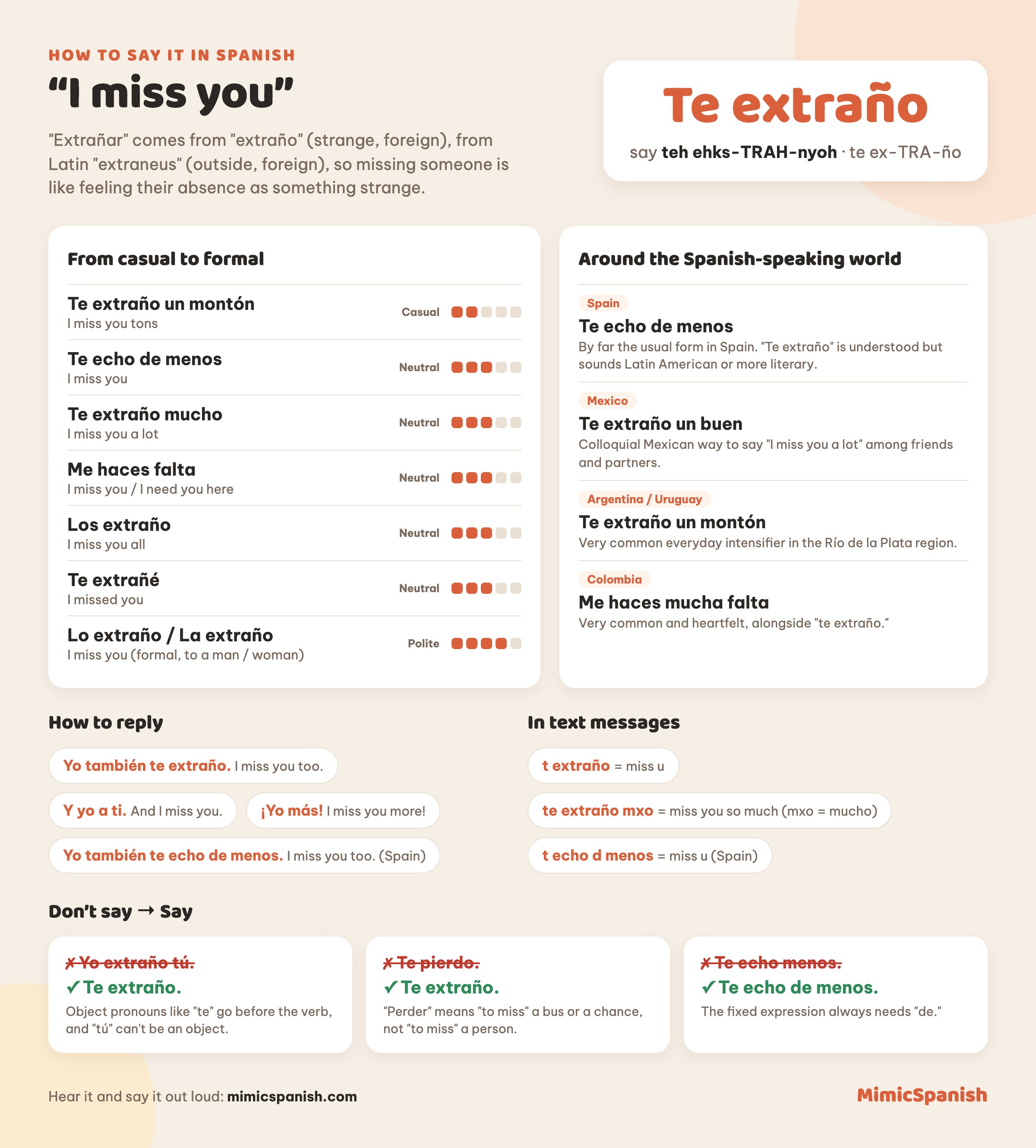
"I miss you" in Spanish is "Te extraño" (teh ehks-TRAH-nyoh), the most common way to say it in Latin America. In Spain people usually say "Te echo de menos." Both are also understood across the Spanish-speaking world. You can say either one to a partner, a friend or a family member.
How to pronounce “Te extraño”
- The ñ sounds like the "ny" in "canyon," so "-ño" is "nyoh."
- The r in "tra" is a single quick tap of the tongue, like the "tt" in American "butter," not an English r.
- Keep the vowels short and pure: "te" is "teh" (not "tay"), and the final o doesn't glide into "ow."
What it literally means
"Extrañar" comes from "extraño" (strange, foreign), from Latin "extraneus" (outside, foreign), so missing someone is like feeling their absence as something strange. "Echar de menos" literally means "to count as less," in the sense of noticing that someone is missing.
Other ways to say it, from casual to formal
- Te extraño un montónI miss you tons · casual chat with friends or a partnerCasual
- Te echo de menosI miss you · standard in Spain; also used in parts of Latin AmericaNeutral
- Te extraño muchoI miss you a lot · showing stronger feeling to anyone closeNeutral
- Me haces faltaI miss you / I need you here · emotional, when you really feel the person's absenceNeutral
- Los extrañoI miss you all · talking to a group, such as family or friendsNeutral
- Te extrañéI missed you · when you finally see the person againNeutral
- Lo extraño / La extrañoI miss you (formal, to a man / woman) · speaking to someone you address as usted, like an older relative or teacherPolite
By country
- Te echo de menosSpain · By far the usual form in Spain. "Te extraño" is understood but sounds Latin American or more literary.
- Te extraño un buenMexico · Colloquial Mexican way to say "I miss you a lot" among friends and partners.
- Te extraño un montónArgentina / Uruguay · Very common everyday intensifier in the Río de la Plata region.
- Me haces mucha faltaColombia · Very common and heartfelt, alongside "te extraño."
In text messages
Example sentences
- Te extraño, mamá.I miss you, Mom.
- ¡Te extrañé mucho!I missed you so much!
- Extraño a mis amigos de la escuela.I miss my friends from school.
- ¿Me extrañas?Do you miss me?
- Los extraño a todos. ¡Nos vemos pronto!I miss you all. See you soon!
- Desde que te fuiste, me haces mucha falta.Since you left, I've really missed you.
Mini dialogue: A video call with a friend abroad
How to reply
- Yo también te extraño.I miss you too.
- Y yo a ti.And I miss you.
- ¡Yo más!I miss you more!
- Yo también te echo de menos.I miss you too. (Spain)
Grammar: Extrañar takes a direct object pronoun before the verb
With "extrañar" (and "echar de menos"), the person you miss is the direct object, and the pronoun goes before the conjugated verb: te (you), lo/la (you formal, him, her), los/las (you all, them). When you name the person, add the personal "a": "Extraño a mi abuela." Note that "hacer falta" works the other way around, like "gustar": "Me haces falta" literally means "You are lacking to me."
- Te extraño. / Me extrañas.I miss you. / You miss me.
- Extraño a mi perro. Lo extraño mucho.I miss my dog. I miss him a lot.
Common mistakes
Culture tip
Spanish speakers say "te extraño" freely and often, not just to romantic partners but also to friends, parents, grandparents and even co-workers they haven't seen in a while. It is very common to add an intensifier like "mucho" or "un montón," and to greet someone you haven't seen with a hug and "¡Te extrañé!" The phrase is also a classic way to end calls and messages with family who live far away.